
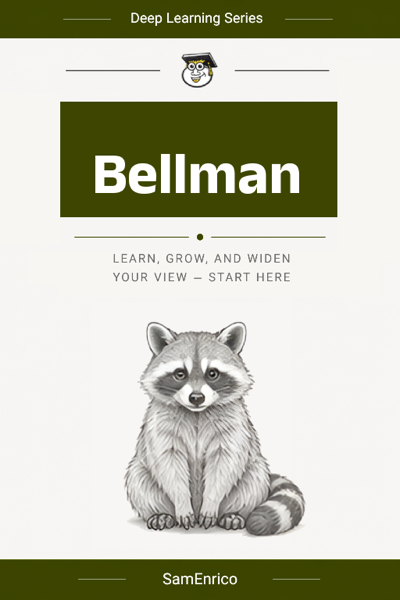
Bellman eBook
A Coursebook on Bellman
A Coursebook on Bellman
Formats
Free sample
Chapter 1: The Failure of Greed...--–- Imagine you are standing at the intersection of five possible futures. To your left, a path that promises immediate reward — a promotion, a purchase, a pleasure — but narrows sharply after the first few steps. To your right, a path that offers nothing now but widens into a landscape of abundant choices later. Between them, three other paths, each with its own trade-off between present satisfaction and future possibility. You have to choose one.
And you have to choose now.This is not a philosophical thought experiment. This is the structure of almost every important decision you will ever make: where to invest your time, how much to save for retirement, whether to confront a problem today or hope it resolves itself tomorrow, which skills to learn, whom to trust, when to walk away. Each decision is not a single event but the first step in a sequence. And the cruel truth — the one that Richard Bellman spent his life proving — is that the most natural, most intuitive, most tempting way to make these decisions is almost always wrong.The intuitive method is simple: at each step, do whatever gives you the best immediate outcome. Want to get from one city to another?
Go to the closest neighboring city first. Want to maximize your career earnings? Take the highest-paying job offer you have right now. Want to finish a project? Work on the task that feels most urgent.
This is called the greedy approach — always grab what looks best in front of you. It feels smart. It feels efficient. It feels like common sense.But common sense, in sequential decision-making, is a trap.The Parable of the Mountain Crossing Consider two hikers standing at the base of a mountain range. Both need to reach the village on the far side.
The mountain is not a single peak but a series of ridges, valleys, and passes. The hikers can only see the immediate terrain — what lies directly ahead — not the entire range. They have a map, but the map shows only elevation, not the difficulty of the path. They must decide at each ridge whether to go left, right, or straight.The first hiker uses the greedy rule: at every point, go in the direction that descends most steeply toward the apparent lowest elevation. This feels wise — down is easier, down is faster, down gets you closer to the valley floor.
So down he goes, stride by stride, always choosing the steepest descent.The second hiker uses a different rule: she looks at the entire map and walks backward from the destination, identifying which path into the village would have been optimal if she were already there, then works her way back to her starting point.The first hiker, following the greedy rule, walks straight into a box canyon. The steepest descent led him to a beautiful, flat meadow — but the meadow has no exit. The walls are sheer. To reach the village, he must climb back up the entire slope he just descended, losing hours and energy. The second hiker, by planning backward, identified a ridge that looks higher in the short term but leads through a hidden pass directly to the village.This is not a metaphor for patience or virtue.
It is a mathematical fact about the structure of sequential problems. And it was first proven — in rigorous, unforgiving algebra — by a chain-smoking mathematician working for the United States Air Force at the RAND Corporation in the early 1950s.Who Was Richard Bellman?Richard Bellman was born in 1920 in Brooklyn, New York, to Polish Jewish immigrants. His father ran a small grocery store. The family was not poor, but they were never secure. Bellman watched his father make decision after decision — how much inventory to order, when to extend credit to customers, whether to open later hours — that looked sensible in isolation but accumulated into a slow, grinding failure.
The store closed when Bellman was seventeen.That experience never left him. He entered Brooklyn College, then transferred to the University of Wisconsin for graduate studies in mathematics. He was brilliant, mercurial, and impatient with abstraction that had no practical consequence. During World War II, he worked on theoretical physics at Los Alamos, though he was not cleared for the most sensitive nuclear work because of his family's political leanings (his uncle had been a socialist). After the war, he earned a Ph D from Princeton and bounced through several academic positions before landing at RAND in 1952.RAND was an extraordinary institution: a think tank funded by the Air Force but staffed by some of the brightest mathematicians, economists, and physicists in the country.
Their mission was to solve problems that had no precedent: logistics for a global air force, strategy for a nuclear standoff, optimization of weapons systems that had not yet been built. The problems were all sequential. Decisions made today about bomber basing affected the vulnerability of those bombers tomorrow. Allocations of fuel to different theaters affected the range of operations next week. Inventory decisions for spare parts at remote air bases determined whether planes could fly at all in the next conflict.Bellman was given a problem that seemed simple: how to allocate a fixed budget of resources across multiple stages of a process, where the returns from each stage depended on how much you allocated and when.
The Air Force wanted to know, for example, how many bombers to send on each day of a multi-day campaign, given that bombers lost on day one could not return for day two, but suppressing enemy defenses early made later days safer.This was not a problem that existing mathematics could solve. Calculus optimizes over continuous variables but assumes you can vary everything simultaneously. Linear programming optimizes over many variables but assumes a single stage, not a sequence. Game theory (just being developed by von Neumann and Morgenstern) dealt with multiple decision-makers but assumed they acted simultaneously, not sequentially.Bellman tried everything. He tried brute-force enumeration: list every possible sequence of decisions and pick the best.
For five stages with ten choices per stage, that is 100,000 sequences — tedious but possible. But the Air Force's problems had dozens of stages and hundreds of choices per stage. The number of sequences grows as (choices)^(stages). For 20 stages and 100 choices, that is 100^20 — a number larger than the number of particles in the known universe. Even the fastest imaginable computer (and in 1952, the fastest computers were human beings with slide rules) could not brute-force a solution.Bellman grew frustrated.
He smoked constantly. His colleagues described him as pacing the hallways of RAND, muttering to himself, occasionally shouting at the blackboard. The breakthrough came not in his office but in the hallway.The Hallway Insight The story — which Bellman later told with theatrical flair — goes like this: He was walking from his office to the cafeteria, late for lunch, thinking about a particular allocation problem with twenty stages. He was trying to compute the optimal decision for stage one, but the calculation kept branching into the nineteen remaining stages, and those branched into eighteen, and so on. He realized, in mid-stride, that he was doing…
This is the end of the free sample. Get the eBook to keep going. Buy now
About this book
Details
- Author
- Willingham Antonette
- Publisher
- SamEnrico
- Language
- English
- Genre
- Non-Fiction, Informative, Educational
- Released
- 2026-05-11
- Pages (approx.)
- 147
- Available as
- eBook, Audiobook

Read better in the ZLOADR app
Your eBooks on your phone or tablet. Sign in with your SamEnrico account and start reading.
More by Willingham Antonette
 The Joy of ExerciseWillingham Antonette$11.99
 Senior Affirmation WorkbookWillingham Antonette$11.99
 Assertive Communication for WomenWillingham Antonette$11.99
 Homeless School YearsWillingham Antonette$11.99
 The Beginner Meditation Mistakes GuideWillingham Antonette$11.99
 Tangaroa’s Wrath: The Birth of the PacificWillingham Antonette$11.99
 Return on Investment Formula GuideWillingham Antonette$12.99
 Intel SWOT Analysis Library GuideWillingham Antonette$12.99
 Understanding Myoclonus AtaxiaWillingham Antonette$17.99
 How to Become a Labeling-machine OperatorWillingham Antonette$11.99