
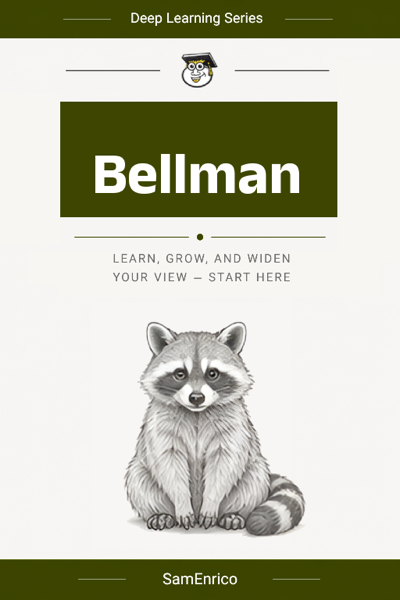
Bellman Audiobook
A Coursebook on Bellman
A Coursebook on Bellman
Formats
Free sample
Chapter 1: The Failure of Greed...--–- Imagine you are standing at the intersection of five possible futures. To your left, a path that promises immediate reward — a promotion, a purchase, a pleasure — but narrows sharply after the first few steps. To your right, a path that offers nothing now but widens into a landscape of abundant choices later. Between them, three other paths, each with its own trade-off between present satisfaction and future possibility. You have to choose one.
And you have to choose now.This is not a philosophical thought experiment. This is the structure of almost every important decision you will ever make: where to invest your time, how much to save for retirement, whether to confront a problem today or hope it resolves itself tomorrow, which skills to learn, whom to trust, when to walk away. Each decision is not a single event but the first step in a sequence. And the cruel truth — the one that Richard Bellman spent his life proving — is that the most natural, most intuitive, most tempting way to make these decisions is almost always wrong.The intuitive method is simple: at each step, do whatever gives you the best immediate outcome. Want to get from one city to another?
Go to the closest neighboring city first. Want to maximize your career earnings? Take the highest-paying job offer you have right now. Want to finish a project? Work on the task that feels most urgent.
This is called the greedy approach — always grab what looks best in front of you. It feels smart. It feels efficient. It feels like common sense.But common sense, in sequential decision-making, is a trap.The Parable of the Mountain Crossing Consider two hikers standing at the base of a mountain range. Both need to reach the village on the far side.
The mountain is not a single peak but a series of ridges, valleys, and passes. The hikers can only see the immediate terrain — what lies directly ahead — not the entire range. They have a map, but the map shows only elevation, not the difficulty of the path. They must decide at each ridge whether to go left, right, or straight.The first hiker uses the greedy rule: at every point, go in the direction that descends most steeply toward the apparent lowest elevation. This feels wise — down is easier, down is faster…
This is the end of the free sample. Get the Audiobook to keep going. Buy now
About this book
Details
- Author
- Willingham Antonette
- Publisher
- SamEnrico
- Language
- English
- Genre
- Non-Fiction, Informative, Educational
- Released
- 2026-05-11
- Pages (approx.)
- 147
- Available as
- eBook, Audiobook

Listen in the VoxFlicks app
Audiobooks and audio dramas wherever you go. Sign in with your SamEnrico account and press play.
More by Willingham Antonette
 The Joy of ExerciseWillingham Antonette$11.99
 Senior Affirmation WorkbookWillingham Antonette$11.99
 Assertive Communication for WomenWillingham Antonette$11.99
 Homeless School YearsWillingham Antonette$11.99
 The Beginner Meditation Mistakes GuideWillingham Antonette$11.99
 Tangaroa’s Wrath: The Birth of the PacificWillingham Antonette$11.99
 Return on Investment Formula GuideWillingham Antonette$12.99
 Intel SWOT Analysis Library GuideWillingham Antonette$12.99
 Understanding Myoclonus AtaxiaWillingham Antonette$17.99
 How to Become a Labeling-machine OperatorWillingham Antonette$11.99