
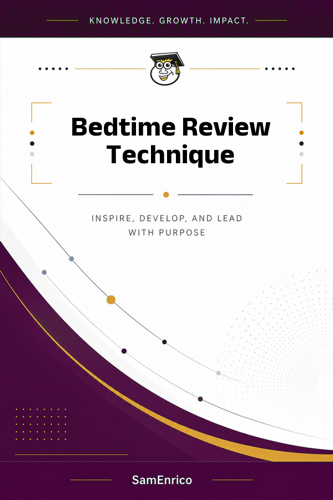
Bedtime Review Technique eBook
Teaches reviewing key information just before ligh
Teaches reviewing key information just before lights out for retention.
Formats
Free sample
Chapter 1: The Midnight Architect--–- Imagine for a moment that you have spent an entire day studying for an important exam. You have read the chapters, highlighted the key passages, reviewed your notes, and repeated the formulas until they feel like second nature. You close the book feeling prepared, even confident. Then you wake up the next morning, sit down to take the test, and realize with a sinking feeling that most of what you studied has vanished. The facts are fuzzy.
The dates are jumbled. The formulas have slipped into a fog. You know you studied them. You know you understood them yesterday. But today, they are gone.
This is not a failure of effort. It is not a failure of intelligence. It is a failure of consolidation. And it is the single greatest obstacle to learning that almost no one understands.Every day, millions of students, professionals, and lifelong learners pour hours of effort into studying, only to watch that effort evaporate overnight. They blame themselves.
They think they are lazy, or stupid, or simply not cut out for the subject. They try harder. They study longer. They cram into the early hours of the morning, drinking coffee and hoping that sheer repetition will force the information to stick. And still, the next morning, the forgetting continues.
This cycle of effort and disappointment is heartbreaking. And it is completely unnecessary. The problem is not that you are not studying hard enough. The problem is that you are fighting against the architecture of your own brain.In this chapter, you will discover a truth that will change everything about how you learn: the brain does not stop working when you close the book. In fact, some of its most important work happens precisely when you are doing nothing at all.
While you sleep, your brain is not resting. It is building. It is sorting. It is filing. It is deciding what to keep and what to throw away.
And if you understand how this process works, you can influence it. You can signal to your brain which memories to prioritize. You can turn your nights into active learning sessions. You can become the architect of your own memory.This is the promise of the Bedtime Review Technique. It is not a study method.
It is not a hack or a trick. It is a scientifically grounded protocol for working with your brain's natural sleep-driven learning systems. By strategically reviewing key information just before lights out, you tell your brain: "This matters. Save this." And your brain listens. Not because of magic, but because of neuroscience.The Great Myth: Learning Stops When Studying Stops Let us begin by naming the myth.
Almost everyone believes that learning happens only when you are consciously engaged with material. You read, you listen, you practice, you repeat. When you stop, learning stops. This seems obvious. It is also completely wrong.The truth is that learning is a two-stage process.
The first stage is encoding—the initial moment when information enters your brain through your senses. This is what you think of as studying. You read a sentence, you hear a lecture, you watch a demonstration. Information flows in. But encoding is fragile.
It is like writing on a whiteboard with a dry-erase marker. The information is there, but it can be smudged, overwritten, or erased with the slightest touch.The second stage is consolidation—the process by which short-term, fragile memories are transformed into long-term, stable ones. This is the hidden work of learning. And it happens almost entirely when you are not consciously trying. It happens during rest.
It happens during downtime. And most importantly, it happens during sleep.Think of encoding as uploading a file to your computer's temporary memory. The file is there, but if the power goes out, it is gone. Consolidation is saving that file to the hard drive. It takes time.
It requires a process. And that process is biological, not volitional. You cannot will yourself to consolidate a memory. You can only create the conditions for consolidation to occur.For decades, sleep scientists believed that the brain simply rested during sleep. It was a time of passivity, of recovery, of doing nothing.
This view has been completely overturned. We now know that the brain is more active during some stages of sleep than it is during wakefulness. It is not resting. It is working. And the specific work it is doing is memory consolidation.The Discovery: Sleep as the Architect of Memory The breakthrough came in the 1990s and early 2000s, when researchers began using electrodes to listen to the electrical activity of sleeping brains.
What they found was astonishing. During sleep, the brain replays the events of the day. Not in real time, but at speeds up to twenty times faster. It is as if the brain is running a highlight reel, selecting the most important moments, and strengthening the neural connections that represent them.The key player in this process is a small, seahorse-shaped structure deep in the brain called the hippocampus. Think of the hippocampus as the brain's inbox.
When you learn something new, the information sits in the hippocampus, waiting to be processed. But the hippocampus has limited space. It is designed for short-term storage. If information stays there too long without being consolidated, it gets overwritten or lost. That is why you forget most of what you study within hours.During sleep, the hippocampus communicates with the neocortex—the outer layer of the brain where long-term memories are stored.
The hippocampus sends signals to the neocortex, saying, "Here is what happened today. Here is what matters. Please file this away." The neocortex responds by strengthening synaptic connections, literally building the physical architecture of memory. By morning, the file has been moved from the temporary inbox to the permanent hard drive.This process is not random. The brain does not replay every moment of the day.
It selects. It prioritizes. It decides what is important and what is not. And here is the crucial insight for learners: you can influence what the brain selects. By reviewing key information just before sleep, you increase the likelihood that your brain will replay that information during the night.
You are not forcing the brain to consolidate. You are signaling to the brain: "This is important. Do not throw this away."The Forgetting Curve: Why Even Good Studying Fails To understand why the Bedtime Review is so powerful, you need to understand what happens when you do not use it. In the late nineteenth century, a German psychologist named Hermann Ebbinghaus conducted a series of experiments on his own memory. He memorized lists of nonsense syllables (like "ZOF" and "KAE") and then tested himself at various intervals to see how much he had forgotten.
The result was the Forgetting Curve.Ebbinghaus discovered that memory decays exponentially. Within one hour of learning something new, the brain forgets approximately 50 percent of it. Within twenty-four hours, up to 70 percent is gone. This is not a failure of your particular memory. It is the default operating system of the human brain.
We are designed to forget. Forgetting is not a bug; it is a feature. Our ancestors needed to remember where…
This is the end of the free sample. Get the eBook to keep going. Buy now
About this book
Details
- Author
- Holloway Violet
- Publisher
- SamEnrico
- Language
- English
- Genre
- Non-Fiction, Self-Help, Revision
- Released
- 2026-06-07
- Pages (approx.)
- 108
- Available as
- eBook, Audiobook

Read better in the ZLOADR app
Your eBooks on your phone or tablet. Sign in with your SamEnrico account and start reading.
More by Holloway Violet
 Mobile Therapy For Remote Communities PrimerHolloway Violet$11.99
 Imposter Job Interview GuideHolloway Violet$11.99
 LTC Home Care Benefits GuideHolloway Violet$11.99
 Breath Awareness While EatingHolloway Violet$11.99
 Stone People Spiritual TeachingsHolloway Violet$11.99
 TM Vs Mindfulness ComparisonHolloway Violet$11.99
 Parent Time QuizHolloway Violet$11.99
 Affirmations For Artist DoubtHolloway Violet$11.99
 The Siege of Nicaea: A Clash of Empires at the GatesHolloway Violet$11.99
 The Last Echoes of the Old Tongues: Rediscovering Asia's Vanishing LanguagesHolloway Violet$11.99
 Growing Plumeria (Frangipani)Holloway Violet$11.99
 The Dancer's Guide to DiscoHolloway Violet$11.99
You may also like
 Hong Kong Handover 1997Dunn Johnnie$11.99
 Zumba For Postnatal Recovery CourseNeal Christian$11.99
 Zumba for BeginnersLadner Nikia$11.99
 YouTube Comment Mining GuideHumes Pandora$12.99
 Worry Box MeditationCarlin Rudy$11.99
 Workplace Stress MeditationNguyen Lynn$11.99
 Workplace Stress and Sleep RepairHawley Ivory$11.99
 Workplace Perfectionism CureDelaney Jeffry$11.99
 Workplace Injustice Anger GuideWallen Isabelle$11.99
 Work Addiction and Burnout LinkGreenwood Ester$11.99
 Women in Yoga and WellnessBeattie Galina$11.99
 Women in Stand Up ComedyChun Evangeline$11.99