
Non-FictionInformativeEducational
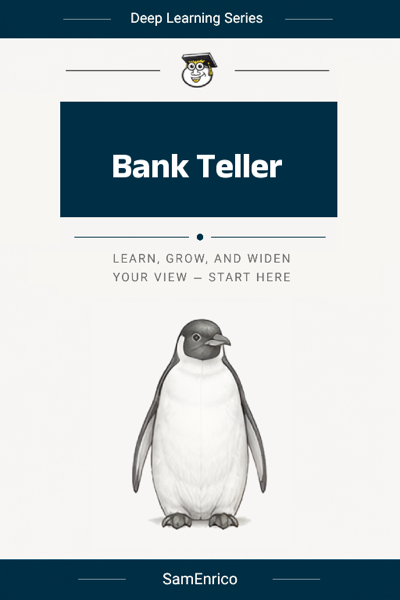
Bank Teller eBook
A Coursebook on Bank Teller
A Coursebook on Bank Teller
Formats
Free sample
Chapter 1: The Unseen Ledger–- The cash drawer slid open with a metallic sigh, revealing twenty thousand dollars in crisp twenty-dollar bills. To the customer waiting in line, it was just money. To the bank, it was a liability waiting to be miscounted. To Maria, the teller with nine years of experience behind the plexiglass, it was something else entirely: a story. Every bill had a path.
Every check had a past. Every customer who stepped to her window carried an invisible ledger of fears, hopes, and assumptions about what a bank could do for them. Most new tellers never learn to read that ledger. They learn to count. They learn to smile.
They learn the ten-key pad. But they never learn why their job matters—not really—until something goes wrong.This chapter exists because the first mistake most tellers make is believing their job is about transactions. It is not. Transactions are what automated teller machines do. ATMs do not comfort a widow cashing her husband's final Social Security check.
ATMs do not spot the subtle tremor in a customer's hand that signals fear of fraud. ATMs do not notice that the teenager depositing a paycheck for the first time has no idea what a routing number is. You are not a machine. You are the human filter between the bank's cold logic and the customer's warm chaos. And that filter, if you learn to use it correctly, will make you invaluable.
This chapter will show you why the teller window has survived every technological revolution, why your role has actually become more important as banking has gone digital, and how the best tellers in the industry think about their work differently than everyone else. By the end of this chapter, you will understand something that most bank employees never learn: that the teller window is not a relic. It is a strategic asset.The Medici Lesson: Why Banking Has Always Been Personal To understand what you do, you must understand where it came from. The first true banks emerged in Renaissance Italy, not because the Medici family invented money, but because they invented trust. In 15th-century Florence, the Medicis operated wooden benches—"banco" in Italian, from which we get the word "bank"—in city marketplaces.
A customer would approach the bench, state a need, and the Medici banker would decide, on the spot, whether to extend credit, exchange currency, or hold funds. There were no computers, no credit scores, no algorithms. There was only judgment. And that judgment rested entirely on the banker's ability to read a human being.Here is what most banking histories leave out: the Medici bankers were not just lenders. They were information brokers.
They knew who was lying about their silk shipments. They knew which merchants were secretly bankrupt. They knew which noble families were about to fall from favor. And they learned all of this from conversations at the bench. A customer would arrive, and the banker would ask questions—not intrusive questions, but careful, observant ones.
"How is your brother's wool business?" "I heard you purchased a new vineyard." "Your daughter's wedding must have been expensive." These were not pleasantries. They were intelligence gathering. The banker was building a mental profile of risk, character, and opportunity.The teller window today is the direct descendant of that wooden bench. When you sit behind your drawer, you occupy a position that has existed for six hundred years. The technology has changed—plastic cards instead of gold coins, screens instead of ledgers—but the core function remains.
You are the bank's front door. You are the first and often only human interaction a customer will have with their financial institution in any given month. And because of that, you see things that no algorithm can see. You see the customer who normally deposits 500every Fridaysuddenlydepositing500 every Friday suddenly depositing 500every Fridaysuddenlydepositing5,000 in cash. You see the elderly woman who asks for the same balance three times in one visit.
You see the small business owner whose hands shake as he requests a loan payment extension. These are not just transactions. They are signals. And the banks that survive and thrive are the ones whose tellers know how to read them.The Great Unlearning: What ATMs Did Not Kill In the 1980s and 1990s, industry experts predicted the death of the bank teller. Automated teller machines were spreading across parking lots and convenience stores.
Online banking was beginning to emerge. The conventional wisdom was that customers would prefer the speed and convenience of machines over the delay and imperfection of humans. Bank after bank closed branches, laid off tellers, and invested heavily in self-service technology. The teller, it seemed, was going the way of the elevator operator and the switchboard attendant.The prediction was wrong. Not partially wrong.
Completely, spectacularly wrong. According to the Bureau of Labor Statistics, the number of bank tellers in the United States today is roughly the same as it was in 1980, even as the number of banking transactions has exploded. What happened? Two things. First, the volume of transactions increased so dramatically that ATMs could not keep up.
Every swipe of a debit card, every mobile deposit, every online transfer creates backend work that eventually flows through a teller's window in some form. Second, and more importantly, customers discovered that machines are terrible at solving problems. An ATM cannot reverse a mistaken charge. An ATM cannot explain why a check is on hold. An ATM cannot waive a fee for a loyal customer.
For routine transactions, the machine is fine. For anything unusual, anything emotional, anything that requires judgment, the customer wants a human.This is what industry analysts call the "high-touch paradox." The more digital banking becomes, the more valuable human interaction becomes. When every other bank offers the same mobile app, the same interest rates, the same fee schedule, the only differentiator is the quality of personal service. A customer who has a problem solved quickly and kindly at the teller window will forgive almost any other shortcoming. A customer who is treated like an interruption will leave for a competitor, often over a fee that could have been waived with a few keystrokes.
The teller window, far from being obsolete, has become the last remaining source of competitive advantage in retail banking.The Three Banks Inside One Bank Before you can understand your role, you must understand the institution you work for. Most new tellers think of their bank as a single entity: "the bank." In reality, you work for three different banks simultaneously, each with its own priorities, rules, and customers. Understanding the differences will save you from confusion and embarrassment.The first bank is the commercial bank. This is the bank that lends money to businesses, issues lines of credit to manufacturers, finances real estate developments, and manages payroll accounts for companies with hundreds of employees. The commercial bank's customers are sophisticated.
They have dedicated relationship managers. They do not stand in teller lines. You will rarely interact with them directly, but their transactions will cross your window in the form of large cash deposits from local businesses, check deposits from vendors, and loan…
This is the end of the free sample. Get the eBook to keep going. Buy now
About this book
Details
- Author
- Tilton Elenore
- Publisher
- SamEnrico
- Language
- English
- Genre
- Non-Fiction, Informative, Educational
- Released
- 2026-05-23
- Pages (approx.)
- 146
- Available as
- eBook, Audiobook

Read better in the ZLOADR app
Your eBooks on your phone or tablet. Sign in with your SamEnrico account and start reading.
More by Tilton Elenore
 Iranian Revolution AftermathTilton Elenore$11.99
 PMS Acne Control HandbookTilton Elenore$11.99
 GAD Research Update GuideTilton Elenore$11.99
 Natural Disaster Dream Trauma GuideTilton Elenore$11.99
 Mindful Walking MBSR PracticeTilton Elenore$11.99
 Whispers of the Marid: The Djinn King’s Lost OathTilton Elenore$11.99
 The Great Arctic Relay: How Arctic Terns Outran the ClockTilton Elenore$11.99
 Artificial Intelligence Architecture OutlookTilton Elenore$12.99
 Canadian Graduate Express Entry GuideTilton Elenore$12.99
 Understanding Hashimoto's ThyroiditisTilton Elenore$17.99
 How to Start a Hobby in NudismTilton Elenore$11.99
You may also like
 Hong Kong Handover 1997Dunn Johnnie$11.99
 Zumba For Postnatal Recovery CourseNeal Christian$11.99
 Zumba for BeginnersLadner Nikia$11.99
 YouTube Comment Mining GuideHumes Pandora$12.99
 Worry Box MeditationCarlin Rudy$11.99
 Workplace Stress MeditationNguyen Lynn$11.99
 Workplace Stress and Sleep RepairHawley Ivory$11.99
 Workplace Perfectionism CureDelaney Jeffry$11.99
 Workplace Injustice Anger GuideWallen Isabelle$11.99
 Work Addiction and Burnout LinkGreenwood Ester$11.99
 Women in Yoga and WellnessBeattie Galina$11.99
 Women in Stand Up ComedyChun Evangeline$11.99