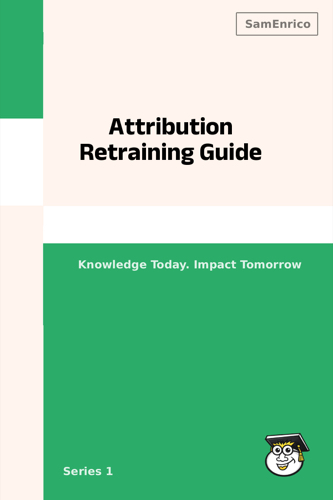
Attribution Retraining Guide eBook
Shifts credit for success from luck to internal ab
by Anglin Jayna
Shifts credit for success from luck to internal ability and effort.
Formats
Free sample
Chapter 1: The Luck Trap--–- The first time I realized I had been lying to myself for over a decade, I was sitting in a rented gray office chair, staring at a rejection email. I had applied for a promotion I had earned—forty-hour weeks, unpaid overtime, three successful product launches. The job went to someone who had been with the company half as long. My first thought, automatic and immediate, was not anger at the decision. It was a quiet, exhausted whisper: I guess I’m just not lucky.That thought felt humble.
It felt like acceptance. It felt like the mature response of someone who understands that life is unfair and that effort does not guarantee reward. What I did not know then—what this entire book exists to correct—is that the sentence I’m just not lucky is not humility. It is a form of self-sabotage so subtle and so socially rewarded that most people never recognize it as the enemy. By the time you finish this chapter, you will never mistake resignation for wisdom again.The Great Disconnect We are taught, from childhood, a simple and beautiful formula: effort leads to success.
The industrious ant stores food while the grasshopper plays. The tortoise beats the hare through persistence. Every fable, every graduation speech, every motivational poster in a middle school hallway insists that hard work is the master key. And yet, as adults, we witness the opposite with crushing regularity. The lazy colleague gets promoted.
The well-connected graduate lands the job you interviewed for. The person with half your experience starts at twice your salary. Effort feels disconnected from outcome, and slowly, without a formal decision, we begin to believe that success is largely a matter of luck.This belief is not crazy. It is not weak. It is, in fact, a reasonable response to a world that genuinely contains randomness, privilege, and structural barriers.
But reasonable is not the same as useful. And the belief that success comes from luck—or from fate, or from being in the right place at the right time, or from having the right parents—produces a predictable set of consequences. If you believe success is luck, you stop trying to replicate it. You stop analyzing what you did. You stop believing that your actions have predictable effects on your outcomes.
You become a passenger in your own life, waiting for the wheel to land on your number.This book is called Attribution Retraining Guide because attribution—the explanation you give for why something happened—is the single most underrated lever of human behavior. Change the story you tell yourself about why you failed or succeeded, and you change everything that follows. The research literature is unanimous on this point, spanning educational psychology, sports psychology, organizational behavior, and clinical therapy. People who attribute success to internal, controllable factors (effort, strategy, preparation) try harder after failure, seek challenges, and outperform their peers over time. People who attribute success to external, uncontrollable factors (luck, fate, other people, innate talent) give up earlier, avoid difficulty, and underperform their potential.This chapter introduces the foundational concept that will reappear in every subsequent page: locus of control.What Is Locus of Control?Locus of control is a psychological construct developed by Julian Rotter in the 1950s.
It refers to the degree to which individuals believe they control their own outcomes. People with an internal locus of control believe that their actions, decisions, and efforts determine what happens to them. People with an external locus of control believe that outcomes are determined by forces outside themselves—luck, fate, powerful others, chance, or a rigged system.At first glance, internal locus sounds obviously superior. Who wouldn’t want to believe they are in control? But the reality is more complicated.
Internal locus can become toxic when it leads to victim-blaming or when applied to genuinely uncontrollable events (cancer, layoffs, accidents). External locus can be accurate when applied to true randomness. The goal of this book is not to make you internal about everything. The goal is to teach you how to distinguish between what you actually control and what you do not—and then to shift your attributions toward the controllable internal factors when those factors are genuinely available.Consider two students who fail a math exam.Student A thinks: I failed because I’m bad at math. This attribution is internal (me), stable (bad at math implies permanent inability), and uncontrollable (if you’re bad at math, you can’t change that quickly).
This is the learned helplessness pattern. It leads to withdrawal.Student B thinks: I failed because I didn’t use the right study strategy. This attribution is internal (me), unstable (study strategies can change), and controllable (I can choose a different strategy next time). This is the mastery orientation. It leads to problem-solving.Both students are making internal attributions.
But one leads to growth and the other leads to paralysis. The difference is not whether you blame yourself or the world. The difference is whether you attribute outcomes to stable, uncontrollable internal factors (talent, intelligence, personality) or unstable, controllable internal factors (effort, strategy, preparation).This distinction is so important that the next two chapters will build an entire matrix around it. For now, the single most useful question you can ask yourself after any success or failure is this: Was the cause something I can change, or something I cannot?The Cultural Training Ground for External Locus If internal locus is so powerful, why don’t more people have it? The answer is that modern culture actively trains us toward external attribution.
And it does so in ways that feel good.First, consider the glorification of natural talent. From sports to music to mathematics, we celebrate the prodigy. We love stories of the child who picks up a violin at age three and plays concertos at five. We call actors “naturals” and athletes “gifted.” This cultural script teaches us that ability is something you either have or you don’t. The implicit message is that effort is for those without talent—that if you have to work hard, you weren’t meant for it.
This is nonsense, but it is pervasive nonsense. Every time you hear someone say “She’s a natural leader” or “He just has a gift for sales,” you are hearing an external attribution for success. The cause is located inside the person, yes, but as a stable, uncontrollable trait. That is the same as luck. You cannot acquire a gift.
You are either born with it or not.Second, consider the rise of standardized testing and single-moment judgments. Schools increasingly assess students with high-stakes exams that claim to measure “aptitude” or “potential.” These tests implicitly teach students that a single Saturday morning can determine their educational trajectory. The message is external: your performance depends on the test, the proctor, the question selection, your mood that day. Even when students study, they learn to attribute outcomes to the test’s difficulty rather than their preparation. You hear this in the common post-exam conversation: “That test was unfair,” not “I didn’t prepare for that format.”Third, consider social media highlight reels.…
This is the end of the free sample. Get the eBook to keep going. Buy now
About this book
Details
- Author
- Anglin Jayna
- Publisher
- SamEnrico
- Language
- English
- Genre
- Non-Fiction, Self-Help, Attribution Theory
- Released
- 2026-06-06
- Pages (approx.)
- 138
- Available as
- eBook, Audiobook

Read better in the ZLOADR app
Your eBooks on your phone or tablet. Sign in with your SamEnrico account and start reading.
More by Anglin Jayna
 Jobs Talent MagnetismAnglin Jayna$11.99
 Storytelling for Personal BrandAnglin Jayna$11.99
 Self Worth Dating GuideAnglin Jayna$11.99
 Sheppard Case Evidence PhotosAnglin Jayna$11.99
 Soviet Sniper Women WarriorAnglin Jayna$11.99
 Executive Function TrainingAnglin Jayna$11.99
 Cyber Insurance ClaimsAnglin Jayna$11.99
 Wayfinding with Maui: The Demigod’s Wisdom Across the WavesAnglin Jayna$11.99
 The Shadow of Damascus: The First Olympic Scandal in the EastAnglin Jayna$11.99
 How to Produce Rubbing OilAnglin Jayna$11.99
 How to Produce Finance and Insurance ServicesAnglin Jayna$11.99
 How to Become a Pump-press OperatorAnglin Jayna$11.99