
Non-FictionSelf-HelpAttribution Theory
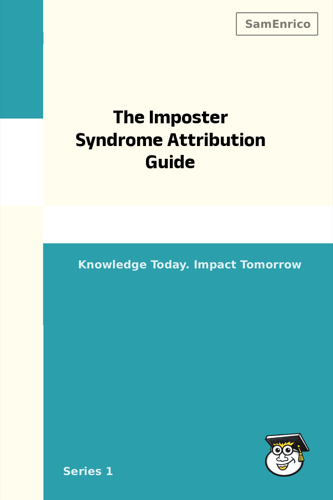
The Imposter Syndrome Attribution Guide
Teaches reattributing success to skill instead of
Teaches reattributing success to skill instead of luck or timing.
Formats
About this book
Free sample
Chapter 1: The Luck Log--–- You have probably said it this week. Maybe today. Someone praised your work—a completed project, a solved problem, a moment of genuine competence—and you opened your mouth to say thank you. But something else came out instead.“It was nothing.”“Anyone could have done it.”“I just got lucky with the timing.”“My team really carried me on that one.”The words felt humble. They felt polite.
They felt like the right thing to say. And in the moment, they probably were—socially speaking. No one wants to be the person who brags about their own success. But here is the question this entire book exists to answer: what did those words do to you?Every time you deflect a compliment, discount a win, or attribute your success to luck rather than skill, you are not just being humble. You are updating your internal operating system.
You are writing code that says: I do not deserve what I just earned. My competence is not real. I am a fraud waiting to be discovered.This is not an exaggeration. This is the psychology of attribution, and it is the single most underrated mechanism driving imposter syndrome.The Attribution Gap Let me introduce you to a concept that will appear in every chapter of this book: the Attribution Gap. It is the distance between how others see your success and how you explain it to yourself.Others look at you and see a person who closes deals, solves problems, leads teams, and produces results.
They see competence. They see skill. They might even see someone who makes success look easy.You look at the same evidence and see something completely different. You see lucky timing. You see a forgiving client.
You see a team that did the real work. You see a moment when the stars aligned and you happened to be standing in the right place.That gap—between external perception and internal explanation—is where imposter syndrome lives. And it is sustained entirely by one cognitive habit: discounting.What Discounting Really Means Discounting is the psychological process…
This is the end of the free sample. Get the eBook to keep going. Buy now
Contents
- Chapter 1
- Chapter 2
- Chapter 3
- Chapter 4
- Chapter 5
- Chapter 6
- Chapter 7
- Chapter 8
- Chapter 9
- Chapter 10
- Chapter 11
- Chapter 12
Details
- Author
- Wiggins Aubrey
- Publisher
- SamEnrico
- Language
- English
- Genre
- Non-Fiction, Self-Help, Attribution Theory
- Released
- 2026-06-06
- Pages (approx.)
- 120
- Available as
- eBook, Audiobook

Read better in the ZLOADR app
Your eBooks on your phone or tablet. Sign in with your SamEnrico account and start reading.
More by Wiggins Aubrey
 Yahoo Cookie Forging AttackWiggins Aubrey$11.99
 Gabon Mba Oil GuideWiggins Aubrey$11.99
 International Fitness ImmigrantWiggins Aubrey$11.99
 Metta for CreativesWiggins Aubrey$11.99
 Grace in Motion: The Pioneers of Black BalletWiggins Aubrey$11.99
 A Beginners Guide to Darts (Volume 1)Wiggins Aubrey$11.99
 Siemens Industrial GuideWiggins Aubrey$12.99
 AI B Roll Footage SourcingWiggins Aubrey$12.99
 Understanding Mps Iii-bWiggins Aubrey$17.99
You may also like
 Hong Kong Handover 1997Dunn Johnnie$11.99
 Zumba For Postnatal Recovery CourseNeal Christian$11.99
 Zumba for BeginnersLadner Nikia$11.99
 YouTube Comment Mining GuideHumes Pandora$12.99
 Worry Box MeditationCarlin Rudy$11.99
 Workplace Stress MeditationNguyen Lynn$11.99
 Workplace Stress and Sleep RepairHawley Ivory$11.99
 Workplace Perfectionism CureDelaney Jeffry$11.99
 Workplace Injustice Anger GuideWallen Isabelle$11.99
 Work Addiction and Burnout LinkGreenwood Ester$11.99
 Women in Yoga and WellnessBeattie Galina$11.99
 Women in Stand Up ComedyChun Evangeline$11.99