
Non-FictionInformativeEducational
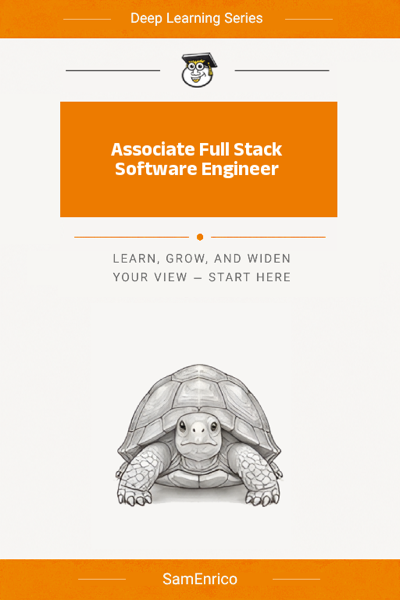
Associate Full Stack Software Engineer eBook
A Coursebook on Associate Full Stack Software Engi
A Coursebook on Associate Full Stack Software Engineer
Formats
Free sample
Chapter 1: The Imposter’s Audit–- The first time you push code to a production system that real people actually use, your hands will tremble. Not from cold, not from caffeine, but from the sudden, crushing realization that your keystrokes now have consequences. This is not the classroom, where a failed assignment meant a lower grade. This is not your personal Git Hub, where a broken commit affects only your own sanity. This is the live web, and somewhere out there, a user is waiting for the page to load, a manager is watching the error logs, and a database is holding the weight of someone’s personal information.
The gap between “I know how to write a for loop” and “I am responsible for this system’s reliability” is wider than most new engineers imagine. And that gap is exactly where this book begins.Every associate full stack software engineer arrives at their first job carrying a heavy secret. The secret sounds something like this: I don’t actually know what I’m doing. I got through the bootcamp. I passed the technical interview.
I built a todo app and a weather dashboard. But when I look at the company’s codebase—thousands of files, hundreds of contributors, ten years of accumulated decisions—I feel like a fraud. Everyone else seems to understand things I’ve never even heard of. They talk about “idempotency” and “race conditions” and “observability” like those are normal words. I keep nodding, but inside, I’m panicking.This feeling has a name.
It’s called impostor syndrome, and it is so universal among software engineers that it has become a cliché. But here is the truth that no one tells you in school: Feeling like an impostor at the associate level is not a sign of weakness. It is a sign of accurate self-assessment. You are supposed to feel underqualified, because you are underqualified. The associate role is explicitly designed for people who know the syntax but have not yet learned the craft.
The entire purpose of the first two years of your career is to close the gap between what you learned from tutorials and what you need to know to build software that survives contact with the real world.The Associate Role: What Employers Actually Expect Let us clear up a dangerous myth right now. Many newcomers believe that “associate software engineer” means “junior version of a senior engineer.” They think the job description is the same, just with lower pay and smaller tasks. This is wrong. The associate role is fundamentally different in kind, not just in degree. Understanding this difference is the first step toward thriving rather than just surviving.What employers do not expect from an associate:Independent architecture decisions that affect the whole system Deep expertise in any particular framework or language The ability to estimate complex tasks with high accuracy Knowledge of the company’s entire codebase or business domain Leading code reviews or mentoring other engineers What employers actually expect from an associate:The ability to read and understand existing code before writing new code Following established patterns rather than inventing new ones Asking questions before spending days going down the wrong path Writing tests for their own code without being reminded Breaking down a well-defined ticket into concrete steps Communicating blockers early and clearly Learning from mistakes without repeating them Notice what is missing from the second list?
Nowhere does it say “memorize every algorithm” or “build a Netflix clone from scratch.” Employers hire associates because they have identified a set of small, well-understood tasks that need to be done—tasks that senior engineers do not have time for, tasks that are perfect for someone who is eager to learn and careful enough not to break things.The single most important skill for an associate is not writing code. It is reading code. Your first weeks on the job will involve far more reading than writing. You will navigate unfamiliar codebases, trace function calls across multiple files, and try to understand why something was written a certain way. The engineers who succeed are not the ones who type the fastest.
They are the ones who can look at a hundred-line function and say, “I see what this is doing, and I know where to add my three lines without breaking anything else.”The Software Development Lifecycle in the Real World Academic programs love to teach the Software Development Lifecycle (SDLC) as a neat flowchart: Requirements → Design → Implementation → Testing → Deployment → Maintenance. It looks clean on a slide. In reality, it looks nothing like that. Real SDLC is messy, iterative, and full of loops that go backward as often as forward.Let us walk through a realistic Tuesday for an associate at a typical company using Agile and Scrum. The day starts with the daily standup (sometimes called the daily scrum).
For fifteen minutes, your team gathers around a virtual or physical board. Each person answers three questions: What did I do yesterday? What will I do today? What is blocking me? As an associate, your answers should be honest and specific.
“Yesterday I finished the validation logic on the signup form. Today I am starting the email confirmation flow. I am blocked because I need API credentials from the operations team.” Notice that you did not try to sound impressive. You stated facts. That is all standup requires.After standup, you look at the sprint board.
Your team works in two-week sprints. At the beginning of each sprint, the team pulls a set of tickets (user stories, bugs, tasks) from the product backlog and commits to completing them. As an associate, your tickets will typically be labeled “good first issue” or have a small story point estimate (1, 2, or 3 on a Fibonacci-like scale). You are not expected to take the eight-point feature that touches six microservices.The ticket you pick up today is a bug fix. A user reported that after submitting a contact form, the page does not show a confirmation message.
The steps to reproduce are clear: fill out the form, click submit, wait. The expected behavior is a green banner saying “Thank you, we will respond within 24 hours.” The actual behavior is nothing—the form clears, but no banner appears.Your job is not to immediately open your editor and start typing. Your job is to reproduce the bug locally. You pull the latest code, run the development environment, and follow the steps. Does the bug happen on your machine?
If not, the problem might be environment-specific, which is a different category of difficulty. If yes, you now have a starting point. You open your debugger, set a breakpoint in the form submission handler, and step through the code line by line. You discover that the API returns a success status (200 OK), but the frontend code that should display the banner is inside a conditional block that never runs because a variable called show Confirmation is always false. You trace that variable back to its source and find that it is set to true only when the API response includes a field called confirmation Id.
The API does not include that field. Is that a bug in the backend or a misunderstanding of the contract?…
This is the end of the free sample. Get the eBook to keep going. Buy now
About this book
Details
- Author
- Lemieux Caprice
- Publisher
- SamEnrico
- Language
- English
- Genre
- Non-Fiction, Informative, Educational
- Released
- 2026-06-02
- Pages (approx.)
- 151
- Available as
- eBook, Audiobook

Read better in the ZLOADR app
Your eBooks on your phone or tablet. Sign in with your SamEnrico account and start reading.
More by Lemieux Caprice
 Physician Stress Management GuideLemieux Caprice$11.99
 Pet Loss FAQ GuideLemieux Caprice$11.99
 Billy Graham AccountLemieux Caprice$11.99
 Body Language for Medical StaffLemieux Caprice$11.99
 The Self Esteem After Trauma GuideLemieux Caprice$11.99
 The Miami Vice Downfall: How a Cop’s Betrayal Brought Down a Drug EmpireLemieux Caprice$11.99
 Understanding Kurczynski–casperson SyndromeLemieux Caprice$17.99
 Post Editing Quality Check WorkbookLemieux Caprice$12.99
 Heat Pump Market Growth GuideLemieux Caprice$12.99
 How to Start a Hobby in Singing and playing musical instrumentsLemieux Caprice$11.99
You may also like
 Hong Kong Handover 1997Dunn Johnnie$11.99
 Zumba For Postnatal Recovery CourseNeal Christian$11.99
 Zumba for BeginnersLadner Nikia$11.99
 YouTube Comment Mining GuideHumes Pandora$12.99
 Worry Box MeditationCarlin Rudy$11.99
 Workplace Stress MeditationNguyen Lynn$11.99
 Workplace Stress and Sleep RepairHawley Ivory$11.99
 Workplace Perfectionism CureDelaney Jeffry$11.99
 Workplace Injustice Anger GuideWallen Isabelle$11.99
 Work Addiction and Burnout LinkGreenwood Ester$11.99
 Women in Yoga and WellnessBeattie Galina$11.99
 Women in Stand Up ComedyChun Evangeline$11.99