
Non-FictionSelf-HelpRemote Work
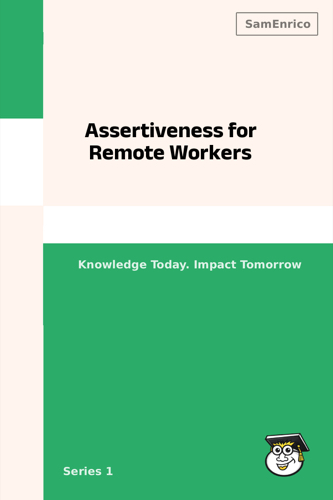
Assertiveness for Remote Workers eBook
Virtual meeting and after hours limits.
by Moyer Zena
Virtual meeting and after hours limits.
Formats
Free sample
Chapter 1: The Invisible Leash--–- The email arrived at 11:47 PM on a Tuesday. Sarah, a senior marketing manager who had been remote for three years, was folding laundry while half-watching a news segment she wasn't really seeing. Her laptop sat open on the kitchen table—where it had sat since 8:15 AM. The ping was sharp, insistent. She walked over, already feeling the pull in her chest.
It was her boss. "Quick question on the Q3 deck—can you take a look?" No "sorry for the late hour." No "tomorrow is fine." Just the question, hanging there in the blue glow like a hook.Sarah opened the deck. It was not a quick question. It was seventeen comments, three of which required pulling new data, and one of which said "let's rethink the entire narrative framework." She worked until 1:20 AM. The next morning, she was on a call at 8:15 AM.
Her child asked her a question during the call. She did not hear it. Her partner made breakfast, and she did not eat it. By noon, she had already been "working" for nearly five hours, but when asked what she had accomplished, she could not answer. She had responded.
She had not produced.Sarah is not lazy. She is not weak. She is not bad at her job. Sarah is on a leash.The Great Unnoticed Expansion Let us begin with a number: forty-eight. That is how many minutes the average remote workday expanded during the pandemic, according to research from the National Bureau of Economic Research.
Not because people worked harder. Not because they were more productive. Because the natural stop signs disappeared.Consider what used to mark the end of a workday: packing a bag, walking to a car or a train, sitting in traffic, listening to a podcast, watching the office building shrink in the rearview mirror. These were not just transitions. They were psychological boundary markers.
They told your brain: done. Finished. Switch modes.Now consider what marks the end of your remote workday. Do you close a laptop? Do you walk from one room to another?
Or do you simply keep the laptop open on the kitchen table, the notifications still trickling in, the Slack icon still buzzing, the workday ending not with a boundary but with a slow, exhausted fade into evening television?Remote work did not create flexibility. It created perpetual accessibility. And most of us did not notice until we were already drowning.Availability Pressure: The Anxiety You Mistook for Work Ethic There is a name for the feeling Sarah experienced when she saw that 11:47 PM email. It is called availability pressure – the low-grade, persistent anxiety that if you do not respond immediately, colleagues will assume you are slacking off, disengaged, or somehow less committed than the person who replies at midnight.Here is what availability pressure feels like: you step away from your laptop to make lunch, and you feel a small spike of guilt. You take a fifteen-minute walk after a meeting, and you find yourself checking your phone twice.
You log off at 5:30 PM, and by 6:15 PM you are already composing an email in your head. You are not responding to actual demands. You are responding to a phantom expectation you have internalized.The research on this is unsettling. A study from the University of California, Irvine found that it takes an average of twenty-three minutes to return to a focused task after an interruption. But here is the hidden cost: the anticipation of interruption—the knowledge that a notification might arrive—reduces cognitive performance by up to 20 percent even when no notification actually appears.
You do not need to be interrupted to be damaged by the possibility of interruption.Availability pressure is not productivity. It is the opposite of productivity. It is reactivity dressed up as diligence. And it is the first link in the invisible leash.Responding vs. Producing: The Crucial Distinction One of the most dangerous confusions in remote work is the conflation of responding with producing.
They are not the same thing. They are not even close.Responding is reactive. It is email, Slack, comments, approvals, quick questions, and the endless small-bore communication that fills the cracks of the day. Responding feels like work because it is effortful—it requires reading, thinking, typing. But responding is almost never the work that matters.
It is the work that enables the work that matters, which is a very different thing.Producing is generative. It is strategy, writing, coding, designing, analyzing, creating. Producing requires uninterrupted focus. It requires the kind of deep cognitive engagement that is impossible when you are also monitoring a chat channel.Here is the problem remote work has created: because our tools (email, Slack, Zoom) are always available, and because our colleagues can see when we are "online," responding has come to feel like the primary work. The quick reply becomes a visible signal of engagement.
The deep work becomes invisible. And so we optimize for the visible. We reply instantly to everything, and we produce nothing of value.Consider your own day. How many times did you check email or Slack? How many of those checks led to a meaningful output?
Now compare that to the amount of uninterrupted time you spent on your most important project. For most remote workers, the ratio is inverted: eighty percent responding, twenty percent producing. It should be the opposite.The Four False Gods of Remote Productivity Before we can solve the problem, we must name the false beliefs that sustain it. Across hundreds of interviews and thousands of survey responses, four myths emerge as the primary drivers of remote work burnout.Myth One: "If I don't reply immediately, they'll think I'm not working." This is the core fear underlying availability pressure. But notice the assumption: that your colleagues are constantly monitoring your response time and using it as a proxy for your work ethic.
Are they? Or are you projecting your own anxiety onto them? Most colleagues are too busy with their own work to track your reply speed. And the ones who do track it are not managers you want to work for.Myth Two: "Flexible work means available work." Many remote workers believe that because they can work at 11 PM, they should work at 11 PM. But flexibility means the freedom to choose when you work, not the obligation to work at all hours.
The distinction is subtle but essential. A flexible schedule is one where you can start at 10 AM because you had a doctor's appointment. An exploitative schedule is one where you are expected to answer emails at midnight because you could. The difference is consent.Myth Three: "Busy is the same as productive." This is the oldest myth in the knowledge work playbook, and remote work has supercharged it. Without the physical cues of an office (desks, papers, people moving with purpose), busyness becomes the only visible signal of effort.
So we manufacture busyness. We send more emails. We join more meetings. We create more noise. And we mistake the noise for impact.Myth Four: "My boundaries are my problem." This is the most insidious myth because it contains a grain of truth.
Yes, you are responsible for setting your own limits. But boundaries are not purely individual. They are negotiated in relationship…
This is the end of the free sample. Get the eBook to keep going. Buy now
About this book
Details
- Author
- Moyer Zena
- Publisher
- SamEnrico
- Language
- English
- Genre
- Non-Fiction, Self-Help, Remote Work
- Released
- 2026-06-06
- Pages (approx.)
- 122
- Available as
- eBook, Audiobook

Read better in the ZLOADR app
Your eBooks on your phone or tablet. Sign in with your SamEnrico account and start reading.
More by Moyer Zena
 Kidney Failure Anticipatory GriefMoyer Zena$11.99
 Thunberg Climate ReparationsMoyer Zena$11.99
 Long Marriage Divorce RecoveryMoyer Zena$11.99
 Religion Change Parent AngerMoyer Zena$11.99
 Key Metrics Dashboard GuideMoyer Zena$11.99
 Consignment Inventory AIMoyer Zena$11.99
 Constraints for WritersMoyer Zena$11.99
 Oisín’s Forgotten Lament: The Bard Who Outlived TimeMoyer Zena$11.99
 The Iron Crown of Burgundy: Maximillian I and the Birth of a DynastyMoyer Zena$11.99
 How to Produce OverallsMoyer Zena$11.99
 How to Produce Conference Room TablesMoyer Zena$11.99
 Camels: CamelusMoyer Zena$11.99
You may also like
 Hong Kong Handover 1997Dunn Johnnie$11.99
 Zumba For Postnatal Recovery CourseNeal Christian$11.99
 Zumba for BeginnersLadner Nikia$11.99
 YouTube Comment Mining GuideHumes Pandora$12.99
 Worry Box MeditationCarlin Rudy$11.99
 Workplace Stress MeditationNguyen Lynn$11.99
 Workplace Stress and Sleep RepairHawley Ivory$11.99
 Workplace Perfectionism CureDelaney Jeffry$11.99
 Workplace Injustice Anger GuideWallen Isabelle$11.99
 Work Addiction and Burnout LinkGreenwood Ester$11.99
 Women in Yoga and WellnessBeattie Galina$11.99
 Women in Stand Up ComedyChun Evangeline$11.99