
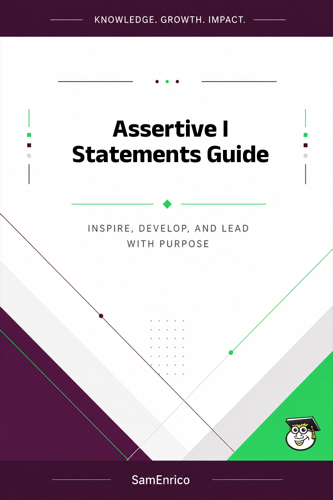
Assertive I Statements Guide Audiobook
Express feelings and needs using I feel, I want, I
by Fish Twana
Express feelings and needs using I feel, I want, I think format.
Formats
Free sample
Chapter 1: The Hidden Epidemic...--–- Every argument you have ever lost—and every one you have ever won but still felt terrible afterward—shares the same hidden architecture. You cannot see it when you are inside the storm, but once you learn to recognize it, you will never unsee it. This chapter reveals that architecture and introduces the single most powerful tool for dismantling it: the Assertive I-Statement.The Argument You’ve Had a Thousand Times Picture this. You come home after a long day. You are tired, hungry, and carrying the weight of twelve hours of decisions.
You walk through the door and see the kitchen exactly as you left it that morning—dishes in the sink, cereal box on the counter, coffee mug ring staining the marble. Your partner is on the couch scrolling through their phone. You feel something tighten in your chest.“You never help around here,” you say.They look up, immediately defensive. “That’s not true. I did the laundry yesterday.”“Oh, the laundry?
Great. One chore in three days. You always leave the kitchen for me.”“You always find something to complain about. I can’t do anything right in your eyes.”“Maybe if you actually did something, I wouldn’t have to complain.”They stand up. “You know what?
Fine. I’ll clean the kitchen. But don’t expect me to be happy about it.”They slam a cabinet door. You feel victorious for approximately four seconds. Then you feel lonely, exhausted, and confused about how two people who love each other ended up here again.This scene—or some version of it—plays out millions of times every day in kitchens, bedrooms, offices, and text message threads.
The specific words change. The underlying structure does not. What you just witnessed is not a failure of love, effort, or compatibility. It is a failure of communication architecture—and the central load-bearing wall of that architecture is the difference between two types of statements: You-Statements and I-Statements.The Anatomy of a Losing Fight Before we can build something better, we must understand what we are tearing down. Let me perform what I call a psychological autopsy of the fight you just read.
Every sentence was chosen deliberately because it represents a predictable, almost mathematical pattern.Line one: “You never help around here.”This is a You-Statement. Notice its components. It contains an absolute (“never”)…
This is the end of the free sample. Get the Audiobook to keep going. Buy now
About this book
Details
- Author
- Fish Twana
- Publisher
- SamEnrico
- Language
- English
- Genre
- Non-Fiction, Self-Help, I Statements, Expression
- Released
- 2026-06-08
- Pages (approx.)
- 138
- Available as
- eBook, Audiobook

Listen in the VoxFlicks app
Audiobooks and audio dramas wherever you go. Sign in with your SamEnrico account and press play.
More by Fish Twana
 Stage Fright Rewiring BlueprintFish Twana$11.99
 The Jodie Foster Career MasterclassFish Twana$11.99
 Experiencing Joy Through BreathFish Twana$11.99
 The Menopause Relationship Stress GuideFish Twana$11.99
 The Ghost of the Bataclan: Forensics and the Paris SiegeFish Twana$11.99
 Field Operations CoordinatorFish Twana$11.99
 Understanding Long Qt Syndrome Type 1Fish Twana$17.99
 How to Start a Taxi Service BusinessFish Twana$11.99
 Non Resident LLC Asset ProtectionFish Twana$12.99
 Technology Adoption ContrastFish Twana$12.99