
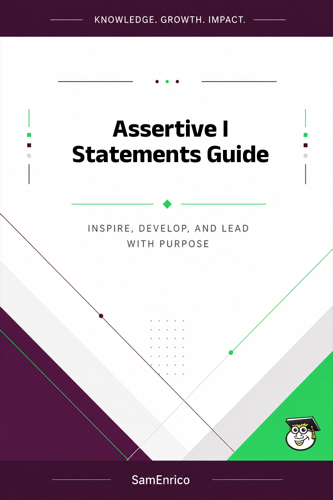
Assertive I Statements Guide eBook
Express feelings and needs using I feel, I want, I
by Fish Twana
Express feelings and needs using I feel, I want, I think format.
Formats
Free sample
Chapter 1: The Hidden Epidemic...--–- Every argument you have ever lost—and every one you have ever won but still felt terrible afterward—shares the same hidden architecture. You cannot see it when you are inside the storm, but once you learn to recognize it, you will never unsee it. This chapter reveals that architecture and introduces the single most powerful tool for dismantling it: the Assertive I-Statement.The Argument You’ve Had a Thousand Times Picture this. You come home after a long day. You are tired, hungry, and carrying the weight of twelve hours of decisions.
You walk through the door and see the kitchen exactly as you left it that morning—dishes in the sink, cereal box on the counter, coffee mug ring staining the marble. Your partner is on the couch scrolling through their phone. You feel something tighten in your chest.“You never help around here,” you say.They look up, immediately defensive. “That’s not true. I did the laundry yesterday.”“Oh, the laundry?
Great. One chore in three days. You always leave the kitchen for me.”“You always find something to complain about. I can’t do anything right in your eyes.”“Maybe if you actually did something, I wouldn’t have to complain.”They stand up. “You know what?
Fine. I’ll clean the kitchen. But don’t expect me to be happy about it.”They slam a cabinet door. You feel victorious for approximately four seconds. Then you feel lonely, exhausted, and confused about how two people who love each other ended up here again.This scene—or some version of it—plays out millions of times every day in kitchens, bedrooms, offices, and text message threads.
The specific words change. The underlying structure does not. What you just witnessed is not a failure of love, effort, or compatibility. It is a failure of communication architecture—and the central load-bearing wall of that architecture is the difference between two types of statements: You-Statements and I-Statements.The Anatomy of a Losing Fight Before we can build something better, we must understand what we are tearing down. Let me perform what I call a psychological autopsy of the fight you just read.
Every sentence was chosen deliberately because it represents a predictable, almost mathematical pattern.Line one: “You never help around here.”This is a You-Statement. Notice its components. It contains an absolute (“never”), a judgment (“help” implies a standard they are failing to meet), and zero information about the speaker’s internal state. The speaker has not said “I feel tired” or “I notice the dishes are still here.” They have made a claim about the other person’s entire character and history. That claim is almost certainly false in its absolute form—they have helped before—but that is not the problem.
The problem is that the sentence is structured as an accusation.Line two: “That’s not true. I did the laundry yesterday.”This is defensiveness. It is not a response to the speaker’s distress. It is a response to the accusation. The accused person hears “You are a bad partner” and immediately scans their memory for evidence to the contrary.
They produce one piece of counter-evidence—laundry. This is not a bad-faith response. It is a neurological reflex.Line three: “Oh, the laundry? Great. One chore in three days.
You always leave the kitchen for me.”This is escalation through sarcasm and a second absolute (“always”). The speaker feels unheard—because their original emotional need was never addressed—so they double down. The accusation becomes more specific and more damning.Line four: “You always find something to complain about. I can’t do anything right in your eyes.”This is counter-accusation and victim identity. The accused person has now shifted from defending a specific behavior (dishes) to defending their entire worth as a human being.
The fight is no longer about the kitchen. It is about whether they are fundamentally adequate.Line five: “Maybe if you actually did something, I wouldn’t have to complain.”This is blame-shifting. The speaker takes no responsibility for their tone or timing. The cause of the complaint is placed entirely on the other person’s actions.Line six: “You know what? Fine.
I’ll clean the kitchen. But don’t expect me to be happy about it.”This is compliance without resolution. The kitchen will be cleaned, but resentment will be deposited in the emotional bank account. The cabinet slam is not an accident. It is a physical punctuation mark meaning “I am doing this under duress.”The result: The kitchen gets cleaned.
The couple does not speak for two hours. Tomorrow, the same fight will happen about something else. This is not a relationship problem. It is a communication loop—and loops do not resolve themselves. They repeat.The Science of Blame: What Happens Inside Your Brain Why do perfectly intelligent adults fall into this trap again and again?
The answer lies in the oldest parts of your brain.When you hear a You-Statement—“You never listen,” “You are so selfish,” “You always do this”—your brain does not process it as information. It processes it as a threat. Neuroimaging studies have shown that the same regions activated by physical pain—the anterior cingulate cortex and the insula—light up when a person receives criticism framed as a character attack. Your amygdala, the brain’s alarm system, triggers within milliseconds. Cortisol and adrenaline flood your system.
Your heart rate increases. Your blood pressure rises. Your prefrontal cortex—the rational, planning part of your brain—partially shuts down.This is the fight, flight, or freeze response. In the context of a conversation, “fight” looks like counter-attack. “Flight” looks like stonewalling (silence, leaving the room, scrolling on a phone).
“Freeze” looks like saying “You’re right, I’m sorry” just to end the argument, while feeling none of the apology internally.None of these responses lead to resolution. They lead to the Blame Cycle.The Blame Cycle:Accusation (You-Statement) → Defensiveness → Counter-accusation → Escalation → Resentment → Silence → Repeat.The cycle is self-perpetuating because each turn deposits more emotional charge. After twenty rounds, the original trigger—dishes in the sink—is completely forgotten. The fight is now about who has been more wrong over the past six months. No one can win that fight because no one can prove a global judgment like “you are lazy” or “you don’t care.” The only possible outcomes are stalemate, withdrawal, or one person surrendering while secretly seething.Locus of Control: The Hidden Philosophy of Arguments There is a psychological concept that explains why You-Statements keep you stuck.
It is called Locus of Control, developed by psychologist Julian Rotter in the 1950s. Simply put, your locus of control is where you believe the power to change your life resides.An external locus of control means you believe your circumstances are determined by outside forces: other people, luck, fate, the economy, your boss, your partner. People with a strong external locus say things like “You made me angry,” “She ruined my day,” or “They never give me a chance.” The sentence structure is always the same: something outside of me causes…
This is the end of the free sample. Get the eBook to keep going. Buy now
About this book
Details
- Author
- Fish Twana
- Publisher
- SamEnrico
- Language
- English
- Genre
- Non-Fiction, Self-Help, I Statements, Expression
- Released
- 2026-06-08
- Pages (approx.)
- 138
- Available as
- eBook, Audiobook

Read better in the ZLOADR app
Your eBooks on your phone or tablet. Sign in with your SamEnrico account and start reading.
More by Fish Twana
 Stage Fright Rewiring BlueprintFish Twana$11.99
 The Jodie Foster Career MasterclassFish Twana$11.99
 Experiencing Joy Through BreathFish Twana$11.99
 The Menopause Relationship Stress GuideFish Twana$11.99
 The Ghost of the Bataclan: Forensics and the Paris SiegeFish Twana$11.99
 Field Operations CoordinatorFish Twana$11.99
 Understanding Long Qt Syndrome Type 1Fish Twana$17.99
 How to Start a Taxi Service BusinessFish Twana$11.99
 Non Resident LLC Asset ProtectionFish Twana$12.99
 Technology Adoption ContrastFish Twana$12.99