
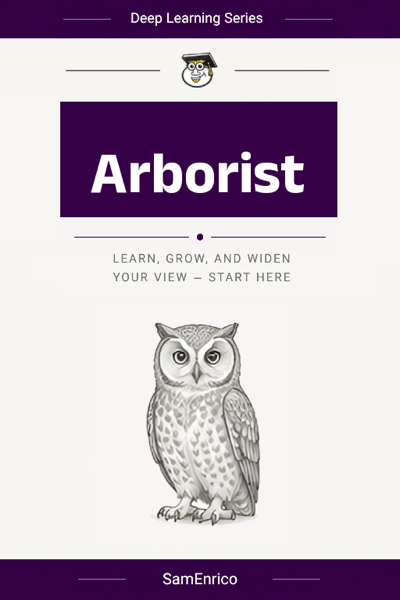
Arborist
A Coursebook on Arborist
A Coursebook on Arborist
Formats
About this book
Free sample
Chapter 1: The Living Architecture--–- Most people look at a tree and see a static object—a wooden立柱 planted in the ground, swaying in the wind, dropping leaves in autumn. They see fuel for a fireplace, lumber for a table, or shade for a picnic. Some see a nuisance with roots that crack sidewalks. A few see something majestic or spiritual. But almost none see what an arborist must see: a high-pressure hydraulic system, a sugar refinery, a chemical defense factory, and a structural marvel all operating simultaneously within a single organism that never sleeps, never rests, and never heals.Not heals.
That word is the most dangerous misconception in all of arboriculture. Trees do not heal. Animals heal. When you cut your skin, your body produces new cells to close the wound, rebuilds blood vessels, restores the tissue to something very close to its original condition. Trees cannot do this.
A tree never replaces a single cell of wood once that cell has been damaged or decayed. Instead, trees do something far more sophisticated and far more alien to our mammalian understanding of biology: they compartmentalize. They wall off the damage, seal it behind chemical and physical barriers, and then grow around it, leaving the wound entombed forever inside newer layers of wood.This single concept—Compartmentalization of Decay in Trees, known universally in arboriculture as CODIT (pronounced CO-dit)—is the master key that unlocks every other practice in tree care. Pruning? You are not healing the cut; you are positioning the cut so the tree's walling-off mechanisms can succeed.
Risk assessment? You are evaluating how previous wounds have been compartmentalized and whether those walls are holding. Tree removal? You are admitting that the compartmentalization has failed. Soil management?
You are feeding the system that produces the energy for compartmentalization. Everything returns to CODIT.Before we can understand CODIT, however, we must understand the two fluid transport systems that make trees possible. These systems are the tree's arteries and veins, but unlike an animal's closed circulatory system, a tree's vascular system is open, passive, and driven entirely by physics and…
This is the end of the free sample. Get the eBook to keep going. Buy now
Contents
- Chapter 1
- Chapter 2
- Chapter 3
- Chapter 4
- Chapter 5
- Chapter 6
- Chapter 7
- Chapter 8
- Chapter 9
- Chapter 10
- Chapter 11
- Chapter 12
Details
- Author
- Talbert Kathie
- Publisher
- SamEnrico
- Language
- English
- Genre
- Non-Fiction, Informative, Educational
- Released
- 2026-05-11
- Pages (approx.)
- 148
- Available as
- eBook, Audiobook

Read better in the ZLOADR app
Your eBooks on your phone or tablet. Sign in with your SamEnrico account and start reading.
More by Talbert Kathie
 Brokerage Account Types ExplainedTalbert Kathie$11.99
 Farmer Harvest PressureTalbert Kathie$11.99
 Civilian Defense VolunteersTalbert Kathie$11.99
 FEMA Disaster Response StressTalbert Kathie$11.99
 The Siege of Malbork: The Teutonic Order's Last StandTalbert Kathie$11.99
 Freemium Shared Kiosk ModeTalbert Kathie$12.99
 How to Produce Bird TreatsTalbert Kathie$11.99
 How to Become a Glass-cleaning-machine TenderTalbert Kathie$11.99