
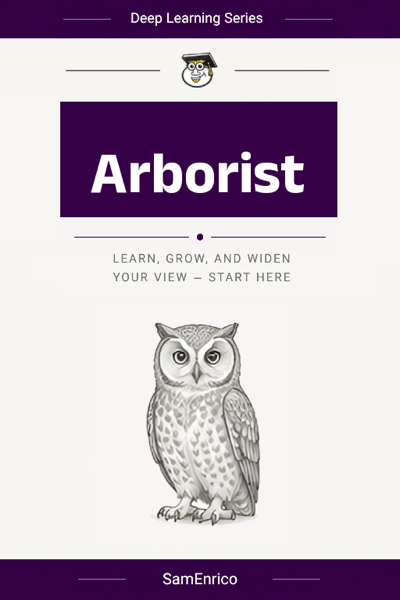
Arborist eBook
A Coursebook on Arborist
A Coursebook on Arborist
Formats
Free sample
Chapter 1: The Living Architecture--–- Most people look at a tree and see a static object—a wooden立柱 planted in the ground, swaying in the wind, dropping leaves in autumn. They see fuel for a fireplace, lumber for a table, or shade for a picnic. Some see a nuisance with roots that crack sidewalks. A few see something majestic or spiritual. But almost none see what an arborist must see: a high-pressure hydraulic system, a sugar refinery, a chemical defense factory, and a structural marvel all operating simultaneously within a single organism that never sleeps, never rests, and never heals.Not heals.
That word is the most dangerous misconception in all of arboriculture. Trees do not heal. Animals heal. When you cut your skin, your body produces new cells to close the wound, rebuilds blood vessels, restores the tissue to something very close to its original condition. Trees cannot do this.
A tree never replaces a single cell of wood once that cell has been damaged or decayed. Instead, trees do something far more sophisticated and far more alien to our mammalian understanding of biology: they compartmentalize. They wall off the damage, seal it behind chemical and physical barriers, and then grow around it, leaving the wound entombed forever inside newer layers of wood.This single concept—Compartmentalization of Decay in Trees, known universally in arboriculture as CODIT (pronounced CO-dit)—is the master key that unlocks every other practice in tree care. Pruning? You are not healing the cut; you are positioning the cut so the tree's walling-off mechanisms can succeed.
Risk assessment? You are evaluating how previous wounds have been compartmentalized and whether those walls are holding. Tree removal? You are admitting that the compartmentalization has failed. Soil management?
You are feeding the system that produces the energy for compartmentalization. Everything returns to CODIT.Before we can understand CODIT, however, we must understand the two fluid transport systems that make trees possible. These systems are the tree's arteries and veins, but unlike an animal's closed circulatory system, a tree's vascular system is open, passive, and driven entirely by physics and evaporation. The first system moves water and mineral nutrients from the roots upward to the leaves. The second system moves sugars from the leaves downward to every living cell in the tree.
One is dead tissue at maturity. The other is alive. One requires no energy input from the tree. The other is the tree's single largest consumer of energy. Together, they explain everything from why trees wilt to why girdling a tree kills it to why you should never remove more than twenty-five percent of a tree's canopy in a single year.This chapter is the foundation upon which every subsequent chapter rests.
The arborist who understands the cohesion-tension theory, the pressure flow hypothesis, and the four walls of CODIT will never guess at a pruning cut, never wonder why a tree declined after construction, and never stand puzzled beneath a leaning oak trying to decide if it is dangerous or merely adapted. The arborist who skips this chapter will spend the rest of their career treating symptoms without understanding causes.The Two Highways: Xylem and Phloem Every tree has two separate and radically different transport systems running through its stem, branches, and roots. They are called xylem (ZY-lum) and phloem (FLO-em). They are as different as a city's water supply system and its internet fiber network—both move something essential, but they operate on completely different principles.Xylem: The Dead Plumbing The xylem is composed of dead cells at functional maturity. This fact surprises many beginners.
The pipes that carry water from the roots to the leaves are dead. They are hollow, reinforced tubes made of lignin, the same rigid polymer that gives wood its strength. In hardwoods (angiosperms like oaks and maples), the xylem consists of vessel elements—short, wide tubes stacked end to end like a drinking straw made of many segments. In conifers (gymnosperms like pines and spruces), the xylem consists of tracheids—long, narrow, tapered cells that overlap at their ends, with water moving through microscopic pits in the cell walls.The water moving through the xylem is not pure H₂O. It is a dilute solution of mineral nutrients absorbed by the roots—nitrogen, phosphorus, potassium, calcium, magnesium, sulfur, and a dozen trace elements.
But the driver of this movement is not the roots pushing water upward. The driver is the leaves pulling water upward.Here is where the cohesion-tension theory enters. Water molecules are polar. The oxygen atom carries a slight negative charge, the hydrogen atoms slight positive charges. This polarity causes water molecules to stick to each other—a property called cohesion—and to stick to other polar surfaces—a property called adhesion.
When water evaporates from the surfaces of leaf cells through the stomata (microscopic pores in the leaf surface), it creates a negative pressure, a tension, that pulls the next water molecule into place. That tension travels down the water column in the xylem, all the way to the roots, pulling water up from the soil in a continuous, unbroken column.The tension is enormous. In a tall tree like a coast redwood (Sequoia sempervirens), the tension at the leaves can reach negative 20 to 30 atmospheres—enough to collapse an ordinary pipe. But the xylem tubes are reinforced with lignin, and the cohesive force of water is strong enough to resist cavitation (the formation of air bubbles) under normal conditions. When cavitation does occur—during drought, freeze-thaw cycles, or physical damage—the bubble blocks the xylem tube, rendering it useless.
That is why a tree wilts in drought: so many xylem tubes have cavitated that not enough water remains to supply the leaves.Phloem: The Living Supply Line If the xylem is dead plumbing, the phloem is a living, energy-demanding transport network. Phloem cells (sieve tube elements) are alive at maturity, though they lack nuclei and many organelles. They are arranged end to end, with sieve plates (porous walls) between them allowing the contents to flow through. Companion cells, living cells adjacent to the sieve tubes, perform the metabolic tasks the enucleated sieve tubes cannot perform.The phloem transports sugars—primarily sucrose—from sources to sinks. Sources are parts of the tree that produce more sugar than they consume: mature leaves performing photosynthesis, and in spring, stored starches in roots or stems that have been converted back to sugar.
Sinks are parts of the tree that consume more sugar than they produce: growing tips (roots, shoots, and buds), developing fruits and seeds, and the cambium (the thin layer of dividing cells that produces new xylem and phloem).The mechanism of phloem transport is the pressure flow hypothesis. Sugars are actively loaded into the phloem at the source. This active transport requires energy (ATP) because the sugars are moving against their concentration gradient. The high concentration of sugar in the phloem at the source draws water into the phloem by osmosis. The influx of water increases the hydrostatic pressure at the source end.
At the sink end, sugars are unloaded from the phloem, which causes water to leave the phloem by osmosis, decreasing the hydrostatic pressure. The pressure gradient—high at…
This is the end of the free sample. Get the eBook to keep going. Buy now
About this book
Details
- Author
- Talbert Kathie
- Publisher
- SamEnrico
- Language
- English
- Genre
- Non-Fiction, Informative, Educational
- Released
- 2026-05-11
- Pages (approx.)
- 148
- Available as
- eBook, Audiobook

Read better in the ZLOADR app
Your eBooks on your phone or tablet. Sign in with your SamEnrico account and start reading.
More by Talbert Kathie
 Brokerage Account Types ExplainedTalbert Kathie$11.99
 Farmer Harvest PressureTalbert Kathie$11.99
 Civilian Defense VolunteersTalbert Kathie$11.99
 FEMA Disaster Response StressTalbert Kathie$11.99
 The Siege of Malbork: The Teutonic Order's Last StandTalbert Kathie$11.99
 Freemium Shared Kiosk ModeTalbert Kathie$12.99
 How to Produce Bird TreatsTalbert Kathie$11.99
 How to Become a Glass-cleaning-machine TenderTalbert Kathie$11.99