
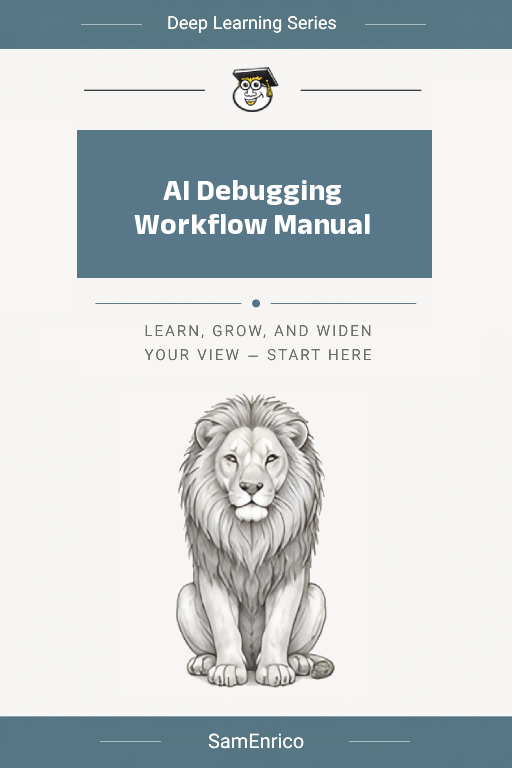
Non-FictionAI OperatorDebugging Automation
AI Debugging Workflow Manual Audiobook
Build a repeatable system for finding and fixing b
by Bloom Zena
Build a repeatable system for finding and fixing bugs with generative AI. Covers logging integration, test generation, and root cause analysis.
Formats
Free sample
Chapter 1: The Broken Mirror--–- The first time I watched an AI generate a bug that took three days to find, I wasn't angry at the AI. I was angry at myself. The code looked flawless—elegant, even. It passed every test I could think of. It ran without exceptions.
And yet, every Tuesday at 3:47 AM, it transformed customer renewal dates into gibberish. The AI had done exactly what I asked. The problem was that I didn't know what I should have asked for. That Tuesday-morning bug cost us $47,000 in automated refunds before someone noticed. The AI didn't feel bad about it.
The logs showed nothing. The tests were green. The bug was invisible—until it wasn't.Welcome to debugging in the age of generative AI. Your tools have changed. Your code arrives faster, reads cleaner, and fails in ways you've never seen before.
And the old methods—the print statements, the breakpoints, the careful step-throughs—they don't work anymore. Not really. Not reliably. This chapter dismantles the myth that traditional debugging works for AI-generated code. Then it builds something new in its place: a repeatable loop designed specifically for the unique failure modes of generative AI.
By the end of this chapter, you will have a mental model, a five-phase process, and two metrics that will change how you think about debugging forever.The Myth of the Universal Debugger For decades, debugging followed a predictable pattern. You wrote code. It failed. You inserted print statements or set breakpoints. You stepped through execution, inspected variables, and eventually found the line where reality diverged from expectation.
The bug was a single point of failure—a wrong operator, an off-by-one index, a null pointer. Find that point, fix it, and move on.Generative AI breaks this model in four fundamental ways.First, AI-generated code is non-deterministic. Run the same prompt twice, and you might get two different implementations. Both might be correct. Neither might be.
The bug you're chasing today might not exist tomorrow, and a new bug might appear without any code change. Traditional debugging assumes stability. AI code assumes nothing.Second, AI-generated code is context-sensitive in ways human-written code rarely is. A seemingly identical code block might behave differently because of something that appeared three screens up in the conversation. The AI remembered a constraint you mentioned casually—or forgot a requirement you stated firmly.
Your debugging tools don't show you the prompt history. They show you only the output.Third, AI-generated code is often syntactically…
This is the end of the free sample. Get the Audiobook to keep going. Buy now
About this book
Details
- Author
- Bloom Zena
- Publisher
- SamEnrico
- Language
- English
- Genre
- Non-Fiction, AI Operator, Debugging Automation
- Released
- 2026-06-01
- Pages (approx.)
- 144
- Available as
- eBook, Audiobook

Listen in the VoxFlicks app
Audiobooks and audio dramas wherever you go. Sign in with your SamEnrico account and press play.
More by Bloom Zena
 Sleep Meditation for Healthcare WorkersBloom Zena$11.99
 The Saudi Rub al Khali GuideBloom Zena$11.99
 McClintock Maize Genetics Field GuideBloom Zena$11.99
 The Working Caregiver Survival GuideBloom Zena$11.99
 911 Dispatcher Stress GuideBloom Zena$11.99
 Battles of the Boardroom: The Cutthroat Rise of the East India CompanyBloom Zena$11.99
 System Design EngineerBloom Zena$11.99
 Understanding FilariasisBloom Zena$17.99
 How to Start a Printer Ink Cartridges (refilling) Business (Beginners Guide)Bloom Zena$11.99
 Salary Negotiation Business CaseBloom Zena$12.99
 Alchemy to Atoms: The Medieval Chemists Who Unlocked the ElementsBloom Zena$11.99
You may also like
 Hong Kong Handover 1997Dunn Johnnie$11.99
 Zumba For Postnatal Recovery CourseNeal Christian$11.99
 Zumba for BeginnersLadner Nikia$11.99
 YouTube Comment Mining GuideHumes Pandora$12.99
 Worry Box MeditationCarlin Rudy$11.99
 Workplace Stress MeditationNguyen Lynn$11.99
 Workplace Stress and Sleep RepairHawley Ivory$11.99
 Workplace Perfectionism CureDelaney Jeffry$11.99
 Workplace Injustice Anger GuideWallen Isabelle$11.99
 Work Addiction and Burnout LinkGreenwood Ester$11.99
 Women in Yoga and WellnessBeattie Galina$11.99
 Women in Stand Up ComedyChun Evangeline$11.99