
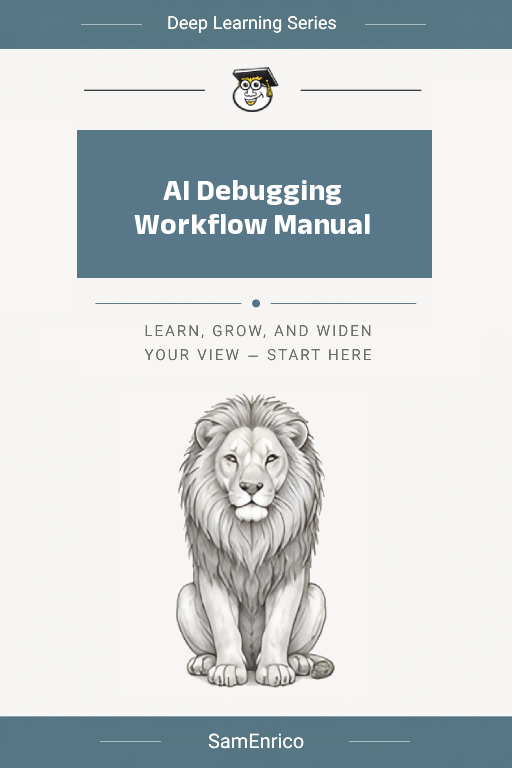
Non-FictionAI OperatorDebugging Automation
AI Debugging Workflow Manual eBook
Build a repeatable system for finding and fixing b
by Bloom Zena
Build a repeatable system for finding and fixing bugs with generative AI. Covers logging integration, test generation, and root cause analysis.
Formats
Free sample
Chapter 1: The Broken Mirror--–- The first time I watched an AI generate a bug that took three days to find, I wasn't angry at the AI. I was angry at myself. The code looked flawless—elegant, even. It passed every test I could think of. It ran without exceptions.
And yet, every Tuesday at 3:47 AM, it transformed customer renewal dates into gibberish. The AI had done exactly what I asked. The problem was that I didn't know what I should have asked for. That Tuesday-morning bug cost us $47,000 in automated refunds before someone noticed. The AI didn't feel bad about it.
The logs showed nothing. The tests were green. The bug was invisible—until it wasn't.Welcome to debugging in the age of generative AI. Your tools have changed. Your code arrives faster, reads cleaner, and fails in ways you've never seen before.
And the old methods—the print statements, the breakpoints, the careful step-throughs—they don't work anymore. Not really. Not reliably. This chapter dismantles the myth that traditional debugging works for AI-generated code. Then it builds something new in its place: a repeatable loop designed specifically for the unique failure modes of generative AI.
By the end of this chapter, you will have a mental model, a five-phase process, and two metrics that will change how you think about debugging forever.The Myth of the Universal Debugger For decades, debugging followed a predictable pattern. You wrote code. It failed. You inserted print statements or set breakpoints. You stepped through execution, inspected variables, and eventually found the line where reality diverged from expectation.
The bug was a single point of failure—a wrong operator, an off-by-one index, a null pointer. Find that point, fix it, and move on.Generative AI breaks this model in four fundamental ways.First, AI-generated code is non-deterministic. Run the same prompt twice, and you might get two different implementations. Both might be correct. Neither might be.
The bug you're chasing today might not exist tomorrow, and a new bug might appear without any code change. Traditional debugging assumes stability. AI code assumes nothing.Second, AI-generated code is context-sensitive in ways human-written code rarely is. A seemingly identical code block might behave differently because of something that appeared three screens up in the conversation. The AI remembered a constraint you mentioned casually—or forgot a requirement you stated firmly.
Your debugging tools don't show you the prompt history. They show you only the output.Third, AI-generated code is often syntactically perfect but semantically wrong. It will compile. It will run. It will produce outputs that look reasonable until they aren't.
This is the most dangerous failure mode because it bypasses every sanity check. No crash. No exception. Just wrong answers delivered confidently.Fourth, the surface area of failure is enormous. A bug might originate in the prompt, the model selection, the temperature setting, the context window truncation, the tokenization boundary, or any of a dozen other AI-specific parameters.
Traditional debuggers don't even have labels for these variables.The consequence is that printing variable values and stepping through breakpoints won't save you. You need a workflow designed for this new reality.The Observe–Isolate–Hypothesize–Fix–Validate Loop The core contribution of this book is a repeatable five-phase loop adapted specifically for AI-generated code. Each phase has a clear entry criterion, a defined output, and a set of tools—many automated, some human—to execute it efficiently.Let me state this plainly: If you do nothing else from this book, implement this loop. The specific tools will change. The models will evolve.
The bugs will mutate. But the loop—Observe, Isolate, Hypothesize, Fix, Validate—will remain your anchor.Here is what each phase means in practice.Phase 1: Observe What happens: You capture everything that could possibly matter before the bug disappears. This includes structured logs (Chapter 2), test failures (Chapter 3), model inputs and outputs, prompt hashes, temperature settings, and Trace IDs that follow the request across multiple AI calls.Entry criterion: A bug has been reported or a test has failed.Output: A complete, timestamped, versioned snapshot of the system state at failure time, including the exact prompt that generated the problematic code.Common mistake: Jumping straight to hypothesis. Most engineers see a failure and immediately think "Ah, it must be X." That instinct is valuable for human code. For AI code, it's a trap.
The failure mode might be something you've never seen before. Observe first. Hypothesize second.Time target: Less than 2 minutes for routine bugs. Up to 10 minutes for complex ones. If you're spending longer observing, you need better automation (Chapter 5 and Chapter 6).Phase 2: Isolate What happens: You shrink the problem to its minimal reproducible form.
This means removing everything that doesn't contribute to the bug. Shorter prompts. Smaller inputs. Fewer context messages. The goal is a minimal failing example—the smallest prompt and code that still produce the incorrect behavior.Entry criterion: You have a reproducible failure snapshot from Phase 1.Output: A minimal failing example that can be shared, versioned, and used as a test case.Common mistake: Manual minimization.
Engineers naturally try to "understand" the bug by reading through the code. This is slow and often misleading. Automated delta-debugging (Chapter 6) can shrink a 2,000-token prompt to 200 tokens in seconds. Use it.Time target: Automated isolation should take under 30 seconds. Manual isolation (when automation fails) should be capped at 15 minutes.
If you can't isolate in 15 minutes, you need better logging from Phase 1.Phase 3: Hypothesize What happens: You generate candidate root causes. This is where AI shines. Use structured prompting (Chapter 4's 5 Whys template) to ask the model why the failure occurred. Query multiple models and compare their hypotheses. The goal is not a single answer but a ranked list of possible causes.Entry criterion: A minimal failing example from Phase 2.Output: A ranked list of root cause hypotheses, each with a confidence score and a proposed validation method.Common mistake: Accepting the first hypothesis.
AI models are overconfident. They will give you a plausible-sounding explanation with high confidence, and it will be wrong 30-40% of the time. Always generate at least three hypotheses. Always cross-validate with different models.Time target: 2-5 minutes for hypothesis generation. If the AI cannot produce a plausible hypothesis in that time, you likely have a logging gap from Phase 1.Phase 4: Fix What happens: You generate and rank candidate patches.
Using the minimal failing example and the top hypothesis, prompt the AI to produce a fix. Generate multiple candidates. Validate each against your test suite automatically. Rank the survivors by minimal change, type consistency, and surprise.Entry criterion: A validated hypothesis from Phase 3.Output: A short list of candidate patches, pre-validated against tests, with the top candidate ready for human review.Common mistake: Letting the AI patch without validation. Blindly accepting an AI fix is how bugs multiply.
The fix for one bug often introduces two new bugs. The validation gate (Chapter 7) is non-negotiable.Time target: Under 1 minute for patch generation and automated validation. Human review should take less than 5 minutes for routine fixes.Phase 5: Validate What happens: You confirm that the fix works and doesn't break anything else. This means running the full test suite, including…
This is the end of the free sample. Get the eBook to keep going. Buy now
About this book
Details
- Author
- Bloom Zena
- Publisher
- SamEnrico
- Language
- English
- Genre
- Non-Fiction, AI Operator, Debugging Automation
- Released
- 2026-06-01
- Pages (approx.)
- 144
- Available as
- eBook, Audiobook

Read better in the ZLOADR app
Your eBooks on your phone or tablet. Sign in with your SamEnrico account and start reading.
More by Bloom Zena
 Sleep Meditation for Healthcare WorkersBloom Zena$11.99
 The Saudi Rub al Khali GuideBloom Zena$11.99
 McClintock Maize Genetics Field GuideBloom Zena$11.99
 The Working Caregiver Survival GuideBloom Zena$11.99
 911 Dispatcher Stress GuideBloom Zena$11.99
 Battles of the Boardroom: The Cutthroat Rise of the East India CompanyBloom Zena$11.99
 System Design EngineerBloom Zena$11.99
 Understanding FilariasisBloom Zena$17.99
 How to Start a Printer Ink Cartridges (refilling) Business (Beginners Guide)Bloom Zena$11.99
 Salary Negotiation Business CaseBloom Zena$12.99
 Alchemy to Atoms: The Medieval Chemists Who Unlocked the ElementsBloom Zena$11.99
You may also like
 Hong Kong Handover 1997Dunn Johnnie$11.99
 Zumba For Postnatal Recovery CourseNeal Christian$11.99
 Zumba for BeginnersLadner Nikia$11.99
 YouTube Comment Mining GuideHumes Pandora$12.99
 Worry Box MeditationCarlin Rudy$11.99
 Workplace Stress MeditationNguyen Lynn$11.99
 Workplace Stress and Sleep RepairHawley Ivory$11.99
 Workplace Perfectionism CureDelaney Jeffry$11.99
 Workplace Injustice Anger GuideWallen Isabelle$11.99
 Work Addiction and Burnout LinkGreenwood Ester$11.99
 Women in Yoga and WellnessBeattie Galina$11.99
 Women in Stand Up ComedyChun Evangeline$11.99