
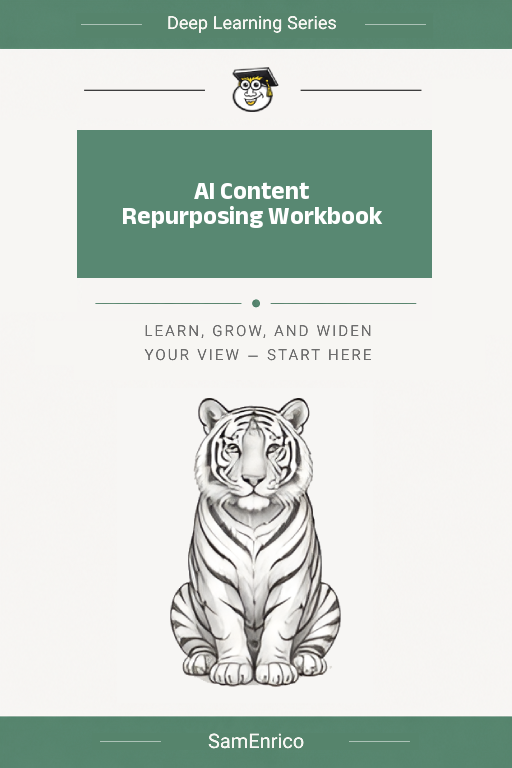
Non-FictionAI OperatorRepurposing
AI Content Repurposing Workbook eBook
Transform one piece of content into blog posts, em
Transform one piece of content into blog posts, emails, and social threads using AI.
Formats
Free sample
Chapter 1: The Spiral of More--–- You’re publishing more than ever. And getting less than you used to.The math doesn’t make sense. You wake up earlier. You prompt harder. You’ve got Chat GPT, Claude, and maybe two other AI tools open in tabs.
You’re feeding the beast every single day—threads, emails, Linked In posts, maybe a newsletter on Thursday.And yet the engagement line on your dashboard is flat. Sometimes it dips.You tell yourself it’s the algorithm. You tell yourself the platform changed again. You tell yourself you just need to post more. One more tweet.
One more carousel. One more “value bomb” email that nobody opens.This is the Spiral of More. It’s the most expensive trap in modern content creation, because it burns the one thing you cannot buy back: time.I’ve watched hundreds of creators, marketers, and agency owners fall into this spiral. They start with a piece of content—a good one, a deep one. A podcast episode they poured hours into.
A blog post that cost them real research. A webinar that got standing ovations internally.Then they publish it. It gets maybe a week of attention. And then it dies.So they create another piece. And another.
And another. Each one takes longer to write, because the well of ideas is running dry. Each one performs a little worse, because there’s no thread connecting them. Eventually, they’re working sixty hours a week and watching their analytics look like a EKG for a patient who’s given up.That was me, once.I remember sitting in front of a Google Doc at 11 PM on a Sunday, trying to write a Twitter thread about… I couldn’t even remember. Something about productivity.
Something about AI. My third cup of coffee had gone cold two hours ago. I had already published four pieces of content that week, and the only comment I got was from a bot selling SEO services.I asked myself: What if I stopped trying to do more? What if I did less—but deeper?That question changed everything.What you’re about to learn in this workbook is the opposite of what most AI content gurus teach. They’ll tell you to generate faster.
To use better prompts. To post at the perfect hour. They’re selling you a faster horse when what you actually need is a different vehicle entirely.You don’t need more content. You need a different relationship to the content you already have.The Mathematics of Burnout Let me show you the numbers that no one talks about.A typical creator spends:2 hours writing a Linked In post from scratch1.5 hours crafting a Twitter thread1 hour on a newsletter30 minutes on social captions for Instagram or Tik Tok That’s five hours for four pieces of content. And those pieces are disconnected.
Each one fights for attention on its own. Each one starts from zero. There’s no momentum from one to the next because there’s no shared spine.Now watch what happens when you reverse the process.Take that same five hours. Spend three hours creating one deep asset—a pillar page. A long-form blog post.
A detailed case study. A webinar. Something with real structure, real examples, real takeaways.Then spend two hours extracting and repurposing that pillar into:7 Twitter threads3 Linked In posts1 email newsletter5 Instagram captions2 You Tube Shorts scripts That’s eighteen pieces of content from the same five hours. And here’s the kicker: because they all share the same core insights, they reinforce each other. Someone sees your tweet, clicks through to the blog, then signs up for the email.
You’ve built a narrative ecosystem instead of a pile of unrelated posts.The math isn’t complicated. But it requires a shift that most creators never make: moving from horizontal thinking (more pieces) to vertical thinking (deeper structure).The 90% Lie That’s Costing You Everything Here’s a hard truth that the data backs up.In 2024, Buffer analyzed over 10,000 social media posts across fifty B2B brands. They looked at engagement rates, click-throughs, and share velocity. The finding was brutal: approximately 90% of repurposed content receives near-zero engagement (Buffer, 2024 State of Social Media Report).Ninety percent.Think about that. For every ten times you’ve taken an old blog post, changed the headline, and reposted it—nine of those efforts were essentially invisible.But here’s what the report also found.
The 10% that did work shared three characteristics:They came from a deep source. The original content had at least five unique insights, not just surface-level tips.They had a clear vector. Each piece was aimed at a specific platform with a specific job to do (not a one-size-fits-all repost).They fit an audience’s existing mental model. The repurposed content assumed prior context—it didn’t start from zero every time.The problem isn’t repurposing. The problem is shallow repurposing.
Spraying the same bland soup across every channel and hoping someone gets hungry.The solution is what I call The Iceberg Principle.The Iceberg Principle: What You See vs. What Works An iceberg floats with only ten percent of its mass above water. The other ninety percent is below the surface, invisible, doing the work of keeping the whole thing upright.Your content ecosystem works the same way.The visible ten percent is what your audience actually sees. Tweets. Linked In posts.
Emails. Reels. The front-facing content that lives in feeds and inboxes.The invisible ninety percent is everything that supports it. Raw transcripts. Full interview notes.
Data tables. Objection libraries. FAQ documents. Internal case studies. The messy, structural material that never gets published but makes the published material possible.Most creators try to build the visible ten percent without the invisible ninety.
They write a tweet about a concept they barely understand. They record a Reel without a script. They send an email that has no backbone.That’s why ninety percent of repurposed content fails. It’s not that the repurposing was done poorly. It’s that the original source was never deep enough to repurpose in the first place.The Iceberg Principle forces you to ask a different question.
Instead of “How do I get more content out faster?” you ask “What do I need to build below the surface so that the visible content is inevitable?”That shift—from output to infrastructure—is the entire point of this workbook.The Pillar Page: Your One True Source So what does the invisible ninety percent look like in practice?It starts with something I call a pillar page.A pillar page is a single piece of content that is intentionally designed to be deconstructed. It’s not just a blog post or a video. It’s a system disguised as a document.Here are the characteristics of a true pillar page:Length: Minimum 3,000 words or 45 minutes of audio/video. This isn’t about word count for its own sake. It’s about depth.
You need enough surface area to find the generative moments.Structure: It follows the SCR method (Situation → Complication → Resolution), which…
This is the end of the free sample. Get the eBook to keep going. Buy now
About this book
Details
- Author
- Mackey Tillie
- Publisher
- SamEnrico
- Language
- English
- Genre
- Non-Fiction, AI Operator, Repurposing
- Released
- 2026-06-01
- Pages (approx.)
- 144
- Available as
- eBook, Audiobook

Read better in the ZLOADR app
Your eBooks on your phone or tablet. Sign in with your SamEnrico account and start reading.
More by Mackey Tillie
 Child Loss Photography MemoryMackey Tillie$11.99
 Nipping Negotiation AnchorsMackey Tillie$11.99
 Daily Sobriety Maintenance ManualMackey Tillie$11.99
 HIIT Periodization GuideMackey Tillie$11.99
 Funeral Planning With PurposeMackey Tillie$11.99
 The Processing Speed BoosterMackey Tillie$11.99
 The Quiet Professional Confidence CourseMackey Tillie$11.99
 No Kids Divorce RecoveryMackey Tillie$11.99
 The Windward Crown: How the Dutch Ruled the WavesMackey Tillie$11.99
 The Storming of the Yuan: Kublai Khan's Last Stand at XiangyangMackey Tillie$11.99
 How to Produce Motor Vehicle TowingMackey Tillie$11.99
 How to Produce Laser EquipmentMackey Tillie$11.99
You may also like
 Hong Kong Handover 1997Dunn Johnnie$11.99
 Zumba For Postnatal Recovery CourseNeal Christian$11.99
 Zumba for BeginnersLadner Nikia$11.99
 YouTube Comment Mining GuideHumes Pandora$12.99
 Worry Box MeditationCarlin Rudy$11.99
 Workplace Stress MeditationNguyen Lynn$11.99
 Workplace Stress and Sleep RepairHawley Ivory$11.99
 Workplace Perfectionism CureDelaney Jeffry$11.99
 Workplace Injustice Anger GuideWallen Isabelle$11.99
 Work Addiction and Burnout LinkGreenwood Ester$11.99
 Women in Yoga and WellnessBeattie Galina$11.99
 Women in Stand Up ComedyChun Evangeline$11.99