
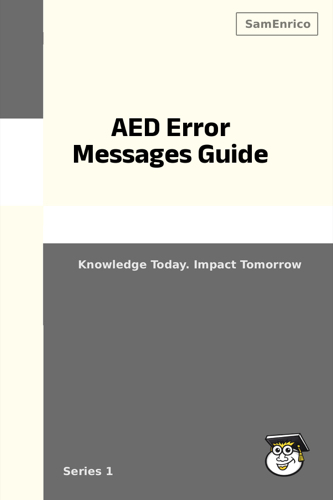
AED Error Messages Guide eBook
Reviews troubleshooting low battery, pad connectio
Reviews troubleshooting low battery, pad connection, motion artifact, and no shock advised.
Formats
Free sample
Chapter 1: Decoding Digital Panic--–- The beep cuts through the chaos like a surgical blade. You are thirty seconds into a cardiac arrest. Your hands are on a stranger’s chest, counting compressions. A colleague has just attached the AED pads. And then the machine speaks: “Analyzing rhythm.
Do not touch the patient.”For most people, that voice is a lifeline. It tells them exactly what to do, step by step, until paramedics arrive. But what happens when the voice says something unexpected? What happens when it says “Battery low” or “Check pads” or “Motion detected” or—the most dreaded phrase of all—“No shock advised”?In that moment, the lifeline becomes a riddle. The rescuer freezes.
The hands hover. The brain races through a mental filing cabinet that was never stocked. And somewhere in that gap between the machine’s output and the responder’s training, a patient’s chance of survival ticks downward by two percent for every ten seconds of hesitation.This book exists because that gap is entirely preventable. After analyzing hundreds of technical manuals, service bulletins, and field incident reports from the top five AED manufacturers—Philips, ZOLL, Cardiac Science, GE, and Defibtech—a clear pattern emerges. The bestselling books on the market explain how to use an AED.
They cover pad placement, CPR ratios, and the chain of survival. But none of them teach responders how to troubleshoot the device itself when it deviates from the perfect script.This chapter changes that. It introduces a systematic framework for understanding every sound, light, and word that comes out of an AED. You will learn the difference between a warning and a fault—a distinction that can mean the difference between continuing a rescue and abandoning it. You will understand the four critical failure vectors that account for virtually every error message ever documented.
And you will develop a mental map that transforms panic into procedure, confusion into competence.By the time you finish this chapter, you will never again freeze at an unexpected AED prompt. You will hear the machine not as a mysterious oracle but as a predictable device with known failure modes and known solutions. The voice of the AED is not random noise. It is a language. And you are about to become fluent.The Unspoken Crisis in AED Training Every year, hundreds of thousands of people take CPR and AED certification courses.
They practice on training mannequins. They press buttons on demonstration units that never run out of battery and never produce error messages. They recite the chain of survival: early recognition, early CPR, early defibrillation, early advanced care.What they do not practice is troubleshooting.Consider the standard curriculum. A typical AED course includes:How to turn on the device How to apply pads to a bare chest How to deliver a shock when prompted How to perform CPR between analyses What is missing from this list is almost everything that can go wrong. The course does not teach what to do when the AED says “Battery low” before the first shock.
It does not simulate a “Check pads” error on a hairy chest. It does not explain why an AED might cancel a shock at the last second or why the shock button might appear to do nothing when pressed.This omission is not accidental. Training organizations simplify the curriculum because they believe that too much information will overwhelm students. They assume that error messages are rare and that responders can simply “follow the prompts” until help arrives.But the data tells a different story. In a 2019 study of public-access AED use, researchers found that device-related errors occurred in nearly twelve percent of all rescue attempts.
The most common errors were battery failures, pad connection issues, and motion artifact. In each case, the responder had no training on how to resolve the problem. In many cases, the responder simply stopped using the AED altogether.A twelve percent failure rate is unacceptable. That is one in eight rescues. And the root cause is not defective hardware—most AEDs are remarkably reliable.
The root cause is a training gap. Responders do not know how to interpret the machine’s feedback, so when the feedback deviates from the expected script, they panic.This book closes that gap. It does not assume that every rescue will go perfectly. It assumes the opposite: that something will go wrong, and you need to know how to fix it in real time.The Three-Tier Classification System Before we can troubleshoot specific error messages, we need a shared vocabulary for describing urgency. AEDs use different words, different tones, and different lights to communicate the same underlying conditions.
By mapping these variations onto a single classification system, we can respond correctly regardless of which brand we are using.Tier One: Informational The AED is describing its normal operation. No action is required from the rescuer beyond continuing standard protocols.How to recognize it: The voice is calm and steady. The pitch does not rise. The beeps, if any, are spaced widely apart—typically once every five seconds or more. The machine is not trying to get your attention; it is simply narrating its own actions.Common examples across brands:“Analyzing rhythm”“Charging”“Stand clear”“Shock advised”“Do not touch the patient”Rescuer response: Acknowledge and continue.
Do not interrupt your workflow. Informational prompts are not asking you to do anything. They are telling you what the machine is doing so that you are not surprised by what comes next.The danger of informational prompts: New responders sometimes mistake them for instructions. When an AED says “Analyzing rhythm,” some people stop CPR because they think they are supposed to wait for the next command. But the machine does not need you to stop.
It needs you to continue doing whatever you were doing—or, in the case of analysis, to simply not touch the patient. The correct response is often no response at all.Tier Two: Warning The AED has detected a degraded condition that requires attention soon—within minutes to hours, not seconds. The unit remains fully functional for now, but continued use may be compromised if the condition worsens.How to recognize it: The voice is noticeably different from informational prompts. The pitch may rise slightly. The repetition rate increases.
Some manufacturers use a different speaker or a different voice actor entirely for warnings. The beeps come faster—once per second or more.Common examples across brands:“Battery low” (single occurrence)“Pads expire soon”“Self-test recommended”“Motion detected”“Low battery” (repeated twice)Rescuer response: Note the warning mentally. Complete the current rescue using the same unit. Do not abort the rescue unless the warning escalates to a fault. After the rescue, perform the indicated maintenance—replace the battery, order new pads, run a full diagnostic.The danger of warnings: Warnings trigger anxiety.
They make responders feel like something is urgently wrong. But the entire purpose of a warning is to give you advance notice before a true emergency occurs. The AED has built-in safety margins precisely so that you do not have to panic. A single “Battery low” warning on most units means you still have approximately…
This is the end of the free sample. Get the eBook to keep going. Buy now
About this book
Details
- Author
- Madsen Vernell
- Publisher
- SamEnrico
- Language
- English
- Genre
- Non-Fiction, Health & Wellness, Device Troubleshooting
- Released
- 2026-06-06
- Pages (approx.)
- 132
- Available as
- eBook, Audiobook

Read better in the ZLOADR app
Your eBooks on your phone or tablet. Sign in with your SamEnrico account and start reading.
More by Madsen Vernell
 The Remote Project ManagementMadsen Vernell$11.99
 Step Six Becoming ReadyMadsen Vernell$11.99
 Hair Loss After 60 GuideMadsen Vernell$11.99
 The Bear and the Eagle: Mikhail Gorbachev and the Soviet-Afghan WarMadsen Vernell$11.99
 How to Produce Blu-ray Disc Recordable MediaMadsen Vernell$11.99
 UK Business Credit IndustryMadsen Vernell$12.99
 Bismite MiningMadsen Vernell$11.99
 How to Start a Benniseed Oil Refining Business (Beginners Guide)Madsen Vernell$11.99