
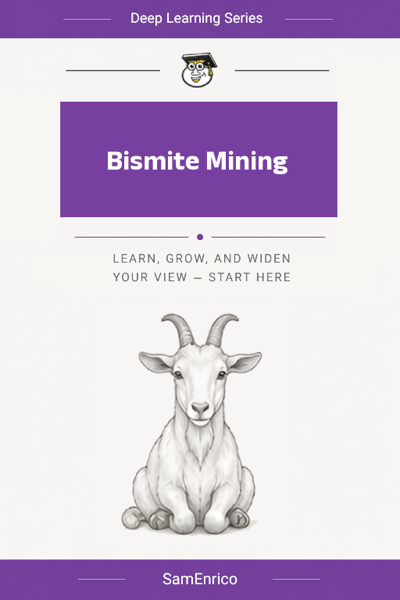
Bismite Mining
A Coursebook on Bismite Mining
A Coursebook on Bismite Mining
Formats
About this book
Free sample
Chapter 1: The Yellow Earth...--The first mistake a prospector makes is walking past the yellow stain. They are looking for glitter—gold, silver, the flash of native copper. But bismuth, in its oxidized form as bismite, does not glitter. It stains. It leaves a pale yellow to greenish-yellow smear on fractured rock surfaces, like a mineral bruise.
That bruise, ignored by generations of miners chasing brighter metals, is the signature of one of the most chemically fascinating and commercially strategic metals on the periodic table. Understanding that yellow earth—what it is, where it came from, and why it matters—is the first step in becoming not just a miner, but a bismite specialist.This chapter establishes the foundational identity of bismite as both a mineral species and an economic commodity. It is not merely a catalog of physical properties. Rather, it is an origin story. We will trace bismuth from its accidental use by pre-Columbian metallurgists through its misidentification as tin or lead in medieval Europe, to its modern recognition as the "green" metal replacing lead in everything from shotgun shells to children's medicine.
We will define bismite (Bi₂O₃) with rigorous mineralogical precision: its crystal structures, its physical properties, and its paragenesis—the sequence of events that creates an economic concentration. Most critically, this chapter will distinguish bismite from its close relatives: native bismuth (the metallic form) and bismuthinite (the sulfide). These distinctions are not academic; they determine every subsequent decision in mining, processing, and marketing. A deposit of native bismuth requires a different extraction strategy than a deposit of bismite. A miner who cannot tell them apart in the field will lose money before the first tonne is crushed.Finally, we will survey the global geography of bismite deposits, from the high-altitude veins of Bolivia's Tasna district to the weathered granites of Australia's Mole River, from the tungsten skarns of China's Hunan Province to the by-product streams of Mexican lead smelters.
Along the way, we will establish the economic language of the trade: cutoff grades, tonnage thresholds, and the critical distinction between primary bismite mines and by-product…
This is the end of the free sample. Get the eBook to keep going. Buy now
Contents
- Chapter 1
- Chapter 2
- Chapter 3
- Chapter 4
- Chapter 5
- Chapter 6
- Chapter 7
- Chapter 8
- Chapter 9
- Chapter 10
- Chapter 11
- Chapter 12
Details
- Author
- Madsen Vernell
- Publisher
- SamEnrico
- Language
- English
- Genre
- Non-Fiction, Informative, Educational
- Released
- 2026-05-25
- Pages (approx.)
- 160
- Available as
- eBook, Audiobook

Read better in the ZLOADR app
Your eBooks on your phone or tablet. Sign in with your SamEnrico account and start reading.
More by Madsen Vernell
 The Remote Project ManagementMadsen Vernell$11.99
 Step Six Becoming ReadyMadsen Vernell$11.99
 Hair Loss After 60 GuideMadsen Vernell$11.99
 AED Error Messages GuideMadsen Vernell$11.99
 The Bear and the Eagle: Mikhail Gorbachev and the Soviet-Afghan WarMadsen Vernell$11.99
 How to Produce Blu-ray Disc Recordable MediaMadsen Vernell$11.99
 UK Business Credit IndustryMadsen Vernell$12.99
 How to Start a Benniseed Oil Refining Business (Beginners Guide)Madsen Vernell$11.99