
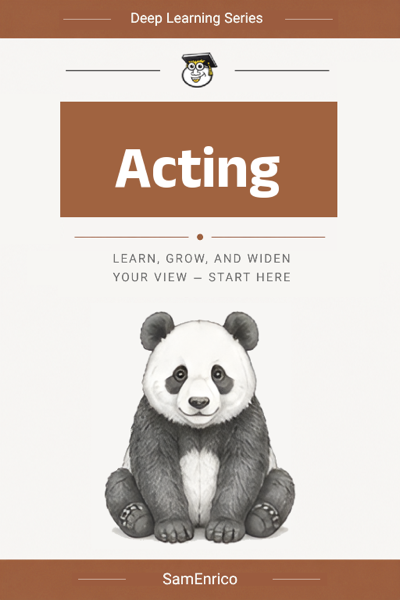
Acting eBook
A Coursebook on Acting
A Coursebook on Acting
Formats
Free sample
Chapter 1: The Six Silent Strings--– In the winter of 1906, a forty-three-year-old actor and director named Konstantin Stanislavski sat in a rehearsal room outside Moscow, watching a student perform a death scene. The student sobbed. He clutched his chest. His voice cracked with anguish. It was, by any conventional measure, a very emotional performance.
And Stanislavski hated it. Not because it was insincere—the student was genuinely trying—but because the emotion was the target. The student had set out to play sadness, and in doing so, he had produced something that looked like sadness but felt like nothing at all. It was acting about acting. It was a photograph of a feeling, not the feeling itself.That moment of disappointment sparked a revolution.
Over the next thirty years, Stanislavski would develop the first systematic, repeatable approach to actor training in the history of Western theater. He asked a question that seems obvious only after someone asks it: What if an actor could learn to produce truth on command, the way a pianist learns to produce a C-major scale? What if inspiration was not a bolt of lightning but a garden that could be cultivated?The answer became the foundation of every acting technique taught today. But somewhere on the journey from Moscow to Broadway, from Broadway to Hollywood, the original insights got scrambled. Stanislavski's system splintered into warring camps.
Strasberg claimed the emotional memory. Adler claimed the imagination. Meisner claimed the moment-to-moment reality. And the beginning actor, standing at the crossroads of these competing orthodoxies, was told to choose a religion.This book refuses that choice. And this chapter begins where every actor must begin: not with a method, not with a guru, but with the silent skills that underlie all methods.
Call them the operating system of the actor's instrument. Call them the strings that must be tuned before any music can be played.They come from Richard Boleslavsky, a student of Stanislavski who brought the first wave of Russian technique to America. In 1933, Boleslavsky published a slim, strange, brilliant book called The First Six Lessons. It is written as a dialogue between an old actor (the teacher) and a young woman (the student). It is deceptively simple.
And almost every actor who has become famous in the past ninety years has absorbed its lessons, often without knowing it.This chapter renames those six lessons, updates them for the twenty-first-century actor working in film, television, stage, and voiceover, and adds a seventh that Boleslavsky implied but never named. They are not exercises to be completed and checked off. They are not a syllabus. They are muscles. You will train them for the rest of your career, or you will watch other actors get the roles you wanted.Here is the truth that separates professionals from amateurs: the amateur waits for inspiration.
The professional builds the conditions for inspiration to arrive. These six silent strings are those conditions.The First String: Concentration The first lesson Boleslavsky teaches his young student is also the most boring to read about and the most brutal to practice. Concentration is not about trying hard. It is not about furrowing your brow and staring at an object. Concentration, in the actor's sense, is the ability to place your attention on an imaginary circumstance and keep it there while the real world—with its buzzing lights, coughing audience members, ringing phones, and your own screaming insecurities—tries to drag it away.Think of a child playing alone in a room.
The child is not pretending to be a astronaut. The child is an astronaut. The cardboard box is not a cardboard box. It is a spaceship. The family cat is not a cat.
It is an alien. The child's concentration is so complete that you could walk into the room, wave your hand in front of their face, and they would not notice you. That is not "focus" as adults use the word—a grim, teeth-clenched effort. That is absorption. That is the state where the imaginary becomes more real than the real.Most actors lose this capacity somewhere between childhood and drama school.
They replace absorption with effort. They replace "the imaginary object is real" with "I must look like I believe the imaginary object is real." The difference is everything.Here is the practical exercise that separates actors who work from actors who wait tables forever. Take an object. Any object. A pencil.
A coffee cup. A single earring. Spend five minutes observing it. Not thinking about it. Not narrating its history in your head.
Observing it. The weight of it in your hand. The temperature of the metal or wood. The way the light catches the edge. The tiny scratches that you have never noticed before.
Now close your eyes. Hold the object behind your back. Recreate it in your imagination with such specific sensory intensity that you could draw it from memory. Now open your eyes. Look at the object again.
Notice what you missed.Do this every day for a week. Then do it with an object that is not there. Hold an imaginary coffee cup. Feel its weight. Feel the heat of the coffee through the ceramic.
Smell the coffee. Now set it down on an imaginary table. Hear the sound it makes. This is not a meditation exercise. This is a rehearsal for acting.
Because on stage or on camera, almost everything you interact with will be imaginary. The coffee cup will not be there. The letter you are reading will be blank paper. The person you are talking to will be a production assistant holding a piece of tape where their eyes should be. And you must see the coffee cup anyway.
You must smell the coffee anyway. You must feel the weight of the letter as if it carried news that changes your life.The greatest screen actors—Meryl Streep, Daniel Day-Lewis, Viola Davis—all describe the same experience when they are working. They are not "trying to act." They are seeing things that are not there. The camera captures that seeing. The audience feels it.
That is concentration. It is not effort. It is the opposite of effort. It is surrender to the imaginary.The Second String: Memory of Emotion (Reframed and Safe)Boleslavsky's second lesson has been more misunderstood, more weaponized, and more dangerous than any other concept in actor training. He called it "memory of emotion." Strasberg called it "affective memory." And for decades, well-meaning teachers have encouraged students to dig up their most painful personal traumas—the death of a parent, a childhood assault, a devastating rejection—and use those memories to fuel performances.
This is not acting. This is psychological self-harm. And it is completely unnecessary.Here is what Boleslavsky actually meant. He noticed that when actors tried to "play sad," they produced fake sadness. But when actors remembered a specific sensory detail from a time they felt sad—the weight of a winter coat, the smell of rain on pavement, the particular gray light of a Tuesday afternoon—the emotion emerged on its own, without being forced.
The sensory detail was the key. The emotion was the byproduct.This is the distinction that changes everything. You do not…
This is the end of the free sample. Get the eBook to keep going. Buy now
About this book
Details
- Author
- Blodgett Loise
- Publisher
- SamEnrico
- Language
- English
- Genre
- Non-Fiction, Informative, Educational
- Released
- 2026-05-18
- Pages (approx.)
- 148
- Available as
- eBook, Audiobook

Read better in the ZLOADR app
Your eBooks on your phone or tablet. Sign in with your SamEnrico account and start reading.
More by Blodgett Loise
 Note Taking Systems GuideBlodgett Loise$11.99
 Slot Machine Addiction ScienceBlodgett Loise$11.99
 Cognitive Restructuring GuideBlodgett Loise$11.99
 Relapse Prevention Motivation InterviewingBlodgett Loise$11.99
 Financial Neglect Childhood GuideBlodgett Loise$11.99
 B-17 Flying Fortress Defensive ArmamentBlodgett Loise$11.99
 Meth Overdose Survivor's TaleBlodgett Loise$11.99
 Delayed Sleep Phase Disorder GuideBlodgett Loise$11.99
 Resentment Toward WealthyBlodgett Loise$11.99
 The Timbuktu Timekeepers: Mathematicians Who Calculated the CosmosBlodgett Loise$11.99
 The Amber Road: Prehistoric Resin and the Birth of Trade in the AmazonBlodgett Loise$11.99
 The Silk and the Spy: A Love That Defied EmpiresBlodgett Loise$11.99