
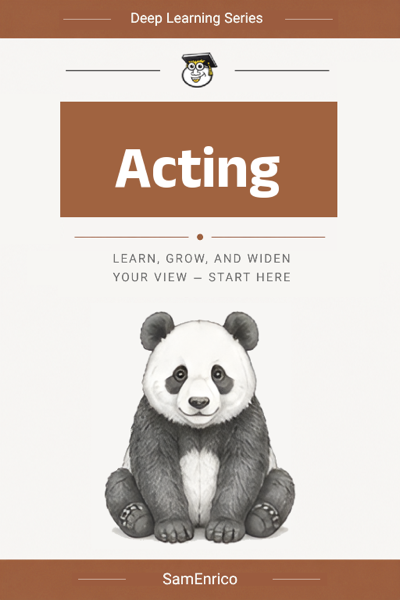
About this book
Free sample
Chapter 1: The Six Silent Strings--– In the winter of 1906, a forty-three-year-old actor and director named Konstantin Stanislavski sat in a rehearsal room outside Moscow, watching a student perform a death scene. The student sobbed. He clutched his chest. His voice cracked with anguish. It was, by any conventional measure, a very emotional performance.
And Stanislavski hated it. Not because it was insincere—the student was genuinely trying—but because the emotion was the target. The student had set out to play sadness, and in doing so, he had produced something that looked like sadness but felt like nothing at all. It was acting about acting. It was a photograph of a feeling, not the feeling itself.That moment of disappointment sparked a revolution.
Over the next thirty years, Stanislavski would develop the first systematic, repeatable approach to actor training in the history of Western theater. He asked a question that seems obvious only after someone asks it: What if an actor could learn to produce truth on command, the way a pianist learns to produce a C-major scale? What if inspiration was not a bolt of lightning but a garden that could be cultivated?The answer became the foundation of every acting technique taught today. But somewhere on the journey from Moscow to Broadway, from Broadway to Hollywood, the original insights got scrambled. Stanislavski's system splintered into warring camps.
Strasberg claimed the emotional memory. Adler claimed the imagination. Meisner claimed the moment-to-moment reality. And the beginning actor, standing at the crossroads of these competing orthodoxies, was told to choose a religion.This book refuses that choice. And this chapter begins where every actor must begin: not with a method, not with a guru, but with the silent skills that underlie all methods.
Call them the operating system of the actor's instrument. Call them the strings that must be tuned before any music can be played.They come from Richard Boleslavsky, a student of Stanislavski who brought the first wave of Russian technique to America. In 1933, Boleslavsky published a slim, strange, brilliant book called The First Six Lessons. It is written…
This is the end of the free sample. Get the eBook to keep going. Buy now
Contents
- Chapter 1
- Chapter 2
- Chapter 3
- Chapter 4
- Chapter 5
- Chapter 6
- Chapter 7
- Chapter 8
- Chapter 9
- Chapter 10
- Chapter 11
- Chapter 12
Details
- Author
- Blodgett Loise
- Publisher
- SamEnrico
- Language
- English
- Genre
- Non-Fiction, Informative, Educational
- Released
- 2026-05-18
- Pages (approx.)
- 148
- Available as
- eBook, Audiobook

Read better in the ZLOADR app
Your eBooks on your phone or tablet. Sign in with your SamEnrico account and start reading.
More by Blodgett Loise
 Note Taking Systems GuideBlodgett Loise$11.99
 Slot Machine Addiction ScienceBlodgett Loise$11.99
 Cognitive Restructuring GuideBlodgett Loise$11.99
 Relapse Prevention Motivation InterviewingBlodgett Loise$11.99
 Financial Neglect Childhood GuideBlodgett Loise$11.99
 B-17 Flying Fortress Defensive ArmamentBlodgett Loise$11.99
 Meth Overdose Survivor's TaleBlodgett Loise$11.99
 Delayed Sleep Phase Disorder GuideBlodgett Loise$11.99
 Resentment Toward WealthyBlodgett Loise$11.99
 The Timbuktu Timekeepers: Mathematicians Who Calculated the CosmosBlodgett Loise$11.99
 The Amber Road: Prehistoric Resin and the Birth of Trade in the AmazonBlodgett Loise$11.99
 The Silk and the Spy: A Love That Defied EmpiresBlodgett Loise$11.99