
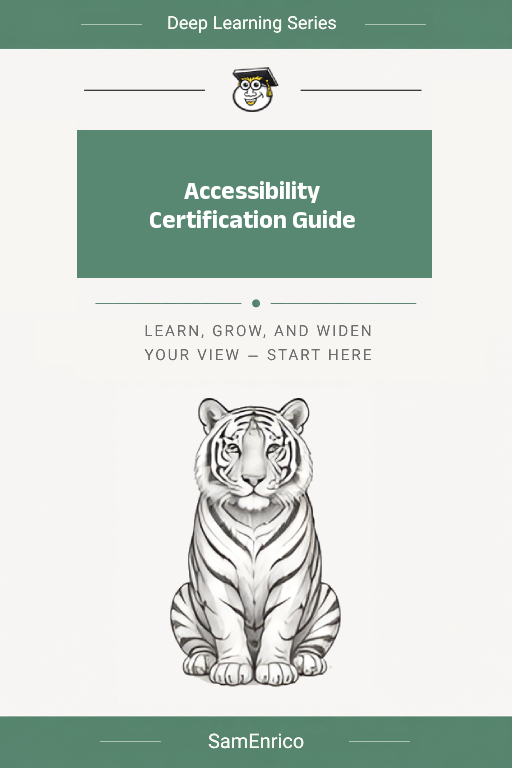
Accessibility Certification Guide eBook
Earn IAAP CPACC credential for accessibility speci
Earn IAAP CPACC credential for accessibility specialist roles at tech companies and government.
Formats
Free sample
Chapter 1: Beyond the Medical Chart...--Imagine you are standing in a corporate boardroom. On the screen is a proposal for a new software product. The project manager has just finished explaining the timeline, the budget, and the feature set. Then someone asks, "What about accessibility?" The room goes quiet. Someone else says, "We'll handle accommodations if any disabled employees need them." Another person adds, "Our legal team said we're fine as long as we don't discriminate." Heads nod.
The presentation continues.Everything about that response—the language, the assumptions, the implied solution—reveals a deeply embedded way of thinking about disability. And that way of thinking, known as the Medical Model, is precisely what the CPACC exam expects you to recognize as insufficient for professional accessibility work. More importantly, it is what your future employers in tech and government expect you to move beyond.This chapter is not a dry taxonomy of academic theories. It is the foundation upon which every accessibility decision you will ever make as a certified professional rests. The models of disability discussed here are not abstract concepts to memorize for a multiple-choice question and then forget.
They are lenses through which you will analyze policies, evaluate designs, advise executives, and defend your recommendations. Choose the wrong lens, and your solution will fail. Choose the right one, and you will remove barriers that have existed for decades.The CPACC exam tests these models extensively, but not by asking you to recite definitions. Instead, you will encounter scenario questions where the correct answer depends entirely on recognizing which model is implicitly operating in a given situation. A policy that requires disabled employees to provide medical documentation for every accommodation request?
That is the Medical Model. A city that installs ramps at all crosswalks without waiting for individual complaints? That is the Social Model. A workplace that offers both physical therapy (Medical) and ergonomic workstations (Social)? That is the Biopsychosocial Model.By the end of this chapter, you will not only be able to identify each model on the exam.
You will be able to articulate why the Social Model has become the professional standard, why the Medical Model still has legitimate applications in specific contexts, and how the most sophisticated accessibility professionals integrate multiple models to solve real-world problems. You will also understand why the language you use—person-first versus identity-first, "wheelchair user" versus "confined to a wheelchair"—signals your professional competency or lack thereof.Let us begin with the model that most people unknowingly carry in their heads, the one that has caused more harm than any other, and the one you must learn to recognize instantly on the exam.The Medical Model: Disability as Defect The Medical Model of disability is exactly what it sounds like. It views disability as an individual medical problem—a defect, a disease, an impairment, or a pathology that resides within the person's body or mind. Under this model, the disabled person is sick, broken, or incomplete. The solution, therefore, is medical intervention: treatment, cure, rehabilitation, or institutional care.
The goal is to fix the person so they can function as normally as possible.Consider a simple example. A wheelchair user approaches a building with a flight of stairs at the entrance. Under the Medical Model, the problem is located in the wheelchair user's legs. They cannot climb stairs because their legs do not work properly. The solution, therefore, is medical: physical therapy to strengthen the legs, surgery to correct the underlying condition, or a prosthetic device that enables stair climbing.
If none of those options succeed, the person is simply out of luck. They should perhaps seek care at a medical facility rather than attempting to enter a building clearly not designed for them.This may sound absurd when stated so bluntly. But the Medical Model operates subtly, embedded in policies, language, and assumptions that you encounter every day. When an employer requires a disabled employee to provide a doctor's note for every accommodation request, that is the Medical Model. When a school places a disabled student in a separate classroom because they are "too difficult to include," that is the Medical Model.
When a government benefits program requires a medical determination of disability before providing any support, that is the Medical Model. When someone says, "I don't see you as disabled," intending it as a compliment, that is the Medical Model treating disability as something shameful to be overlooked.The Medical Model is not entirely without value. It has driven medical research that has improved the lives of countless people. It has created rehabilitation services, assistive technology, and medical treatments that genuinely help. The problem is not that the Medical Model exists.
The problem is that it has historically been the only model, and it places the entire burden of adaptation on the disabled individual while absolving society of any responsibility to remove barriers.On the CPACC exam, you will encounter Medical Model questions in several forms. You might see a scenario where an employer's accommodation policy is described, and you must identify the underlying model. The distractor answers will often include attractive options that sound reasonable but are rooted in the Medical Model. For example, a question might describe a workplace where an employee with anxiety requests a quiet workspace. The Medical Model answer would be "Provide counseling or medication to manage the anxiety." The Social Model answer would be "Modify the physical workspace to reduce noise and interruptions." Both could help the employee.
The exam expects the Social Model answer as the professional accessibility standard.You might also see a question where the Medical Model's strengths are also its weaknesses. For instance, in a clinical rehabilitation setting, the Medical Model is entirely appropriate. A patient recovering from a spinal cord injury needs medical treatment, physical therapy, and rehabilitation. The exam will test your ability to recognize that the Medical Model has contextual legitimacy, not that it is always wrong. The key is to identify when a scenario calls for a medical approach (rare in accessibility governance) versus a social or systemic approach (common in tech and government roles).The Social Model: Barriers, Not Bodies If the Medical Model places disability inside the individual, the Social Model places it outside, in the environment.
The Social Model, developed by disabled activists and scholars in the 1970s and 1980s, particularly through the Union of the Physically Impaired Against Segregation in the United Kingdom, makes a radical shift. It argues that people are disabled not by their impairments but by societal barriers—physical, attitudinal, communication, and systemic.Let us return to the wheelchair user and the stairs. Under the Social Model, the wheelchair user's impairment is the fact that they use a wheelchair. That impairment does not inherently disable them. What disables them is a society that builds stairs instead of ramps.
If the building had a ramp, automatic doors, and an elevator, the wheelchair user would have no difficulty entering. The problem is not the person's body. The problem is the architect's failure to design inclusively.Now apply this to other contexts. A blind person is not disabled by their lack of sight. They are disabled by websites that are…
This is the end of the free sample. Get the eBook to keep going. Buy now
About this book
Details
- Author
- Croteau Neomi
- Publisher
- SamEnrico
- Language
- English
- Genre
- Non-Fiction, Student's Shortcut
- Released
- 2026-06-01
- Pages (approx.)
- 150
- Available as
- eBook, Audiobook

Read better in the ZLOADR app
Your eBooks on your phone or tablet. Sign in with your SamEnrico account and start reading.
More by Croteau Neomi
 Benzo Taper Symptoms JournalCroteau Neomi$11.99
 Stillbirth Complicated Grief GuideCroteau Neomi$11.99
 Managing Remote Work InterruptionsCroteau Neomi$11.99
 Snowfall Silence VisualizationCroteau Neomi$11.99
 The CEO Nap MorningCroteau Neomi$11.99
 Office Building Valuation ManualCroteau Neomi$11.99
 NVC For Performance ReviewsCroteau Neomi$11.99
 Student Study Block GuideCroteau Neomi$11.99
 Memory for TradingCroteau Neomi$11.99
 Crowns and Controversy: The Unconventional Wedding of King Carl XVI Gustaf and Silvia SommerlathCroteau Neomi$11.99
 The Deep Blue Equation: Chandrasekhar and the Pulsar RevolutionCroteau Neomi$11.99
 Love and Gunpowder: The Siege of SeringapatamCroteau Neomi$11.99
You may also like
 Hong Kong Handover 1997Dunn Johnnie$11.99
 Zumba For Postnatal Recovery CourseNeal Christian$11.99
 Zumba for BeginnersLadner Nikia$11.99
 YouTube Comment Mining GuideHumes Pandora$12.99
 Worry Box MeditationCarlin Rudy$11.99
 Workplace Stress MeditationNguyen Lynn$11.99
 Workplace Stress and Sleep RepairHawley Ivory$11.99
 Workplace Perfectionism CureDelaney Jeffry$11.99
 Workplace Injustice Anger GuideWallen Isabelle$11.99
 Work Addiction and Burnout LinkGreenwood Ester$11.99
 Women in Yoga and WellnessBeattie Galina$11.99
 Women in Stand Up ComedyChun Evangeline$11.99