
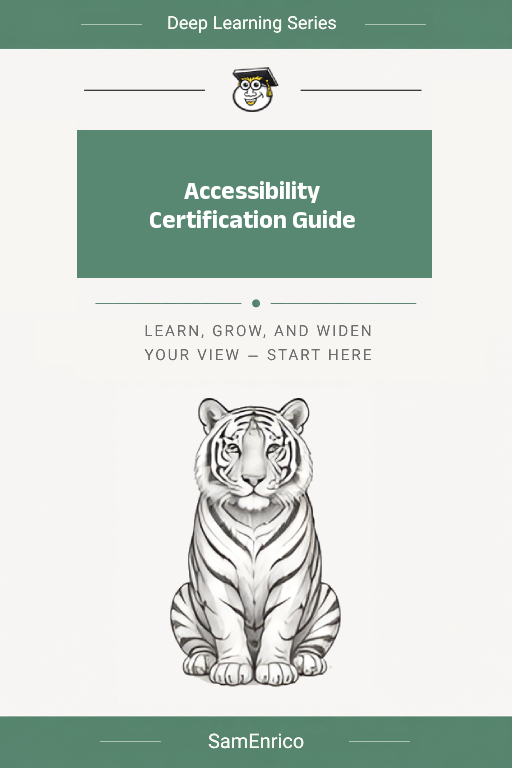
Accessibility Certification Guide
Earn IAAP CPACC credential for accessibility speci
Earn IAAP CPACC credential for accessibility specialist roles at tech companies and government.
Formats
About this book
Free sample
Chapter 1: Beyond the Medical Chart...--Imagine you are standing in a corporate boardroom. On the screen is a proposal for a new software product. The project manager has just finished explaining the timeline, the budget, and the feature set. Then someone asks, "What about accessibility?" The room goes quiet. Someone else says, "We'll handle accommodations if any disabled employees need them." Another person adds, "Our legal team said we're fine as long as we don't discriminate." Heads nod.
The presentation continues.Everything about that response—the language, the assumptions, the implied solution—reveals a deeply embedded way of thinking about disability. And that way of thinking, known as the Medical Model, is precisely what the CPACC exam expects you to recognize as insufficient for professional accessibility work. More importantly, it is what your future employers in tech and government expect you to move beyond.This chapter is not a dry taxonomy of academic theories. It is the foundation upon which every accessibility decision you will ever make as a certified professional rests. The models of disability discussed here are not abstract concepts to memorize for a multiple-choice question and then forget.
They are lenses through which you will analyze policies, evaluate designs, advise executives, and defend your recommendations. Choose the wrong lens, and your solution will fail. Choose the right one, and you will remove barriers that have existed for decades.The CPACC exam tests these models extensively, but not by asking you to recite definitions. Instead, you will encounter scenario questions where the correct answer depends entirely on recognizing which model is implicitly operating in a given situation. A policy that requires disabled employees to provide medical documentation for every accommodation request?
That is the Medical Model. A city that installs ramps at all crosswalks without waiting for individual complaints? That is the Social Model. A workplace that offers both physical therapy (Medical) and ergonomic workstations (Social)? That is the Biopsychosocial Model.By the end of this chapter, you will not only be able to identify each model on the exam.
You will be able to articulate why the Social Model has become the professional standard, why the Medical Model still…
This is the end of the free sample. Get the eBook to keep going. Buy now
Contents
- Chapter 1
- Chapter 2
- Chapter 3
- Chapter 4
- Chapter 5
- Chapter 6
- Chapter 7
- Chapter 8
- Chapter 9
- Chapter 10
- Chapter 11
- Chapter 12
Details
- Author
- Croteau Neomi
- Publisher
- SamEnrico
- Language
- English
- Genre
- Non-Fiction, Student's Shortcut
- Released
- 2026-06-01
- Pages (approx.)
- 150
- Available as
- eBook, Audiobook

Read better in the ZLOADR app
Your eBooks on your phone or tablet. Sign in with your SamEnrico account and start reading.
More by Croteau Neomi
 Benzo Taper Symptoms JournalCroteau Neomi$11.99
 Stillbirth Complicated Grief GuideCroteau Neomi$11.99
 Managing Remote Work InterruptionsCroteau Neomi$11.99
 Snowfall Silence VisualizationCroteau Neomi$11.99
 The CEO Nap MorningCroteau Neomi$11.99
 Office Building Valuation ManualCroteau Neomi$11.99
 NVC For Performance ReviewsCroteau Neomi$11.99
 Student Study Block GuideCroteau Neomi$11.99
 Memory for TradingCroteau Neomi$11.99
 Crowns and Controversy: The Unconventional Wedding of King Carl XVI Gustaf and Silvia SommerlathCroteau Neomi$11.99
 The Deep Blue Equation: Chandrasekhar and the Pulsar RevolutionCroteau Neomi$11.99
 Love and Gunpowder: The Siege of SeringapatamCroteau Neomi$11.99
You may also like
 Hong Kong Handover 1997Dunn Johnnie$11.99
 Zumba For Postnatal Recovery CourseNeal Christian$11.99
 Zumba for BeginnersLadner Nikia$11.99
 YouTube Comment Mining GuideHumes Pandora$12.99
 Worry Box MeditationCarlin Rudy$11.99
 Workplace Stress MeditationNguyen Lynn$11.99
 Workplace Stress and Sleep RepairHawley Ivory$11.99
 Workplace Perfectionism CureDelaney Jeffry$11.99
 Workplace Injustice Anger GuideWallen Isabelle$11.99
 Work Addiction and Burnout LinkGreenwood Ester$11.99
 Women in Yoga and WellnessBeattie Galina$11.99
 Women in Stand Up ComedyChun Evangeline$11.99