
Non-FictionHealth & WellnessSpecial Needs
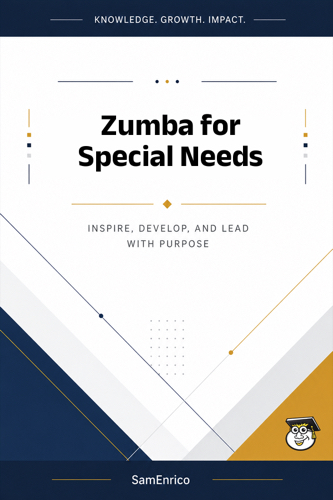
Zumba for Special Needs eBook
Adaptive dance fitness for individuals with develo
Adaptive dance fitness for individuals with developmental disabilities.
Formats
Free sample
Chapter 1: The Sensory Key...–- It was a Tuesday afternoon in a fluorescent-lit community center, and Maria had given up hope. Her son, Leo, then seven years old and diagnosed with severe autism spectrum disorder, had not made eye contact with her in eleven months. He spent his days spinning the wheels of a toy dump truck, watching the motion blur into a silver circle, rocking on his heels when the world became too loud. They had tried speech therapy (Leo remained non-verbal), occupational therapy (he tolerated the brush but hated the swing), and applied behavior analysis (he learned to sit still but his anxiety skyrocketed). Then, on a desperate whim—because the babysitter cancelled and the YMCA had free childcare—Maria walked into a Zumba class.
She sat Leo in the corner with his tablet, hoping he would not melt down. Ninety seconds into the first song, something shifted. A reggaeton bass dropped. The floor vibrated. Leo looked up.
His foot tapped once. Then twice. Then he stood up. By the end of the song, he was swaying—not in the frantic, self-stimulatory way that worried his therapists, but in time with the beat, in sync with the dozen other bodies in the room. Maria started crying.
She did not know why. This book is the answer to that question.The Broken Model: Why Traditional Exercise Fails Special Populations For decades, the fitness industry has operated on a simple, seductive premise: calories in, calories out. Move your body, burn energy, lose weight, gain health. This model assumes a functioning nervous system that can plan, sequence, and execute movement on command. It assumes that the person in front of you can hear verbal instructions, process them, translate them into motor plans, and then execute those plans without sensory interference.
For a significant portion of the population—including individuals with autism spectrum disorder, Down syndrome, cerebral palsy, ADHD, anxiety disorders, and sensory processing differences—these assumptions are not merely optimistic. They are dangerously wrong.Consider the traditional gym class. The instructor stands at the front, facing the class, and says, "Okay everyone, step right foot out, then left, then together—no, wait, I said right foot first. Let's try it again." For a neurotypical adult, this is mildly annoying. For a child with dyspraxia (a motor planning difficulty common in autism), those words are a scrambled signal.
Their brain receives "step," "right," "left," "together," but cannot sequence them. They freeze. They watch others. They fall behind. Eventually, they sit down.
The instructor assumes they are lazy or oppositional. In reality, their nervous system is doing the equivalent of a computer trying to run a program with missing code.This chapter dismantles the calories-in, calories-out model and replaces it with a framework that actually works: the neurodevelopmental approach. Instead of asking, "How many calories did they burn?" we ask, "Did their nervous system become more organized?" Instead of measuring pounds lost, we measure meltdowns avoided. Instead of counting reps, we count moments of spontaneous joy. This is not soft pedagogy.
This is neuroscience.Rhythm as a Back Door to the Trapped Body The human brain is, among other things, a pattern-recognition machine. It craves predictability because predictability means safety. When the brain detects a reliable pattern—a beat, a cycle, a repetition—it releases a cascade of calming neurochemicals, including GABA and serotonin. This is why lullabies work. This is why people tap their feet to music without thinking.
This is why, when Leo felt the reggaeton bass through the floor, his body began to move before his conscious mind could stop it.Zumba, at its core, is not a workout. It is a rhythmic intervention disguised as a party. Every Zumba song operates on a 4/4 time signature—four beats per measure, with the first beat emphasized. This is the same structure as a march, a lullaby, and a heartbeat. The predictability of 4/4 time allows the brain to anticipate what comes next.
For individuals with developmental disabilities, who often live in a world that feels random and threatening, this predictability is transformative.Sensorimotor Integration: The Metronome in the Motor Cortex The term "sensorimotor integration" refers to the brain's ability to take in information from the senses (sight, sound, touch, proprioception, vestibular) and use that information to plan and execute movement. In typical development, this system is automatic. You see a ball coming toward your face, and your hand moves up to catch it without conscious thought. In many developmental disabilities, particularly autism and dyspraxia, sensorimotor integration is delayed or disordered. The signal gets stuck somewhere between the sensory cortex and the motor cortex.This is where rhythm acts as a rescue device.
A steady external beat—like the 4/4 time of a Zumba song—provides a temporal scaffold for the motor cortex. It is like a metronome for a musician who has lost their internal timing. The brain does not have to generate the rhythm internally; it simply has to follow the rhythm externally. This reduces the cognitive load of motor planning by approximately 40 percent, according to research cited in Winnick and Porretta's Adapted Physical Education and Sport.Practical example: A student with apraxia (difficulty planning movements) cannot perform a simple sequence like "clap, then stomp, then reach up." The steps feel disconnected. But if you put on a song with a clear 4/4 beat and say, "Clap on 1, stomp on 2, reach on 3," suddenly the sequence becomes possible.
The beat holds the steps together. The student is not executing three separate movements; they are executing one rhythmic pattern. This is not a metaphor. This is how the basal ganglia—the part of the brain responsible for timing and sequencing—actually works.The Affective Domain: Why Joy Is a Neurological Necessity For decades, special education and therapy have prioritized compliance over joy. The implicit message has been: first, learn to sit still.
Then, learn to follow instructions. Then, maybe, if you behave, you can have fun. This hierarchy is backwards. Research in affective neuroscience—the study of how emotions shape learning—has shown that positive affect (joy, excitement, interest) releases dopamine, which in turn enhances neuroplasticity, the brain's ability to rewire itself. Put simply: joyful brains learn faster.A 2018 study cited in Sherrill's Adapted Physical Activity, Recreation and Sport found that children with Down syndrome who engaged in dance-based activities showed twice the motor skill retention of children who engaged in traditional physical therapy, even though both groups received the same number of practice trials.
The difference was not in the mechanics of the movement. The difference was in the emotional context. The dance group smiled more. They laughed. They asked to repeat the activity.
Their brains were soaked in dopamine, and that dopamine told their motor cortex, "This is important. Remember this."This has profound implications for how we structure classes. If a student is not smiling, they are not learning optimally. If a student is anxious, their cortisol levels are high, and cortisol inhibits neuroplasticity. The first goal of any Zumba for Special Needs class is not to get the steps right.
The first goal is to create a state of joyful arousal—a Goldilocks zone of alertness where the student is engaged but…
This is the end of the free sample. Get the eBook to keep going. Buy now
About this book
Details
- Author
- Escobar Paige
- Publisher
- SamEnrico
- Language
- English
- Genre
- Non-Fiction, Health & Wellness, Special Needs
- Released
- 2026-06-08
- Pages (approx.)
- 144
- Available as
- eBook, Audiobook

Read better in the ZLOADR app
Your eBooks on your phone or tablet. Sign in with your SamEnrico account and start reading.
More by Escobar Paige
 The Disappointment Of OthersEscobar Paige$11.99
 Small Talk for Police EncountersEscobar Paige$11.99
 EQ for Anxiety Reduction HandbookEscobar Paige$11.99
 Internal Distraction Management GuideEscobar Paige$11.99
 The Quit Smoking Acupuncture GuideEscobar Paige$11.99
 Open Book Exam GuideEscobar Paige$11.99
 Bear App Notes GuideEscobar Paige$11.99
 Child Loss And PurposeEscobar Paige$11.99
 The Vanishing of Flight 1956: A Cold Case RevisitedEscobar Paige$11.99
 The Djinn Knight of Camelot: A Sultan’s Oath in AvalonEscobar Paige$11.99
 The Minstrels of the Streets: How Medieval Europe's Wandering Musicians Laid the Groundwork for Hip-HopEscobar Paige$11.99
 The Mineral Guide to KamaciteEscobar Paige$11.99
You may also like
 Hong Kong Handover 1997Dunn Johnnie$11.99
 Zumba For Postnatal Recovery CourseNeal Christian$11.99
 Zumba for BeginnersLadner Nikia$11.99
 YouTube Comment Mining GuideHumes Pandora$12.99
 Worry Box MeditationCarlin Rudy$11.99
 Workplace Stress MeditationNguyen Lynn$11.99
 Workplace Stress and Sleep RepairHawley Ivory$11.99
 Workplace Perfectionism CureDelaney Jeffry$11.99
 Workplace Injustice Anger GuideWallen Isabelle$11.99
 Work Addiction and Burnout LinkGreenwood Ester$11.99
 Women in Yoga and WellnessBeattie Galina$11.99
 Women in Stand Up ComedyChun Evangeline$11.99