
Non-FictionSelf-HelpInterpersonal Skills
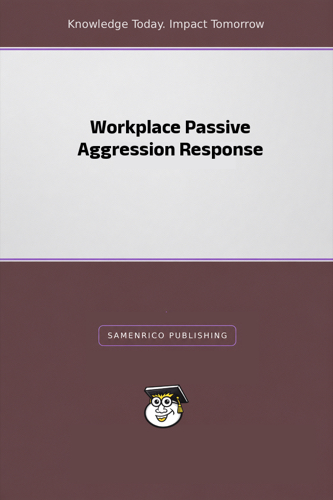
Workplace Passive Aggression Response eBook
Address subtle hostility and indirect communicatio
Address subtle hostility and indirect communication without escalating conflict.
Formats
Free sample
Chapter 1: The Perfectly Deniable Insult...–- You cannot fire someone for a sigh.Let that sink in for a moment. You can sit in a performance review with every fiber of your being screaming that this person is toxic, undermining, and deliberately obstructionist. You can have a folder full of emails that feel wrong but say nothing technically actionable. You can watch them roll their eyes in a meeting, mutter “fine” under their breath, or “forget” to cc you on a critical thread for the fourth time this month. And when you go to HR, they will ask you a question that stops you cold: “Can you prove it was intentional?”You cannot.
And that is exactly the point.Passive aggression is the perfect workplace crime. It is designed to be deniable. It leaves no fingerprints. It operates in the space between what is said and what is meant, between the policy manual and the human heart. The person who sighs at you is not violating any company rule.
The colleague who gives you the silent treatment is “just focused.” The peer who “forgets” your deadline is “overwhelmed.” And you—you are left standing there, frustrated, angry, and looking like the problem.This chapter is about understanding why passive aggression thrives in corporate environments, how to recognize it before it destroys your team, and why the standard advice to “just ignore it” or “confront them directly” usually makes things worse. You will learn the anatomy of the Passive Aggressive Conflict Cycle —the trap that turns your legitimate frustration into their manufactured victimhood. You will meet The Angry Smile —the sugarcoated hostility that smiles to your face while sabotaging you behind your back. And you will begin to see that the sigh was never just a sigh.The Sigh That Launched a Thousand Fights Let me paint a picture. It is 10:00 AM on a Tuesday.
You are in a team meeting. You ask a straightforward question: “Sarah, do you have the updated numbers for the Q3 report?”Sarah does not answer immediately. Instead, she exhales. Loudly. Slowly.
Deliberately. It is a sigh that seems to come from the bottom of her soul. She looks at her computer screen, then back at you, then at the ceiling. She mutters, almost inaudibly, “Fine. I’ll get it to you.”The room goes quiet.
You feel your face flush. You want to say, “What is that supposed to mean?” But you do not. You are a professional. You let it go. The meeting continues.
But something has shifted. You are now the “demanding” one. Sarah is the “overworked” one. And you have no idea how it happened.This scene plays out in thousands of offices every single day. The sigh is the opening move in a game that most people do not even know they are playing.
It is a non-verbal expression of exasperation that says, “You are bothering me. Your request is unreasonable. I am the victim here.” And because it is non-verbal, it is deniable. If you confront it, Sarah will say, “I didn’t even notice I did that. I was just breathing.”The sigh is not just a sigh.
It is a weapon.Why Hierarchy Makes Everything Worse Passive aggression does not thrive in a vacuum. It thrives in environments where direct anger is punished and professional niceness is mandatory. That describes almost every corporate workplace in existence.Consider the power dynamics. If you are a manager and you express direct anger at a subordinate, you are labeled “abusive” or “a micromanager.” If you are an individual contributor and you express direct anger at a peer, you are labeled “difficult to work with.” If you express direct anger at your boss, you are labeled “insubordinate” and shown the door. The message is clear: keep it inside.
Smile. Be professional.But anger does not disappear when you suppress it. It goes underground. It comes out sideways. It becomes the sigh, the forgotten deadline, the silent treatment, the gossip in the breakroom.
This is the fundamental paradox of corporate niceness: by outlawing direct conflict, we do not eliminate conflict. We just drive it into the shadows, where it becomes harder to name, harder to address, and infinitely more destructive.The passive-aggressive person understands this dynamic intuitively. They know that you cannot punish a sigh. They know that you cannot write someone up for a tone of voice. They know that if they keep their hostility just below the threshold of the policy manual, they can torment you with impunity.
And when you finally snap—when the tenth sigh pushes you over the edge—they will point at you and say, “See? They are the problem. I was just sitting here quietly.”This is the trap. And most people fall into it every single time.The Angry Smile There is a name for the facial expression that accompanies workplace passive aggression. Psychologists call it The Angry Smile —the sugarcoated hostility where the lips are smiling but the eyes are furious.
It is the look that says, “I am going to comply with your request in a way that makes you regret ever asking.”The Angry Smile is dangerous precisely because it is ambiguous. Is she really angry, or are you imagining it? Is that a genuine smile, or is there something behind it? The ambiguity keeps you off balance. You cannot confront a smile.
You cannot write up a facial expression. So you do nothing. And the behavior continues.The Angry Smile is not limited to facial expressions. It is a whole category of behavior that looks cooperative on the surface but is actually hostile underneath. It is the “Yes, but…” response to a request—agreement followed immediately by a reason it will fail.
It is the “I’ll try” that means “I have no intention of doing this.” It is the “Let me play devil’s advocate” that is actually just an attack on your idea.The key to recognizing The Angry Smile is to trust your gut. If a behavior feels hostile, even if you cannot articulate why, pay attention. Your brain is picking up on micro-expressions, tone shifts, and contextual cues that your conscious mind has not yet processed. You do not need to prove intent to yourself. You just need to notice the pattern.Intentional Inefficiency and Weaponized Incompetence Let me introduce you to two concepts that will change how you see workplace sabotage.Intentional Inefficiency is the art of doing a task so poorly or so slowly that someone else has to take over.
The passive-aggressive person does not refuse the work—that would be insubordination. They simply do it at a glacial pace, or with so many errors that it is unusable. When you finally step in to fix it, they say, “I was getting to it. You are so impatient.”Weaponized Incompetence is a close cousin. It is the strategic performance of helplessness.
“I just don’t understand this spreadsheet.” “I am not good at that kind of task.” “Can you show me again?” The goal is to make the task so painful for you that you eventually stop asking. You do the work yourself because it…
This is the end of the free sample. Get the eBook to keep going. Buy now
About this book
Details
- Author
- Thatcher Williemae
- Publisher
- SamEnrico
- Language
- English
- Genre
- Non-Fiction, Self-Help, Interpersonal Skills
- Released
- 2026-06-07
- Pages (approx.)
- 115
- Available as
- eBook, Audiobook

Read better in the ZLOADR app
Your eBooks on your phone or tablet. Sign in with your SamEnrico account and start reading.
More by Thatcher Williemae
 Journalism Essay PromptsThatcher Williemae$11.99
 Scheduled Distraction Breaks GuideThatcher Williemae$11.99
 Jamaican Tech Support TrainingThatcher Williemae$11.99
 The Mordecai Kaplan ReconstructionismThatcher Williemae$11.99
 Hansando: The Turtle Ships' Last StandThatcher Williemae$11.99
 Understanding PneumocystosisThatcher Williemae$17.99
 Badge Reel DesignerThatcher Williemae$11.99
 Wave Receipt Scanning GuideThatcher Williemae$12.99
 Specialty Chemicals M&AThatcher Williemae$12.99
 How to Start a Optical Density Measuring Equipment (electronic) Business (Beginners Guide)Thatcher Williemae$11.99
You may also like
 Hong Kong Handover 1997Dunn Johnnie$11.99
 Zumba For Postnatal Recovery CourseNeal Christian$11.99
 Zumba for BeginnersLadner Nikia$11.99
 YouTube Comment Mining GuideHumes Pandora$12.99
 Worry Box MeditationCarlin Rudy$11.99
 Workplace Stress MeditationNguyen Lynn$11.99
 Workplace Stress and Sleep RepairHawley Ivory$11.99
 Workplace Perfectionism CureDelaney Jeffry$11.99
 Workplace Injustice Anger GuideWallen Isabelle$11.99
 Work Addiction and Burnout LinkGreenwood Ester$11.99
 Women in Yoga and WellnessBeattie Galina$11.99
 Women in Stand Up ComedyChun Evangeline$11.99