
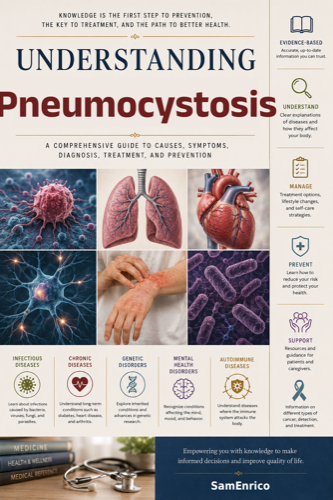
Understanding Pneumocystosis
This disease publication, published by SamEnrico,
This disease publication, published by SamEnrico, covers Understanding Pneumocystosis
Formats
About this book
Free sample
Chapter 1: The Silent Epidemic...–- In the early 1980s, before the world had a name for the disease that would define a generation, pulmonologists in Los Angeles, New York, and San Francisco began noticing something profoundly unsettling. Young, previously healthy men were presenting with a strange pneumonia—one that their immune systems seemed utterly incapable of fighting. The organism responsible was not a bacterium, not a virus, but something that had been dismissed for decades as a harmless commensal of the human lung. This was the moment when Pneumocystis stepped out of the shadows of medical obscurity and into the glaring light of a global crisis. The story of how this organism transformed from a microscopic curiosity into a leading cause of death in immunocompromised patients, and then receded in one population only to re-emerge in another, is not merely a historical footnote.
It is a parable about the delicate balance between host and pathogen, the unintended consequences of medical progress, and the perpetual need for clinical vigilance. Understanding pneumocystosis today requires understanding this journey—from its mistaken identity, through the devastation of the AIDS epidemic, to the new, silent epidemic unfolding in cancer wards and transplant centers across the developed world.The Discovery of an Organism Without a Home The history of Pneumocystis begins not with a pandemic, but with a puzzle. In 1909, Brazilian researcher Carlos Chagas, while studying trypanosomes in guinea pigs, observed two distinct morphological forms of a microorganism in the lungs of his experimental animals. He mistakenly classified what he saw as part of the life cycle of Trypanosoma cruzi, the parasite responsible for Chagas disease. Two years later, his colleague Antonio Carini made a similar observation in rats, but remained uncertain about the organism's true identity.
The scientific community of the early twentieth century was ill-equipped to resolve this ambiguity. Microscopy was primitive, tissue staining techniques were evolving slowly, and the concept of opportunistic infection had not yet entered medical vocabulary.It was not until 1912 that the brothers Edouard and Alphonse Delanoë, working at the Pasteur Institute in Paris, recognized that these organisms constituted a…
This is the end of the free sample. Get the eBook to keep going. Buy now
Contents
- Chapter 1
- Chapter 2
- Chapter 3
- Chapter 4
- Chapter 5
- Chapter 6
- Chapter 7
- Chapter 8
- Chapter 9
- Chapter 10
- Chapter 11
- Chapter 12
Details
- Author
- Thatcher Williemae
- Publisher
- SamEnrico
- Language
- English
- Genre
- Non-Fiction, Informative, Educational
- Released
- 2026-06-02
- Pages (approx.)
- 147
- Available as
- eBook, Audiobook

Read better in the ZLOADR app
Your eBooks on your phone or tablet. Sign in with your SamEnrico account and start reading.
More by Thatcher Williemae
 Journalism Essay PromptsThatcher Williemae$11.99
 Scheduled Distraction Breaks GuideThatcher Williemae$11.99
 Jamaican Tech Support TrainingThatcher Williemae$11.99
 Workplace Passive Aggression ResponseThatcher Williemae$11.99
 The Mordecai Kaplan ReconstructionismThatcher Williemae$11.99
 Hansando: The Turtle Ships' Last StandThatcher Williemae$11.99
 Badge Reel DesignerThatcher Williemae$11.99
 Wave Receipt Scanning GuideThatcher Williemae$12.99
 Specialty Chemicals M&AThatcher Williemae$12.99
 How to Start a Optical Density Measuring Equipment (electronic) Business (Beginners Guide)Thatcher Williemae$11.99