
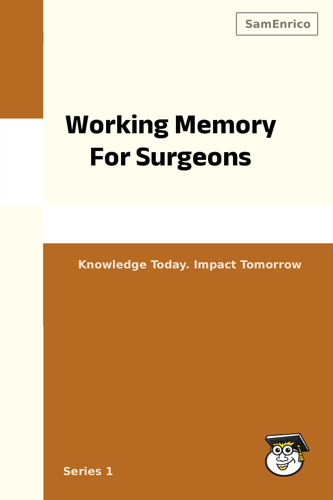
Non-FictionSelf-HelpSurgical Education
Working Memory For Surgeons eBook
Enhances procedural recall and intraoperative focu
Enhances procedural recall and intraoperative focus.
Formats
Free sample
Chapter 1: The Two-Pound Oracle--–- The overhead paging system crackled. "Dr. Harris, please call the blood bank. Dr. Harris, blood bank." In the middle of a difficult laparoscopic cholecystectomy, the senior surgeon’s eyes flickered upward for just a fraction of a second.
That was all it took. The cystic artery, partially divided, tore instead of clipping cleanly. Blood filled the field. What should have been a routine 45-minute case became a 3-hour conversion to open surgery, four units of packed red blood cells, and a week-long ICU stay for a patient who had expected to go home that evening.The surgeon, a board-certified general surgeon with fifteen years of experience, had done nothing technically wrong. His knot-tying was flawless.
His instrument handling was economical. His anatomy was textbook. And yet, a patient nearly died because a two-pound organ—the human brain—had a momentary lapse in a function most people don't even know they have.That function is working memory.Not memory for facts (that's long-term memory). Not memory for skills (that's procedural memory). Working memory is the brain's real-time mental workspace—the place where you hold information, manipulate it, and use it to guide your next action.
It is the difference between knowing how to do an operation and actually doing it safely when the room is noisy, the pager is buzzing, and the anatomy isn't quite what the textbook promised.This book is about that two-pound oracle: how it works, why it fails, and most importantly, how you can train it to protect your patients and yourself.The Myth of the Manual Art Surgery has long been understood as a physical craft. The surgeon's hands are celebrated. Dexterity is worshipped. Suturing contests and laparoscopic simulators focus on hand-eye coordination, speed, and precision. All of this matters.
But it misses something essential.Consider the evidence. Studies comparing expert and novice surgeons under high cognitive load—distractions, time pressure, unexpected findings—consistently show that the experts' advantage is not primarily in their hand speed. It is in their cognitive efficiency. Experts know what to pay attention to and what to ignore. They hold fewer pieces of information in working memory at once because they have compressed that information into larger, more meaningful chunks.
They are less derailed by irrelevant distractions because they have learned to filter. Their working memory is not larger than the novice's—the biological limit of 5–9 chunks is universal—but they use that limited capacity far more effectively.In other words, surgery is not just a manual art. It is a cognitive art. The brain holds the scalpel every bit as much as the hand does.The Neurosurgical Window: What Brain Stimulation Reveals One of the most extraordinary windows into human cognition comes from a surprising place: the awake craniotomy. When a patient has a brain tumor near critical areas controlling language or movement, neurosurgeons sometimes keep the patient awake during surgery.
The patient, under local anesthesia, performs tasks while the surgeon probes the exposed brain with a small electrical stimulator. When a critical area is stimulated, the patient suddenly cannot speak, or cannot name an object, or cannot move a finger. Then the stimulator is removed, and function returns.These moments are called the "Neurosurgical Window," and they reveal something profound about the organ that surgeons rely on every day.Stimulate the temporal lobe near the hippocampus, and a patient may suddenly lose the ability to form new memories—forgetting what was said just seconds ago while retaining memories from before the stimulation. Stimulate Broca's area in the frontal lobe, and language production halts mid-sentence. Stimulate the parietal lobe, and spatial perception distorts—the patient may reach for a scalpel but miss it by several inches, or feel as though their hand belongs to someone else.What these moments demonstrate is that surgery—our surgery—depends entirely on the integrity of specific neural circuits.
The surgeon who cannot remember the last step of a procedure (temporal lobe), cannot communicate a critical finding to the anesthesiologist (Broca's area), or cannot accurately perceive the depth of a dissection (parietal lobe) will fail regardless of how strong or fast their hands are.The Anatomy of Working Memory To train working memory, we must first understand it. The most influential model in cognitive science comes from Alan Baddeley, who described working memory not as a single storage bin but as a coordinated system with four components.The first component is the phonological loop. This is the "inner voice" that holds verbal and auditory information. It is what allows you to repeat a phone number to yourself as you walk to the phone. In the operating room, the phonological loop holds the spoken instructions from the attending ("clamp the cystic duct"), the step you are about to perform ("I am at Step 4 of the Whipple"), and the question the circulating nurse just asked ("Do you want the 2-0 silk?").The second component is the visuospatial sketchpad.
This is the "inner eye" that holds visual and spatial information. It maintains the mental image of the operative field, the location of the retractor relative to the liver, the trajectory of the needle driver as it approaches the tissue. When you close your eyes and mentally rehearse a case, you are using your visuospatial sketchpad.The third component is the episodic buffer. This is the integration system that binds information from the phonological loop and visuospatial sketchpad together with long-term memory. It creates a unified representation of the current moment—not just the visual field and the sounds, but the meaning of what you are seeing and hearing.
It is the episodic buffer that tells you, "That bleeding is venous, not arterial, so I do not need to rush as much as I thought."The fourth component is the central executive. This is the "conductor" of the entire system—the attentional controller that decides what information to hold, what to ignore, what to manipulate, and what to offload to long-term memory. The central executive is the most important component for surgeons because it is the one that manages multitasking, blocks distractions, and switches between goals. When the central executive fails, the entire working memory system collapses.The 7 ± 2 Bottleneck Here is the biological reality that every surgeon must accept: the average human working memory can hold only 5 to 9 discrete "chunks" of information at any given moment. This is not a suggestion.
It is not a guideline. It is a hard biological limit, like the fact that you cannot hold your breath for twenty minutes.What counts as a chunk? A chunk is any meaningful unit of information. For a novice surgeon, "identify the cystic duct" might be one chunk. "Open the grasper" might be another chunk.
"Retract the gallbladder fundus" might be a third. Very quickly, the novice reaches 7 chunks and the system begins to fail.For an expert surgeon, "complete the critical view of safety" might be a single chunk that internally contains fifteen individual steps. The expert has not increased working memory capacity—that is impossible. The expert has increased the density of each chunk, compressing more information into the same 5–9 slots.This compression happens through a process called chunking, which we will…
This is the end of the free sample. Get the eBook to keep going. Buy now
About this book
Details
- Author
- Holliday Merri
- Publisher
- SamEnrico
- Language
- English
- Genre
- Non-Fiction, Self-Help, Surgical Education
- Released
- 2026-06-11
- Pages (approx.)
- 123
- Available as
- eBook, Audiobook

Read better in the ZLOADR app
Your eBooks on your phone or tablet. Sign in with your SamEnrico account and start reading.
More by Holliday Merri
 Emotion Recognition TrainingHolliday Merri$11.99
 Self Esteem After Baby LossHolliday Merri$11.99
 Detox Vomiting ManagementHolliday Merri$11.99
 Personal Branding Portfolio GuideHolliday Merri$11.99
 The Remote Flow State GuideHolliday Merri$11.99
 EMDR Trigger PreparationHolliday Merri$11.99
 Additional Insured EndorsementHolliday Merri$11.99
 Blood Moon: The Last Hunt of the Beast of GévaudanHolliday Merri$11.99
 A Collector's Handbook to the Aston Martin VantageHolliday Merri$11.99
 Airedale Terrier: King of TerriersHolliday Merri$11.99
 How to Produce a Safety LampHolliday Merri$11.99
 JEE Integer Type Question GuideHolliday Merri$12.99
You may also like
 Hong Kong Handover 1997Dunn Johnnie$11.99
 Zumba For Postnatal Recovery CourseNeal Christian$11.99
 Zumba for BeginnersLadner Nikia$11.99
 YouTube Comment Mining GuideHumes Pandora$12.99
 Worry Box MeditationCarlin Rudy$11.99
 Workplace Stress MeditationNguyen Lynn$11.99
 Workplace Stress and Sleep RepairHawley Ivory$11.99
 Workplace Perfectionism CureDelaney Jeffry$11.99
 Workplace Injustice Anger GuideWallen Isabelle$11.99
 Work Addiction and Burnout LinkGreenwood Ester$11.99
 Women in Yoga and WellnessBeattie Galina$11.99
 Women in Stand Up ComedyChun Evangeline$11.99