
Non-FictionSelf-HelpSurgical Education
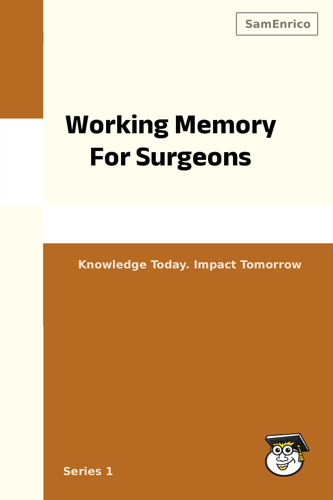
Working Memory For Surgeons Audiobook
Enhances procedural recall and intraoperative focu
Enhances procedural recall and intraoperative focus.
Formats
Free sample
Chapter 1: The Two-Pound Oracle--–- The overhead paging system crackled. "Dr. Harris, please call the blood bank. Dr. Harris, blood bank." In the middle of a difficult laparoscopic cholecystectomy, the senior surgeon’s eyes flickered upward for just a fraction of a second.
That was all it took. The cystic artery, partially divided, tore instead of clipping cleanly. Blood filled the field. What should have been a routine 45-minute case became a 3-hour conversion to open surgery, four units of packed red blood cells, and a week-long ICU stay for a patient who had expected to go home that evening.The surgeon, a board-certified general surgeon with fifteen years of experience, had done nothing technically wrong. His knot-tying was flawless.
His instrument handling was economical. His anatomy was textbook. And yet, a patient nearly died because a two-pound organ—the human brain—had a momentary lapse in a function most people don't even know they have.That function is working memory.Not memory for facts (that's long-term memory). Not memory for skills (that's procedural memory). Working memory is the brain's real-time mental workspace—the place where you hold information, manipulate it, and use it to guide your next action.
It is the difference between knowing how to do an operation and actually doing it safely when the room is noisy, the pager is buzzing, and the anatomy isn't quite what the textbook promised.This book is about that two-pound oracle: how it works, why it fails, and most importantly, how you can train it to protect your patients and yourself.The Myth of the Manual Art Surgery has long been understood as a physical craft. The surgeon's hands are celebrated. Dexterity is worshipped. Suturing contests and laparoscopic simulators focus on hand-eye coordination, speed, and precision. All of this matters.
But it misses something essential.Consider the evidence. Studies comparing expert and novice surgeons under high cognitive load—distractions, time pressure, unexpected findings—consistently show that the experts' advantage is not primarily in their hand speed. It is in their cognitive efficiency. Experts know what to pay attention to and what to ignore. They hold fewer pieces of information in working memory at once because they have compressed that information into larger, more meaningful chunks.
They are less derailed by irrelevant distractions because they have learned to filter. Their working memory is not larger than the novice's—the biological limit of 5–9…
This is the end of the free sample. Get the Audiobook to keep going. Buy now
About this book
Details
- Author
- Holliday Merri
- Publisher
- SamEnrico
- Language
- English
- Genre
- Non-Fiction, Self-Help, Surgical Education
- Released
- 2026-06-11
- Pages (approx.)
- 123
- Available as
- eBook, Audiobook

Listen in the VoxFlicks app
Audiobooks and audio dramas wherever you go. Sign in with your SamEnrico account and press play.
More by Holliday Merri
 Emotion Recognition TrainingHolliday Merri$11.99
 Self Esteem After Baby LossHolliday Merri$11.99
 Detox Vomiting ManagementHolliday Merri$11.99
 Personal Branding Portfolio GuideHolliday Merri$11.99
 The Remote Flow State GuideHolliday Merri$11.99
 EMDR Trigger PreparationHolliday Merri$11.99
 Additional Insured EndorsementHolliday Merri$11.99
 Blood Moon: The Last Hunt of the Beast of GévaudanHolliday Merri$11.99
 A Collector's Handbook to the Aston Martin VantageHolliday Merri$11.99
 Airedale Terrier: King of TerriersHolliday Merri$11.99
 How to Produce a Safety LampHolliday Merri$11.99
 JEE Integer Type Question GuideHolliday Merri$12.99
You may also like
 Hong Kong Handover 1997Dunn Johnnie$11.99
 Zumba For Postnatal Recovery CourseNeal Christian$11.99
 Zumba for BeginnersLadner Nikia$11.99
 YouTube Comment Mining GuideHumes Pandora$12.99
 Worry Box MeditationCarlin Rudy$11.99
 Workplace Stress MeditationNguyen Lynn$11.99
 Workplace Stress and Sleep RepairHawley Ivory$11.99
 Workplace Perfectionism CureDelaney Jeffry$11.99
 Workplace Injustice Anger GuideWallen Isabelle$11.99
 Work Addiction and Burnout LinkGreenwood Ester$11.99
 Women in Yoga and WellnessBeattie Galina$11.99
 Women in Stand Up ComedyChun Evangeline$11.99