
Non-FictionSelf-HelpLegal Support
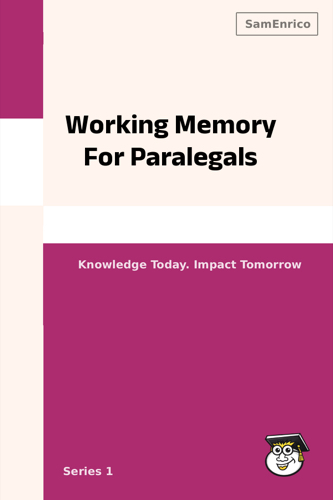
Working Memory For Paralegals eBook
Boosts retention of case files and deadlines.
Boosts retention of case files and deadlines.
Formats
Free sample
Chapter 1: The 27-Second Catastrophe--–- The email arrived at 9:47 AM. The paralegal saw it at 9:48. She read the subject line—"Smith v. Jones—Discovery Deadline Extension Request Denied"—and felt a cold wash of recognition. The original deadline was still in effect.
It was due tomorrow. She had known this. She had calendared it. She had even told the supervising attorney about it three weeks ago. And yet, as she stared at the screen, her mind was a white sheet of nothing.
The deadline had been there. Now it wasn't.She spent the next hour scrambling. Documents were misfiled. The table of exhibits was missing three entries. The verification page was signed with yesterday's date.
By the time she realized the error, the courthouse's e-filing system had already timestamped the submission—one minute past midnight. One minute. The case was dismissed. The client hired new counsel. The firm paid a $150,000 settlement to avoid a malpractice trial.
And the paralegal spent the next six months looking over her shoulder, waiting for the other shoe to drop.This is not a story about incompetence. It is not a story about laziness, carelessness, or a lack of training. It is a story about working memory—and about how every single legal professional, from the newest paralegal to the most seasoned trial attorney, is operating with a cognitive system that was never designed for the demands of modern litigation.The paralegal in this story did everything "right." She calendared the deadline. She notified the attorney. She had the file organized.
But somewhere between 9:47 AM on Tuesday and the moment she opened that email, the deadline slipped out of her working memory and disappeared into the void of things she once knew but could no longer access. This is not a failure of character. It is a feature of the human brain. And until you understand how that feature works, no amount of effort, no number of calendars, and no level of dedication will protect you from the 27-second catastrophe.The Legal Brain: An Owner's Manual for a Broken Machine Let us begin with a confession: your brain is not a computer. It does not store files in perfect folders, retrieve them instantly upon command, or maintain data integrity across decades of use.
Your brain is, if we are being honest, a slightly upgraded version of the organ that helped your ancestors avoid being eaten by predators on the African savanna. It is excellent at spotting movement, detecting threats, and remembering the emotional valence of a bad experience. It is terrible at remembering statutory deadlines, discovery cutoffs, and the correct spelling of "res judicata."This mismatch between the brain's evolutionary design and the demands of legal practice is the single greatest source of preventable errors in the legal profession. Every missed filing, every miscalculated deadline, every exhibit left off a list, and every party misnamed in a pleading can be traced back to the same root cause: a paralegal asked their working memory to do something it was never built to do.Working memory, to use a definition we will carry through this entire book, is the brain's temporary scratch pad. It is where you hold information while you are actively using it.
When someone gives you a phone number and you repeat it to yourself until you can dial it, that is working memory. When you keep the elements of a negligence claim in mind while reviewing a complaint, that is working memory. When you juggle three discovery deadlines, a client phone call, and an email from opposing counsel simultaneously, that is also working memory—and it is failing you in ways you cannot see.The problem is capacity. Working memory is not infinite. It is not even generous.
The most widely accepted estimate, based on decades of cognitive psychology research, is that working memory can hold approximately three to four distinct items at any given moment. Not paragraphs. Not pages. Items. A deadline is an item.
A client's name is an item. A hearing time is an item. The name of the judge is an item. The rule number for a filing is an item. Three to four items.
That is the entire budget.If this sounds absurdly small, you are not wrong. It is absurdly small. And yet, it is the biological reality that every paralegal fights against every single day. The average litigation paralegal is responsible for tracking between twenty and sixty active cases at any given time. Each case has multiple deadlines, multiple parties, multiple documents, and multiple procedural rules.
The math does not work. You cannot fit sixty cases into four working memory slots. Something will fall out. And when something falls out, it is rarely the trivial thing. It is almost always the deadline that looked distant, the filing that seemed routine, the exhibit that was supposed to be obvious.The Interruption Epidemic: How Your Day Destroys Your Memory Now add interruptions to this already impossible equation.
A landmark study of legal professionals found that the average attorney or paralegal is interrupted every three to six minutes. That is between ten and twenty interruptions per hour. Each interruption can come from anywhere: an email chime, a phone call, a colleague stopping by your desk, a supervising attorney with a "quick question," opposing counsel demanding an immediate response, a client who cannot find the retainer agreement, a court clerk who needs a filing number, a software update that requires a restart.Each interruption does something insidious to your working memory. When you are focused on a task—say, calculating a response deadline under Rule 6 of the Federal Rules of Civil Procedure—your brain has dedicated its three to four slots to the components of that calculation: the date of service, the number of days allowed, the exclusion of weekends and holidays, the final filing date. Then the phone rings.
You answer. The call lasts forty-five seconds. You hang up. You return to the deadline calculation.But here is the catch: you are not returning with a clean slate. The interruption has left behind what cognitive psychologists call "attentional residue." Your brain is still processing the phone call while you are trying to return to the deadline.
One of your four working memory slots is now occupied by the residue of the interruption. You are effectively trying to complete a four-slot calculation with three slots. The error risk is not linear. It is exponential.Research on this phenomenon has produced alarming numbers. A study tracking professionals in high-cognitive-load occupations found that a single interruption of even fifteen seconds can degrade working memory performance by up to forty percent for the next three to five minutes.
Multiple interruptions compound the effect. After four interruptions within a ten-minute window, effective working memory capacity drops to near zero. You are not forgetting because you are careless. You are forgetting because your environment has made forgetting inevitable.This is the hidden mathematics of legal work. Every email you answer while drafting a brief, every phone call you take while reviewing discovery, every "quick question" you handle while calendaring a deadline—each one steals a percentage of your cognitive capacity and does not return it.
By 3:00 PM on a typical Tuesday, the average paralegal is operating with a working memory that has been degraded…
This is the end of the free sample. Get the eBook to keep going. Buy now
About this book
Details
- Author
- Wilkinson Ellie
- Publisher
- SamEnrico
- Language
- English
- Genre
- Non-Fiction, Self-Help, Legal Support
- Released
- 2026-06-05
- Pages (approx.)
- 150
- Available as
- eBook, Audiobook

Read better in the ZLOADR app
Your eBooks on your phone or tablet. Sign in with your SamEnrico account and start reading.
More by Wilkinson Ellie
 Attachment Trigger PatternsWilkinson Ellie$11.99
 Self Esteem Mental Health LoveWilkinson Ellie$11.99
 Propranolol Alcohol Detox GuideWilkinson Ellie$11.99
 Adult CPR Quick GuideWilkinson Ellie$11.99
 Retirement Imposter GuideWilkinson Ellie$11.99
 CRSD Tracking LogWilkinson Ellie$11.99
 Business Insurance Master GuideWilkinson Ellie$11.99
 The Timbuktu Technocrats: Africa's Renaissance of Mathematics and EngineeringWilkinson Ellie$11.99
 The Master Forger of Mexico: The Elusive Genius Behind the Art Scandal of the CenturyWilkinson Ellie$11.99
 A Collector's Handbook to the Auburn 12-160Wilkinson Ellie$11.99
 Installment Pricing Inflation GuideWilkinson Ellie$12.99
 ARIPO Legal AssistanceWilkinson Ellie$12.99
You may also like
 Hong Kong Handover 1997Dunn Johnnie$11.99
 Zumba For Postnatal Recovery CourseNeal Christian$11.99
 Zumba for BeginnersLadner Nikia$11.99
 YouTube Comment Mining GuideHumes Pandora$12.99
 Worry Box MeditationCarlin Rudy$11.99
 Workplace Stress MeditationNguyen Lynn$11.99
 Workplace Stress and Sleep RepairHawley Ivory$11.99
 Workplace Perfectionism CureDelaney Jeffry$11.99
 Workplace Injustice Anger GuideWallen Isabelle$11.99
 Work Addiction and Burnout LinkGreenwood Ester$11.99
 Women in Yoga and WellnessBeattie Galina$11.99
 Women in Stand Up ComedyChun Evangeline$11.99