
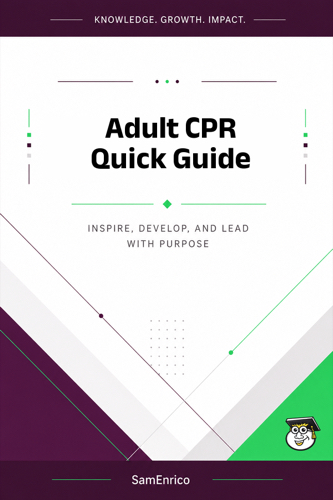
Non-FictionHealth & WellnessEmergency
Adult CPR Quick Guide
Master chest compressions and rescue breaths for a
Master chest compressions and rescue breaths for adults experiencing cardiac arrest.
Formats
About this book
Free sample
Chapter 1: The Gasp That Lies--–- The paramedic arrived at 7:42 PM. The family had already moved the grandfather from the kitchen floor to the sofa. “We thought he was still breathing,” the daughter said. “He was making these sounds—like snoring, but not quite.” The paramedic listened to the recorded 911 call later. The dispatcher had asked, “Is he breathing normally?” The daughter paused for seven seconds—an eternity in cardiac arrest—and said, “I think so.
He’s making noise.” She was wrong. The noise was agonal breathing. The man died with a room full of people who thought he was still alive because they heard a sound they did not understand.This chapter exists to ensure you never make that mistake. Within the next fifteen minutes, you will learn to recognize cardiac arrest in less than five seconds—faster than most emergency medical responders. You will understand why the old rules changed.
You will never again confuse a dying gasp with a living breath. And you will act before the doubt creeps in.Why Everything You Thought You Knew About CPR Is Backwards For decades, first aid training taught a sequence called A-B-C: Airway, Breathing, Compressions. The logic seemed sound. Open the airway first. Check for breathing second.
Only then, if the victim was not breathing, start chest compressions. This approach made intuitive sense—but intuition killed people.The problem is physics and physiology combined in a way that trainers did not fully understand until the early 2000s. When an adult heart stops suddenly—what physicians call sudden cardiac arrest—the blood already contains enough oxygen to sustain the brain and other vital organs for approximately four to six minutes. The victim does not need oxygen delivered to the lungs. The victim needs that existing oxygen moved from the blood into the tissues.
And the only way to move it is to pump the heart.The old A-B-C sequence wasted precious time. A typical rescuer following A-B-C would spend ten to fifteen seconds opening the airway, another ten seconds checking for breathing, and often additional seconds hesitating because agonal breathing…
This is the end of the free sample. Get the eBook to keep going. Buy now
Contents
- Chapter 1
- Chapter 2
- Chapter 3
- Chapter 4
- Chapter 5
- Chapter 6
- Chapter 7
- Chapter 8
- Chapter 9
- Chapter 10
- Chapter 11
- Chapter 12
Details
- Author
- Wilkinson Ellie
- Publisher
- SamEnrico
- Language
- English
- Genre
- Non-Fiction, Health & Wellness, Emergency
- Released
- 2026-06-09
- Pages (approx.)
- 130
- Available as
- eBook, Audiobook

Read better in the ZLOADR app
Your eBooks on your phone or tablet. Sign in with your SamEnrico account and start reading.
More by Wilkinson Ellie
 Attachment Trigger PatternsWilkinson Ellie$11.99
 Self Esteem Mental Health LoveWilkinson Ellie$11.99
 Propranolol Alcohol Detox GuideWilkinson Ellie$11.99
 Retirement Imposter GuideWilkinson Ellie$11.99
 CRSD Tracking LogWilkinson Ellie$11.99
 Business Insurance Master GuideWilkinson Ellie$11.99
 Working Memory For ParalegalsWilkinson Ellie$11.99
 The Timbuktu Technocrats: Africa's Renaissance of Mathematics and EngineeringWilkinson Ellie$11.99
 The Master Forger of Mexico: The Elusive Genius Behind the Art Scandal of the CenturyWilkinson Ellie$11.99
 A Collector's Handbook to the Auburn 12-160Wilkinson Ellie$11.99
 Installment Pricing Inflation GuideWilkinson Ellie$12.99
 ARIPO Legal AssistanceWilkinson Ellie$12.99
You may also like
 Hong Kong Handover 1997Dunn Johnnie$11.99
 Zumba For Postnatal Recovery CourseNeal Christian$11.99
 Zumba for BeginnersLadner Nikia$11.99
 YouTube Comment Mining GuideHumes Pandora$12.99
 Worry Box MeditationCarlin Rudy$11.99
 Workplace Stress MeditationNguyen Lynn$11.99
 Workplace Stress and Sleep RepairHawley Ivory$11.99
 Workplace Perfectionism CureDelaney Jeffry$11.99
 Workplace Injustice Anger GuideWallen Isabelle$11.99
 Work Addiction and Burnout LinkGreenwood Ester$11.99
 Women in Yoga and WellnessBeattie Galina$11.99
 Women in Stand Up ComedyChun Evangeline$11.99