
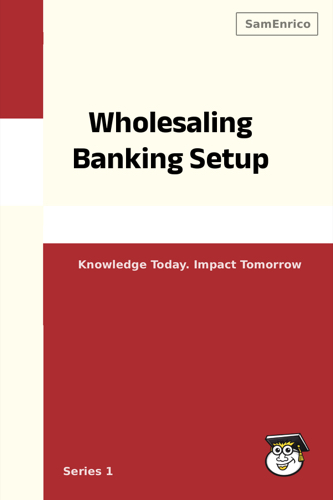
Free sample
Chapter 1: The Invisible Machine--Every morning, a treasurer in Chicago presses a single button on her computer screen. That action moves $47 million from a manufacturing company’s account to a supplier in Vietnam. The transfer takes less than three seconds. The treasurer does not think about SWIFT codes, correspondent banking relationships, intraday liquidity, or nostro account reconciliation. She does not think about the twelve banks, two clearing houses, and one central bank that silently facilitate that transfer.
She does not think about wholesale banking at all.That is precisely the problem.Wholesale banking is the most economically significant financial system that almost no one understands. It moves trillions of dollars daily between corporations, governments, financial institutions, and investors. It funds the construction of power plants, the expansion of airline fleets, the acquisition of competitors, and the daily working capital needs of global supply chains. Yet unlike retail banking—which every consumer interacts with through mortgages, credit cards, and checking accounts—wholesale banking operates in the shadows. Its invisibility is not an accident of complexity.
It is a consequence of design, habit, and a dangerous industry-wide assumption that the people running wholesale banks already know how they work.They do not.This book exists because the gap between what wholesale banking does and how well it is understood has become a systemic risk. Banks lose billions not because their traders are unlucky but because their leaders do not understand the machine they are operating. Fintech startups raise unicorn valuations by promising to disrupt a system their founders have never worked inside. Regulators write thousand-page rules based on theoretical models that bear little resemblance to daily operations. And the treasurers pressing buttons every morning have no idea which of their twelve partner banks might fail to settle a payment tomorrow.This chapter defines the arena.
It draws the boundaries between wholesale banking and its cousins—retail and investment banking. It introduces the three-pillar framework that structures this entire book. And it names the single greatest threat to wholesale banking success: the Silo Trap.But before any of that, we must answer a more fundamental question. What, exactly, is wholesale banking?The Client Definition Wholesale banking is defined by its clients, not by its products.A retail bank serves individuals. It takes consumer deposits, makes personal loans, issues mortgages, and provides credit cards.
The products themselves are not unique to retail—corporations also have deposit accounts and credit cards—but the client relationship is fundamentally different. Retail clients are numerous, relatively homogeneous in their needs, and protected by consumer regulations that assume an information asymmetry between the bank and the customer.A wholesale bank serves institutions. Its clients include corporations (from small businesses to multinational giants), governments (national, state, and local), financial institutions (other banks, insurance companies, asset managers, hedge funds), and intermediaries (clearing houses, exchanges, fintech platforms). These clients are fewer in number, vastly more complex in their needs, and sophisticated enough to negotiate terms, challenge pricing, and walk away to competitors.This distinction matters because it changes everything about how a wholesale bank operates. A retail bank can succeed with standardized products, branch networks, and mass marketing.
A wholesale bank cannot. Wholesale clients demand customized solutions, dedicated relationship managers, and access to products that span lending, trading, and transaction services. They expect their bank to understand their industry, their supply chain, their regulatory burden, and their competitive pressures. They will not tolerate a one-size-fits-all approach.The product distinction follows from the client definition. Wholesale banks offer three broad categories of products—the three pillars that will anchor every chapter of this book.
But the pillars are not the definition. The client is.Wholesale Versus Retail: The Critical Distinctions The difference between wholesale and retail banking is not merely a matter of scale. It is a difference in kind, not degree.Consider the liability side of the balance sheet. A retail bank funds itself primarily through consumer deposits—small balances, large numbers of account holders, and deposit insurance that makes those balances stable even during financial crises. A wholesale bank funds itself through a mix of corporate deposits (larger balances, fewer account holders, no insurance), interbank borrowing, repurchase agreements, and capital markets issuance.
This funding is more volatile. When confidence falters, wholesale funding disappears overnight. The 2008 financial crisis demonstrated this brutally: Bear Stearns and Lehman Brothers did not fail because their retail depositors ran. They failed because their wholesale funding counterparties refused to roll over short-term loans.Now consider the asset side. A retail bank makes loans to individuals and small businesses—mortgages, auto loans, credit cards, lines of credit.
These loans are relatively small, standardized, and held to maturity on the bank’s balance sheet. A wholesale bank makes loans to large corporations and institutions—syndicated loans, project finance, bridge financing, leveraged loans. These loans are large, customized, and often sold to other investors rather than held. The act of lending is separated from the act of holding credit risk through syndication and securitization, topics we will explore in depth in Chapter 4.The operational differences are equally stark. Retail banking requires branch networks, ATMs, call centers, and mobile apps.
Wholesale banking requires trading floors, SWIFT connectivity, clearing house membership, and relationship management teams. A retail bank’s competitive advantage comes from convenience, brand recognition, and customer service. A wholesale bank’s competitive advantage comes from expertise, speed, balance sheet capacity, and the quality of its relationships at the CFO and treasurer level.Finally, consider the regulatory environment. Retail banking is heavily focused on consumer protection—truth in lending, fair lending, anti-predatory lending rules. Wholesale banking is focused on systemic risk, capital adequacy, and counterparty exposure.
The regulations that matter for wholesale banks—Basel III, the Dodd-Frank Act’s Title VII, the European Market Infrastructure Regulation—are incomprehensible to most retail bankers and completely irrelevant to their business.A bank that tries to be both a retail leader and a wholesale leader faces a fundamental tension. The cultures clash. The risk appetites diverge. The regulatory requirements pull in opposite directions. This is the Universal Bank Dilemma, which we will examine in detail through the HSBC case study in Chapter 2.
For now, the takeaway is simple: wholesale and retail banking look similar on a chart of accounts. In practice, they are different businesses requiring different strategies, different people, and different mindsets.Wholesale Versus Investment Banking: A Clarification The relationship between wholesale banking and investment banking is more complicated—and more frequently misunderstood.Many people use the terms interchangeably. They are wrong. Others treat investment banking as completely separate from wholesale banking. They are also wrong.
This book takes a middle position that resolves the confusion while remaining useful for practitioners.Investment banking, in its purest form, consists of two activities: advisory and underwriting. Advisory includes mergers and acquisitions (M&A), restructuring, and other strategic transactions where the bank provides advice but does not commit its own balance sheet. Underwriting includes initial public offerings (IPOs), follow-on equity offerings, and bond issuances where the bank promises to buy any unsold securities from the client—a commitment that does require balance sheet capacity.Wholesale banking, as defined in this book, includes those investment banking activities plus three additional categories: lending (syndicated…
This is the end of the free sample. Get the eBook to keep going. Buy now
About this book
Details
- Author
- Santiago Stephen
- Publisher
- SamEnrico
- Language
- English
- Genre
- Non-Fiction, Business Brief / Banking
- Released
- 2026-06-06
- Pages (approx.)
- 142
- Available as
- eBook, Audiobook

Read better in the ZLOADR app
Your eBooks on your phone or tablet. Sign in with your SamEnrico account and start reading.
More by Santiago Stephen
 Assertiveness for Executives GuideSantiago Stephen$11.99
 History Timeline PalaceSantiago Stephen$11.99
 Book Value per Share GuideSantiago Stephen$12.99
 Validation for GriefSantiago Stephen$11.99
 The Shockwave Therapy GuideSantiago Stephen$11.99
 Sleep Paralysis NightmaresSantiago Stephen$11.99
 ED and Low TestosteroneSantiago Stephen$11.99
 Freelance While UnemployedSantiago Stephen$11.99
 The Calculus of the Cosmos: The African Mathematicians Who Charted the HeavensSantiago Stephen$11.99
 The Bloodstained Canvases: The 1895 Cape Town Art Heist and the Birth of Forensic Art AnalysisSantiago Stephen$11.99
 A Collector's Handbook to the Alfa Romeo SportSantiago Stephen$11.99
 How to Produce RiceSantiago Stephen$11.99
You may also like
 Hong Kong Handover 1997Dunn Johnnie$11.99
 Zumba For Postnatal Recovery CourseNeal Christian$11.99
 Zumba for BeginnersLadner Nikia$11.99
 YouTube Comment Mining GuideHumes Pandora$12.99
 Worry Box MeditationCarlin Rudy$11.99
 Workplace Stress MeditationNguyen Lynn$11.99
 Workplace Stress and Sleep RepairHawley Ivory$11.99
 Workplace Perfectionism CureDelaney Jeffry$11.99
 Workplace Injustice Anger GuideWallen Isabelle$11.99
 Work Addiction and Burnout LinkGreenwood Ester$11.99
 Women in Yoga and WellnessBeattie Galina$11.99
 Women in Stand Up ComedyChun Evangeline$11.99