
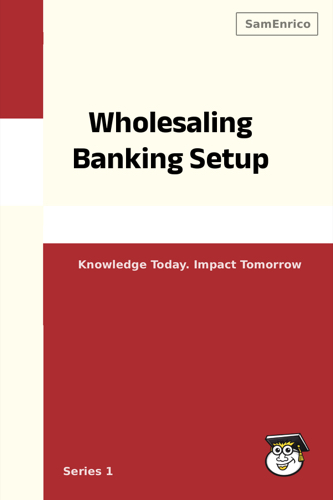
Free sample
Chapter 1: The Invisible Machine--Every morning, a treasurer in Chicago presses a single button on her computer screen. That action moves $47 million from a manufacturing company’s account to a supplier in Vietnam. The transfer takes less than three seconds. The treasurer does not think about SWIFT codes, correspondent banking relationships, intraday liquidity, or nostro account reconciliation. She does not think about the twelve banks, two clearing houses, and one central bank that silently facilitate that transfer.
She does not think about wholesale banking at all.That is precisely the problem.Wholesale banking is the most economically significant financial system that almost no one understands. It moves trillions of dollars daily between corporations, governments, financial institutions, and investors. It funds the construction of power plants, the expansion of airline fleets, the acquisition of competitors, and the daily working capital needs of global supply chains. Yet unlike retail banking—which every consumer interacts with through mortgages, credit cards, and checking accounts—wholesale banking operates in the shadows. Its invisibility is not an accident of complexity.
It is a consequence of design, habit, and a dangerous industry-wide assumption that the people running wholesale banks already know how they work.They do not.This book exists because the gap between what wholesale banking does and how well it is understood has become a systemic risk. Banks lose billions not because their traders are unlucky but because their leaders do not understand the machine they are operating. Fintech startups raise unicorn valuations by promising to disrupt a system their founders have never worked inside. Regulators write thousand-page rules based on theoretical models that bear little resemblance to daily operations. And the treasurers pressing buttons every morning have no idea which of their twelve partner banks might fail to settle a payment tomorrow.This chapter defines the arena.
It draws the boundaries between wholesale banking and its cousins—retail and investment banking. It introduces the three-pillar framework that structures this entire book. And it names the single greatest threat to wholesale banking success: the Silo Trap.But before any of that, we must answer a more fundamental question. What, exactly, is wholesale banking?The Client Definition Wholesale banking is defined by its clients, not by its products.A retail bank serves individuals. It takes consumer deposits, makes personal loans, issues mortgages, and provides credit cards.
The products themselves are not unique to retail—corporations also have deposit accounts and credit cards—but the client relationship is fundamentally…
This is the end of the free sample. Get the Audiobook to keep going. Buy now
About this book
Details
- Author
- Santiago Stephen
- Publisher
- SamEnrico
- Language
- English
- Genre
- Non-Fiction, Business Brief / Banking
- Released
- 2026-06-06
- Pages (approx.)
- 142
- Available as
- eBook, Audiobook

Listen in the VoxFlicks app
Audiobooks and audio dramas wherever you go. Sign in with your SamEnrico account and press play.
More by Santiago Stephen
 Assertiveness for Executives GuideSantiago Stephen$11.99
 History Timeline PalaceSantiago Stephen$11.99
 Book Value per Share GuideSantiago Stephen$12.99
 Validation for GriefSantiago Stephen$11.99
 The Shockwave Therapy GuideSantiago Stephen$11.99
 Sleep Paralysis NightmaresSantiago Stephen$11.99
 ED and Low TestosteroneSantiago Stephen$11.99
 Freelance While UnemployedSantiago Stephen$11.99
 The Calculus of the Cosmos: The African Mathematicians Who Charted the HeavensSantiago Stephen$11.99
 The Bloodstained Canvases: The 1895 Cape Town Art Heist and the Birth of Forensic Art AnalysisSantiago Stephen$11.99
 A Collector's Handbook to the Alfa Romeo SportSantiago Stephen$11.99
 How to Produce RiceSantiago Stephen$11.99
You may also like
 Hong Kong Handover 1997Dunn Johnnie$11.99
 Zumba For Postnatal Recovery CourseNeal Christian$11.99
 Zumba for BeginnersLadner Nikia$11.99
 YouTube Comment Mining GuideHumes Pandora$12.99
 Worry Box MeditationCarlin Rudy$11.99
 Workplace Stress MeditationNguyen Lynn$11.99
 Workplace Stress and Sleep RepairHawley Ivory$11.99
 Workplace Perfectionism CureDelaney Jeffry$11.99
 Workplace Injustice Anger GuideWallen Isabelle$11.99
 Work Addiction and Burnout LinkGreenwood Ester$11.99
 Women in Yoga and WellnessBeattie Galina$11.99
 Women in Stand Up ComedyChun Evangeline$11.99