
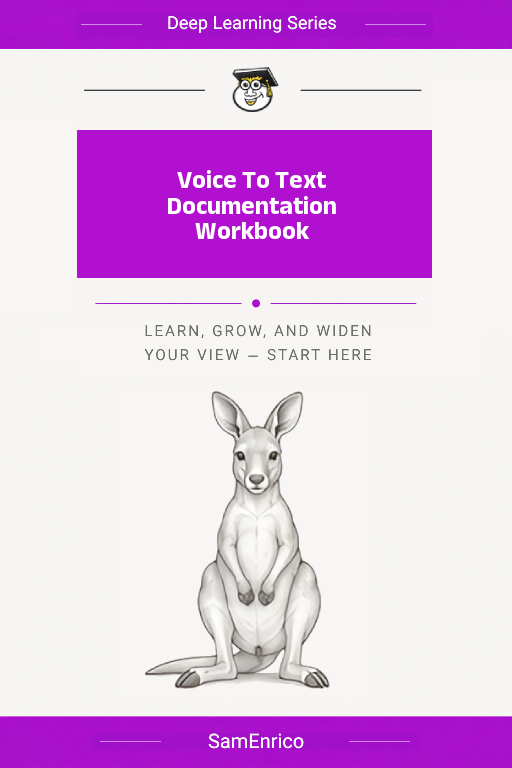
Non-FictionAI OperatorHealthcare AdminWorkbook
Voice To Text Documentation Workbook
Train AI to transcribe clinical dictations with sp
Train AI to transcribe clinical dictations with specialty-specific vocabulary and formatting rules. Includes accent adaptation, abbreviation expansion, and real-time editing prompts.
Formats
About this book
Free sample
Chapter 1: The Listening Lie...--–- Most doctors believe that voice-to-text software hears what they say. That is the first and most dangerous lie in medical documentation. The truth is far stranger and far more important: Automatic Speech Recognition (ASR) systems do not hear at all. They predict. Every word that appears on your screen is not a recording of your voice but a statistical bet made by a machine that has never understood a single syllable of human language.This distinction between hearing and predicting is not academic pedantry.
It is the entire foundation upon which this workbook is built. If you approach AI transcription as if it were a human transcriptionist—someone who listens, understands context, and types what you meant—you will spend hours correcting the same errors, cursing the software, and eventually reverting to typing your own notes. But if you understand that the AI is a probability engine that needs to be trained, edited, and commanded in real time, you become something far more valuable than a transcriptionist. You become a Medical Language Specialist.The medical documentation profession is undergoing its most radical transformation since the adoption of the typewriter. In the past five years, the role has shifted from linear typing (listen → type verbatim → review) to parallel editing (listen → AI transcribes → edit simultaneously → command corrections).
The human at the keyboard is no longer a typist; they are a diagnostician of machine error, a prompt engineer, and a risk manager rolled into one. This chapter dismantles the old mindset and builds the new one, starting with the single most important concept: the Hybrid Workflow.The Great Role Reversal For decades, medical transcription followed a linear, predictable path. A clinician dictated into a cassette recorder or a digital voice file. A human transcriptionist listened, typed, printed, and filed. The transcriptionist's job was verbatim accuracy—every "um," every false start, every repetition preserved.
The skill that mattered was typing speed. The faster you typed, the more notes you produced, the more you were paid. The clinician reviewed the final document and signed it.That world is dead. Not…
This is the end of the free sample. Get the eBook to keep going. Buy now
Contents
- Chapter 1
- Chapter 2
- Chapter 3
- Chapter 4
- Chapter 5
- Chapter 6
- Chapter 7
- Chapter 8
- Chapter 9
- Chapter 10
- Chapter 11
- Chapter 12
Details
- Author
- Sewell Helene
- Publisher
- SamEnrico
- Language
- English
- Genre
- Non-Fiction, AI Operator, Healthcare Admin, Workbook
- Released
- 2026-05-30
- Pages (approx.)
- 137
- Available as
- eBook, Audiobook

Read better in the ZLOADR app
Your eBooks on your phone or tablet. Sign in with your SamEnrico account and start reading.
More by Sewell Helene
 Nonverbal Cues in RelationshipsSewell Helene$11.99
 Burnout Prevention for Optometrists HandbookSewell Helene$11.99
 Pet Loss Ceremony GuideSewell Helene$11.99
 Joan of Arc AccountSewell Helene$11.99
 The Self Esteem After Divorce WorkbookSewell Helene$11.99
 The Scarab's Oath: Nefertiti's Lost ProphecySewell Helene$11.99
 Understanding Kozlowski–ouvrier SyndromeSewell Helene$17.99
 SaaS International Expansion GuideSewell Helene$12.99
 Architectural DraftsmanSewell Helene$11.99
 How to Start a Hobby in Snow SkiingSewell Helene$11.99
You may also like
 Hong Kong Handover 1997Dunn Johnnie$11.99
 Zumba For Postnatal Recovery CourseNeal Christian$11.99
 Zumba for BeginnersLadner Nikia$11.99
 YouTube Comment Mining GuideHumes Pandora$12.99
 Worry Box MeditationCarlin Rudy$11.99
 Workplace Stress MeditationNguyen Lynn$11.99
 Workplace Stress and Sleep RepairHawley Ivory$11.99
 Workplace Perfectionism CureDelaney Jeffry$11.99
 Workplace Injustice Anger GuideWallen Isabelle$11.99
 Work Addiction and Burnout LinkGreenwood Ester$11.99
 Women in Yoga and WellnessBeattie Galina$11.99
 Women in Stand Up ComedyChun Evangeline$11.99