
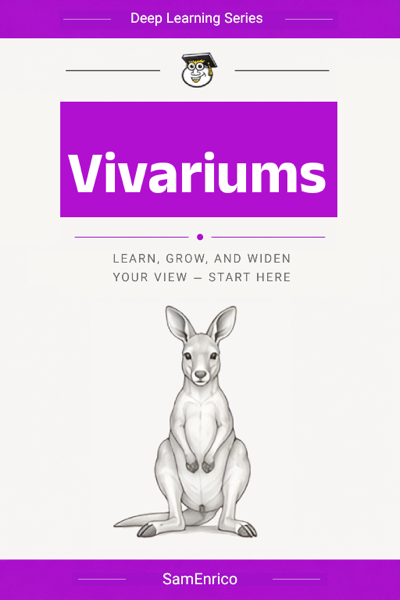
Non-FictionInformativeEducational
Vivariums eBook
A Coursebook on Vivariums
A Coursebook on Vivariums
Formats
Free sample
Chapter 1: The Graveyard of Good Intentions– I killed my first vivarium. Not slowly, not gracefully, but with the enthusiastic incompetence of someone who had read exactly three forum posts and decided he was ready to build a rainforest in his living room. The tank was a standard forty-gallon breeder, purchased secondhand for thirty dollars, complete with a mysterious white residue on the glass that I now know was calcium deposit from years of hard water and neglect. The substrate was potting soil from the hardware store, chosen because the bag featured a lush green fern on the front and the word "organic" in cheerful font. The plants were whatever the garden center had on clearance–a sad little fern, some sort of trailing vine I couldn't name, and a bromeliad that looked like it had already given up on life before I brought it home.
The animals were three poison dart frogs, purchased from an online breeder because they were beautiful and because I had convinced myself that difficulty was a sign of virtue.Within six weeks, the fern had melted into brown sludge. The vine had developed a fuzzy gray mold that spread across the substrate like a slow-motion invasion. The bromeliad's central cup, which I had dutifully filled with distilled water every morning, had become a breeding ground for some sort of mosquito-like insect that I could only assume was plotting against me. The frogs, those jewel-toned ambassadors of my ambition, sat hunched on the single surviving leaf, their colors dulled to a bruised green, refusing to eat the fruit flies I sprinkled into their dying kingdom. The smell was the worst part–a sweet, rotten odor that clung to the room and announced to every visitor that something was profoundly wrong inside that glass box.I had built a cage.
I had intended to build a world.This chapter is for everyone who has stood in front of a dying vivarium and wondered what went wrong. It is for the beginner who just spent four hundred dollars on equipment and has no idea where to start. It is for the intermediate keeper who has kept a leopard gecko alive for three years but suspects the animal is merely surviving rather than thriving. And it is for the expert who knows that every system, no matter how well designed, is one equipment failure away from disaster. Because before we talk about substrates and lighting and clean-up crews and all the technical machinery of a functioning vivarium, we need to talk about the philosophy that makes all of that machinery meaningful.
We need to understand why the cage mindset fails and what the ecosystem mindset requires. We need to unlearn almost everything that pet stores and popular culture have taught us about keeping animals in glass boxes.The Cage Mindset: A Failure of Imagination The traditional approach to keeping reptiles, amphibians, and invertebrates in captivity is what I call the Cage Mindset. It is a philosophy of containment, sterilization, and control that prioritizes the keeper's convenience over the animal's biology. In a cage, the primary goals are simple: keep the animal from escaping, keep the enclosure easy to clean, and keep the animal alive long enough to justify the initial investment. Everything else–behavioral enrichment, psychological well-being, the complex web of ecological relationships that the animal evolved to inhabit–is treated as optional decoration at best, or as a nuisance to be engineered away at worst.This mindset manifests in familiar ways.
The glass tank with paper towel substrate, a plastic hide shaped like a half-log, a ceramic water bowl, and a single fake plant. The reptile carpet that can be pulled out and hosed down once a week. The bare-bottom enclosure where feces are visible and therefore removable. The philosophy is seductive because it promises cleanliness and control. You can see everything.
You can sanitize everything. There are no surprises, because there is nothing in the tank that you did not put there yourself.But here is the truth that the pet industry does not want you to hear: a sterile environment is a stressful environment. When we strip away the complexity of a natural habitat–the leaf litter, the soil microbes, the hiding places, the microclimates, the sheer untidiness of a living world–we are not simplifying the animal's life. We are removing the very cues and choices that allow it to regulate its own biology.Consider what happens to a reptile in a bare enclosure. In nature, a lizard can move between sun and shade, dry leaf litter and moist soil, exposed perches and hidden crevices.
It can choose, moment by moment, the conditions that best suit its current needs. In a barren cage, those choices vanish. The animal cannot thermoregulate properly because the temperature is the same everywhere, or because the only heat source creates a single hot spot that the animal cannot escape without leaving the warm side entirely. It cannot hide because there is nowhere to hide, or because the hide is a plastic box that provides no sensory complexity. It cannot find moisture because the only water is in a bowl, or because the substrate is too dry or too wet everywhere.
The animal is not living. It is waiting.I spent three years working at a reptile rescue during college. We received hundreds of animals from well-meaning owners who had followed the instructions they were given. The ball pythons came in glass tanks with aspen bedding, a heat lamp, and a single hide. The bearded dragons came in forty-gallon breeders with reptile carpet and a bowl of pellets.
The crested geckos came in tall enclosures with paper towel substrate, a plastic plant, and a dish of powdered diet. On paper, these setups met the minimum requirements. In reality, the animals arrived with metabolic bone disease, chronic respiratory infections, stress-induced anorexia, and a thousand small miseries that their owners had mistaken for normal reptile behavior.The problem was not malice. The problem was a failure of imagination. The owners had never been taught to think of their enclosures as ecosystems.
They had been taught to think of them as cages.The Ecosystem Mindset: A Different Way of Seeing The alternative to the Cage Mindset is what this book calls the Ecosystem Mindset. It is a philosophy that begins from a radically different premise: a vivarium is not a cage. It is a controlled environment where the interaction of light, water, soil, plants, microbes, and animals creates a self-regulating habitat. The keeper's role is not to clean and control. The keeper's role is to design, to balance, and to intervene only when the system requires recalibration.In an ecosystem, waste is not something to be removed.
It is something to be processed. In an ecosystem, sterilization is not a goal. It is a failure to understand the role of decomposers. In an ecosystem, the visible health of the animals is the last indicator of system function, not the first. By the time a frog stops eating, the vivarium has been failing for weeks.
The signs were there–in the humidity readings, in the condition of the leaf litter, in the activity of the clean-up…
This is the end of the free sample. Get the eBook to keep going. Buy now
About this book
Details
- Author
- Waggoner Dortha
- Publisher
- SamEnrico
- Language
- English
- Genre
- Non-Fiction, Informative, Educational
- Released
- 2026-05-04
- Pages (approx.)
- 150
- Available as
- eBook, Audiobook

Read better in the ZLOADR app
Your eBooks on your phone or tablet. Sign in with your SamEnrico account and start reading.
More by Waggoner Dortha
 CrossFit Competition Prep HandbookWaggoner Dortha$11.99
 Crop Insurance Agency DirectoryWaggoner Dortha$11.99
 The Shame of Loneliness WorkbookWaggoner Dortha$11.99
 Meditation for Sickle Cell PainWaggoner Dortha$11.99
 Beginner Fitness Warm Up GuideWaggoner Dortha$11.99
 The Last Tycoon’s Island: How Howard Hughes Bought His Own ParadiseWaggoner Dortha$11.99
 The Ballot Rebellion: How a Single Town Overturned a GovernorWaggoner Dortha$11.99
 Understanding D-glyceric AcidemiaWaggoner Dortha$17.99
 Docker Certification GuideWaggoner Dortha$12.99
 Dissolved Entities CTA GuideWaggoner Dortha$12.99
 How to Become a Charger OperatorWaggoner Dortha$11.99
You may also like
 Hong Kong Handover 1997Dunn Johnnie$11.99
 Zumba For Postnatal Recovery CourseNeal Christian$11.99
 Zumba for BeginnersLadner Nikia$11.99
 YouTube Comment Mining GuideHumes Pandora$12.99
 Worry Box MeditationCarlin Rudy$11.99
 Workplace Stress MeditationNguyen Lynn$11.99
 Workplace Stress and Sleep RepairHawley Ivory$11.99
 Workplace Perfectionism CureDelaney Jeffry$11.99
 Workplace Injustice Anger GuideWallen Isabelle$11.99
 Work Addiction and Burnout LinkGreenwood Ester$11.99
 Women in Yoga and WellnessBeattie Galina$11.99
 Women in Stand Up ComedyChun Evangeline$11.99