
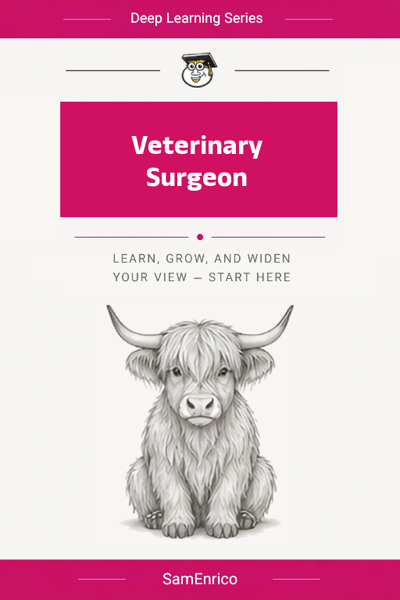
Non-FictionInformativeEducational
Veterinary Surgeon eBook
A Coursebook on Veterinary Surgeon
A Coursebook on Veterinary Surgeon
Formats
Free sample
Chapter 1: The Room Where It Happens--– The surgical suite is not a room. It is a living system of airflow, sterility, traffic patterns, and human behavior—and if any part of that system fails, the patient pays the price. Most veterinary students walk into their first surgery rotation believing that the surgeon’s hands matter most. They are wrong. The environment matters first.
You can be the most gifted technician with the steadiest hands in the profession, but if you operate in a poorly designed space, if your sterilization cycle was interrupted, if a door was left open to the corridor—your patient will develop a surgical site infection, and nothing you do with a scalpel will undo that damage.This chapter is about the room where surgery happens. Not the glamour, not the drama, not the heroic saves. The boring, obsessive, life-saving details of facility design, aseptic technique, sterilization science, patient optimization, and team safety. Master this material, and you will never be the reason a patient dies from a preventable infection. Ignore it, and you become a liability—no matter how many TPLOs you can perform in under an hour.The Operating Suite: Zones, Airflow, and the War Against Contamination Every surgical facility, regardless of size or species focus, should be organized into three concentric zones of decreasing contamination risk.
These zones are not suggestions; they are the foundation of aseptic discipline.The unrestricted zone is the outermost perimeter. Street clothes are permitted here. This area includes the hospital lobby, public corridors, administrative offices, and the janitorial closet. No surgical activity occurs here, and no sterile supplies should ever be stored here. The transition from unrestricted to semi-restricted is where most contamination events begin—because people forget to change their shoes, put on a cap, or wash their hands.The semi-restricted zone is where surgical team members change into scrub attire.
This area includes locker rooms, scrub sinks, and the corridor leading to the operating room doors. Only authorized personnel wearing clean scrubs, surgical caps, and dedicated surgical shoes (or shoe covers) may enter. In well-designed facilities, the scrub sink area functions as a psychological and physical barrier—you cannot proceed into the operating room without passing through the hand hygiene ritual. Traffic flow should be one-way: from unrestricted to semi-restricted to restricted. Any backtracking increases contamination risk.The restricted zone is the operating room itself.
Here, everyone wears a surgical mask (covering both nose and mouth—a detail violated constantly in busy practices), a sterile gown after scrubbing, and sterile gloves. The doors must remain closed except during patient transfer. In an ideal world, the OR has a separate entry for sterile instruments and supplies, preventing personnel from crossing traffic patterns.Airflow is the invisible guardian of the restricted zone. Positive pressure ventilation means air flows out of the OR when the door opens, not into it. Minimum standards call for 15 air changes per hour (ACH) in an operating room, with at least 3 of those being fresh outdoor air.
HEPA filtration removes 99.97% of particles 0.3 microns or larger. Air should enter through ceiling diffusers and exit through low-wall returns, creating vertical laminar flow that sweeps contaminants away from the surgical field. In equine and bovine facilities, air handling becomes even more critical because of the sheer volume of organic material (hair, dander, manure) brought in on large animals—some referral hospitals dedicate separate ventilation systems for large animal ORs.Sterilization: The Science of Killing Everything Sterilization is not the same as disinfection. Disinfection reduces microbial load but does not eliminate bacterial spores. Sterilization eliminates all forms of microbial life, including spores.
For any instrument that penetrates tissue or enters a sterile body space, sterilization is non-negotiable.Steam sterilization (autoclaving) is the gold standard for most veterinary instruments. It uses saturated steam under pressure at 121–134°C (250–273°F). The killing mechanism is protein coagulation—the same process that turns egg whites opaque. Autoclaving is fast (15–30 minutes), non-toxic, and inexpensive. But it cannot be used for heat-sensitive items like endoscopes, power tools, or certain plastics.
Wrapping instruments in sterilization pouches or textile wraps maintains sterility after the cycle ends—provided the package remains dry. A wet pack is a contaminated pack, because moisture wicks bacteria through the barrier.Gas sterilization using ethylene oxide (Et O) is the alternative for heat-sensitive instruments. Et O alkylates microbial DNA and proteins, killing at low temperatures (37–55°C). The cycle is long (2–12 hours) and requires aeration (8–12 hours) to remove toxic residues. Et O is a carcinogen, mutagen, and respiratory irritant—operating rooms using Et O must have dedicated exhaust systems and personnel monitoring.
In many practices, Et O has been replaced by hydrogen peroxide gas plasma (Sterrad), which is safer and faster (45–75 minutes) but requires specialized equipment and cannot process liquids or powders.Cold sterilization using chemical solutions (glutaraldehyde, peracetic acid, ortho-phthalaldehyde) is not true sterilization for most practical purposes. Glutaraldehyde achieves high-level disinfection after 20 minutes and sterilization after 10 hours—but the 10-hour immersion is rarely practical or verified in busy practices. Cold sterilization is acceptable for semi-critical items (endoscopes that contact mucous membranes) but never for critical instruments that penetrate tissue. The single most common sterilization failure in veterinary medicine is relying on cold sterilization for instruments that should be autoclaved.Sterilization monitoring is mandatory, not optional. Mechanical indicators (temperature, pressure gauges) are checked every cycle.
Chemical indicators (autoclave tape, indicator strips) confirm that steam or gas reached the instrument. Biological indicators (spore strips containing Geobacillus stearothermophilus for steam, Bacillus atrophaeus for Et O) are the gold standard—run at least weekly in any surgical practice. If a biological indicator returns positive, all instruments processed since the last negative test must be recalled and re-sterilized.Preoperative Patient Assessment: The ASA System and Risk Prediction Surgery begins not in the operating room but at the moment the patient is admitted. The single most powerful predictor of surgical outcome is not the procedure itself but the patient’s preoperative health status.The American Society of Anesthesiologists (ASA) Physical Status Classification System is the universal language of preoperative risk assessment. Every veterinary surgical patient should receive an ASA score before anesthesia.
The scoring is subjective but validated: higher ASA scores correlate with higher perioperative mortality.ASA I describes a normal, healthy patient. No systemic disease. A 2-year-old spayed Labrador retriever with no comorbidities. Perioperative mortality risk: approximately 0.05–0.1%.ASA II describes a patient with mild systemic disease that does not limit activity. Well-controlled hypothyroidism, a low-grade heart murmur without hemodynamic significance, or a dog with mild obesity.
Mortality risk: 0.3–0.5%.ASA III describes a patient with severe systemic disease that limits activity but is not immediately life-threatening. Diabetes mellitus, compensated congestive heart failure, or moderate chronic kidney disease. Mortality risk: 1.5–4.0%.ASA IV describes a patient with severe systemic disease that is a constant threat to life. Decompensated heart failure, uremia from renal failure, or a septic abdomen. Mortality risk: 7–20%.ASA V describes a moribund patient not expected to survive 24 hours without surgery.
Resuscitation required before anesthesia is even attempted. Mortality risk: 20–50% or higher.ASA VI is reserved for brain-dead patients whose organs are being harvested for transplantation—essentially irrelevant in veterinary medicine except for research contexts.The letter “E” is appended for…
This is the end of the free sample. Get the eBook to keep going. Buy now
About this book
Details
- Author
- Gilman Gregorio
- Publisher
- SamEnrico
- Language
- English
- Genre
- Non-Fiction, Informative, Educational
- Released
- 2026-05-07
- Pages (approx.)
- 138
- Available as
- eBook, Audiobook

Read better in the ZLOADR app
Your eBooks on your phone or tablet. Sign in with your SamEnrico account and start reading.
More by Gilman Gregorio
 Flow HandbookGilman Gregorio$11.99
 Email Follow Up System GuideGilman Gregorio$11.99
 Holiday Party Small TalkGilman Gregorio$11.99
 Food Addiction Visualization GuideGilman Gregorio$11.99
 The Weekly Meal Prep Sunday GuideGilman Gregorio$11.99
 Anansi's Lyrical Web: The Spider's Symphony of TrickeryGilman Gregorio$11.99
 How to Start a Photocopier Printing Business (Beginners Guide)Gilman Gregorio$11.99
 Ghana Mobility Startup GuideGilman Gregorio$12.99
 Depressed CEO HandbookGilman Gregorio$12.99
 Understanding Wiedemann–grosse–dibbern SyndromeGilman Gregorio$17.99
You may also like
 Hong Kong Handover 1997Dunn Johnnie$11.99
 Zumba For Postnatal Recovery CourseNeal Christian$11.99
 Zumba for BeginnersLadner Nikia$11.99
 YouTube Comment Mining GuideHumes Pandora$12.99
 Worry Box MeditationCarlin Rudy$11.99
 Workplace Stress MeditationNguyen Lynn$11.99
 Workplace Stress and Sleep RepairHawley Ivory$11.99
 Workplace Perfectionism CureDelaney Jeffry$11.99
 Workplace Injustice Anger GuideWallen Isabelle$11.99
 Work Addiction and Burnout LinkGreenwood Ester$11.99
 Women in Yoga and WellnessBeattie Galina$11.99
 Women in Stand Up ComedyChun Evangeline$11.99