
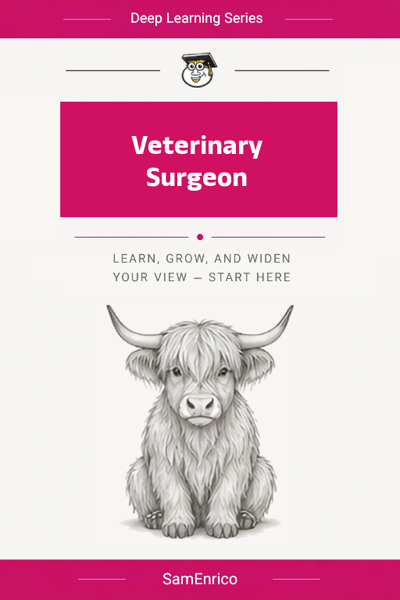
Non-FictionInformativeEducational
Veterinary Surgeon Audiobook
A Coursebook on Veterinary Surgeon
A Coursebook on Veterinary Surgeon
Formats
Free sample
Chapter 1: The Room Where It Happens--– The surgical suite is not a room. It is a living system of airflow, sterility, traffic patterns, and human behavior—and if any part of that system fails, the patient pays the price. Most veterinary students walk into their first surgery rotation believing that the surgeon’s hands matter most. They are wrong. The environment matters first.
You can be the most gifted technician with the steadiest hands in the profession, but if you operate in a poorly designed space, if your sterilization cycle was interrupted, if a door was left open to the corridor—your patient will develop a surgical site infection, and nothing you do with a scalpel will undo that damage.This chapter is about the room where surgery happens. Not the glamour, not the drama, not the heroic saves. The boring, obsessive, life-saving details of facility design, aseptic technique, sterilization science, patient optimization, and team safety. Master this material, and you will never be the reason a patient dies from a preventable infection. Ignore it, and you become a liability—no matter how many TPLOs you can perform in under an hour.The Operating Suite: Zones, Airflow, and the War Against Contamination Every surgical facility, regardless of size or species focus, should be organized into three concentric zones of decreasing contamination risk.
These zones are not suggestions; they are the foundation of aseptic discipline.The unrestricted zone is the outermost perimeter. Street clothes are permitted here. This area includes the hospital lobby, public corridors, administrative offices, and the janitorial closet. No surgical activity occurs here, and no sterile supplies should ever be stored here. The transition from unrestricted to semi-restricted is where most contamination events begin—because people forget to change their shoes, put on a cap, or wash their hands.The semi-restricted zone is where surgical team members change into scrub attire.
This area includes locker rooms, scrub sinks, and the corridor leading to the operating room doors. Only authorized personnel wearing clean scrubs, surgical caps, and dedicated surgical shoes (or shoe covers) may enter. In well-designed facilities, the scrub sink area functions as a psychological and physical barrier—you cannot proceed into the operating room without passing through the hand hygiene ritual. Traffic flow should be one-way: from unrestricted to semi-restricted to restricted. Any backtracking increases contamination risk.The restricted zone is the operating room itself.
Here, everyone wears a surgical mask (covering both nose and mouth—a detail violated constantly in busy practices), a sterile gown…
This is the end of the free sample. Get the Audiobook to keep going. Buy now
About this book
Details
- Author
- Gilman Gregorio
- Publisher
- SamEnrico
- Language
- English
- Genre
- Non-Fiction, Informative, Educational
- Released
- 2026-05-07
- Pages (approx.)
- 138
- Available as
- eBook, Audiobook

Listen in the VoxFlicks app
Audiobooks and audio dramas wherever you go. Sign in with your SamEnrico account and press play.
More by Gilman Gregorio
 Flow HandbookGilman Gregorio$11.99
 Email Follow Up System GuideGilman Gregorio$11.99
 Holiday Party Small TalkGilman Gregorio$11.99
 Food Addiction Visualization GuideGilman Gregorio$11.99
 The Weekly Meal Prep Sunday GuideGilman Gregorio$11.99
 Anansi's Lyrical Web: The Spider's Symphony of TrickeryGilman Gregorio$11.99
 How to Start a Photocopier Printing Business (Beginners Guide)Gilman Gregorio$11.99
 Ghana Mobility Startup GuideGilman Gregorio$12.99
 Depressed CEO HandbookGilman Gregorio$12.99
 Understanding Wiedemann–grosse–dibbern SyndromeGilman Gregorio$17.99
You may also like
 Hong Kong Handover 1997Dunn Johnnie$11.99
 Zumba For Postnatal Recovery CourseNeal Christian$11.99
 Zumba for BeginnersLadner Nikia$11.99
 YouTube Comment Mining GuideHumes Pandora$12.99
 Worry Box MeditationCarlin Rudy$11.99
 Workplace Stress MeditationNguyen Lynn$11.99
 Workplace Stress and Sleep RepairHawley Ivory$11.99
 Workplace Perfectionism CureDelaney Jeffry$11.99
 Workplace Injustice Anger GuideWallen Isabelle$11.99
 Work Addiction and Burnout LinkGreenwood Ester$11.99
 Women in Yoga and WellnessBeattie Galina$11.99
 Women in Stand Up ComedyChun Evangeline$11.99