
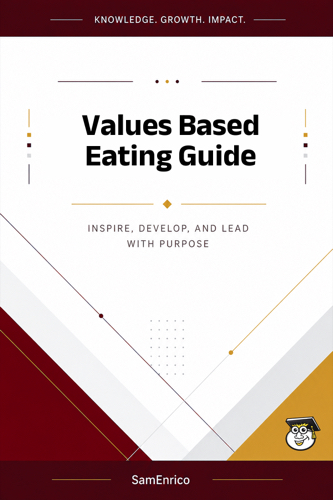
Values Based Eating Guide eBook
Align food choices with personal values like healt
Align food choices with personal values like health vitality or family.
Formats
Free sample
Chapter 1: The Spiral Beneath--–- It was 7:42 on a Tuesday evening when I found myself standing in my pantry, eating shredded cheddar cheese directly from the bag, tears streaming down my face. I wasn't hungry. I wasn't even particularly fond of that brand of cheese. But I had just finished making a separate dinner for my toddler (buttered noodles, no sauce), a separate dinner for my spouse (leftover stir-fry reheated in the microwave), and a sad desk salad for myself that I had abandoned after three bites because it tasted like guilt. The cheese was not dinner.
The cheese was a surrender.This is not a story about weakness. This is a story about a system designed to make you fail, and then convince you that the failure is your fault.For twenty years, I had been a model dieter. Weight Watchers points in college. Atkins in my twenties. Paleo in my early thirties.
Intermittent fasting during the pandemic when no one was watching. I had a spreadsheet of my macros. I owned a food scale. I could recite the calorie count of a Starbucks pumpkin scone from memory (480, in case you are wondering). And I was miserable.
Not because the diets didn't work—they worked, temporarily, every single time. I lost the same fifteen pounds approximately seventeen times. But each time, the weight came back with a vengeance, bringing along a plus-one: shame.The shame was the worst part. The shame whispered that I lacked willpower. That I was lazy.
That if I just tried harder, followed the rules more strictly, I would finally arrive at the promised land of being "good enough." The shame did not mention that the rules were rigged from the start.This book is not another set of rules. It is an exit ramp from the rules altogether.The Diet Industry's Best-Kept Secret Let me tell you something the diet industry does not want you to know: they need you to fail. Their business model depends on it.Weight Watchers (now WW) has been around since 1963. In that time, the company has gone public, gone private, gone public again, and reinvented its point system at least seven times. Not because the science improved dramatically every few years, but because if the old system worked permanently, they would lose their customers.
The same is true for every diet program, detox tea, meal delivery service, and "wellness" app on your phone. They are not in the business of curing your problem. They are in the business of managing it.Consider this: the average American adult has tried 126 different diets over their lifetime. One hundred and twenty-six. That is not a typo.
And yet, obesity rates have tripled in the last fifty years. Something is not adding up. If diets worked, wouldn't we be the healthiest generation in history? Instead, we are the most anxious, the most ashamed, and the most confused about what to put on our plates.The problem is not your willpower. The problem is the system.The Moral Hierarchy of Food Here is a quick experiment.
I am going to name three foods, and I want you to notice the emotion that arises with each one.Kale.Pizza.Apple.Chocolate cake.Did you feel it? That subtle surge of virtue when you read "kale" and "apple"? That flicker of guilt when you read "pizza" and "chocolate cake"? You have been trained to feel that. It is not natural.
Children do not feel guilty about eating cake. They feel joy. Somewhere along the way, we were taught that food carries moral weight—that eating "good" foods makes us good people, and eating "bad" foods makes us bad people.This is what I call the Moral Hierarchy of Food. At the top: raw vegetables, lean proteins, "superfoods" like quinoa and acai. In the middle: whole grains, dairy, fruit.
At the bottom: sugar, white flour, fried anything, and the dreaded "processed foods." The hierarchy is not based on nutrition science alone—if it were, the difference between an apple and a handful of berries would be negligible. The hierarchy is based on a patriarchal, capitalist system that profits from your perpetual dissatisfaction.Here is how it works. You eat "good" foods all day. You feel virtuous, superior, in control. But restriction breeds deprivation.
Deprivation breeds craving. Eventually, you "slip up" and eat a "bad" food—a cookie at the office, a slice of pizza at a birthday party, a bowl of ice cream after a hard day. The Moral Hierarchy converts that slip into shame. You are not just someone who ate a cookie; you are a bad person who ate a bad food. And because you are already bad, you might as well eat the whole sleeve.
Then tomorrow, you restart the cycle with renewed restriction, deeper deprivation, and the promise that this time will be different.It will not be different. The system is designed to repeat.The Spiral: A Name for What You Have Been Feeling I want to give you a name for this cycle. I call it The Spiral.The Spiral has four stages, and once you learn to recognize them, you will see them everywhere—in your own kitchen, in your friends' frustrated comments about their weight, in the wellness influencer who claims she "fell off the wagon" over the holidays.Stage One: Restriction This is where most diets begin. You decide to follow a set of external rules. Maybe you download an app that sets a calorie limit.
Maybe you cut out an entire food group—carbs, sugar, dairy, meat, whatever the current villain happens to be. Maybe you sign up for a program that delivers pre-portioned meals in boxes. The restriction feels good at first. It feels like control. You are finally doing something about your "problem."But here is what is happening beneath the surface.
Your body does not know the difference between intentional dieting and accidental starvation. When you consistently eat fewer calories than your body needs, your biology sounds the alarm. Hunger hormones (ghrelin) surge. Satiety hormones (leptin) plummet. Your metabolism slows down to conserve energy.
Your brain starts fixating on food—specifically, on the foods you have forbidden.This is not a character flaw. This is survival biology. Your body is not trying to sabotage you; your body is trying to keep you alive.Stage Two: Deprivation After days or weeks of restriction, you enter the deprivation phase. This is not just physical hunger—it is psychological scarcity. You start thinking about the forbidden foods constantly.
You dream about bread. You snap at your children because your blood sugar is low. You avoid social situations where food will be present because you do not trust yourself to "be good."Deprivation has a paradox at its heart: the more you restrict a food, the more desirable it becomes. Psychologists call this the "forbidden fruit effect." In one study, researchers told one group of participants that they could not eat a specific type of cookie, while another group was given no restrictions. The restricted group rated the cookie as significantly more desirable, ate more of it when given the chance, and reported higher levels of craving days…
This is the end of the free sample. Get the eBook to keep going. Buy now
About this book
Details
- Author
- Clevenger Julianna
- Publisher
- SamEnrico
- Language
- English
- Genre
- Non-Fiction, Health & Wellness, Values
- Released
- 2026-06-06
- Pages (approx.)
- 133
- Available as
- eBook, Audiobook

Read better in the ZLOADR app
Your eBooks on your phone or tablet. Sign in with your SamEnrico account and start reading.
More by Clevenger Julianna
 Bedroom Declutter Sleep AidClevenger Julianna$11.99
 Strength Training For BodybuildingClevenger Julianna$11.99
 Nobel Laureates In PhysiologyClevenger Julianna$11.99
 Mindful Walking for Anxiety ReliefClevenger Julianna$11.99
 The Last Transmission of the BeagleClevenger Julianna$11.99
 Titanic’s Forgotten Tycoon: The Man Who Built the Unsinkable DreamClevenger Julianna$11.99
 One Page Referral Program ManualClevenger Julianna$12.99
 Grant Peer Review GuideClevenger Julianna$12.99
 Understanding Gm2 Gangliosidosis, 0 VariantClevenger Julianna$17.99
 Parts RunnerClevenger Julianna$11.99
 How to Start a Hobby in PapermacheClevenger Julianna$11.99