
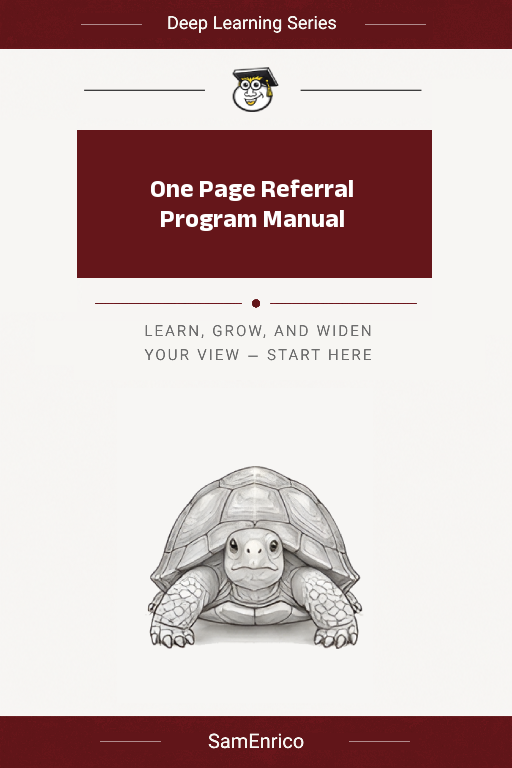
One Page Referral Program Manual
Design a customer referral system on one sheet inc
Design a customer referral system on one sheet including incentives, sharing mechanics, and tracking for word of mouth growth.
Formats
About this book
Free sample
Chapter 1: The Trust Transfer...--–- It was 1999, and a small startup called Pay Pal was burning through 20millionincustomeracquisitioncostseverysinglemonth.Themathwasterrifying.Eachnewcustomercostroughly20 million in customer acquisition costs every single month. The math was terrifying. Each new customer cost roughly 20millionincustomeracquisitioncostseverysinglemonth.Themathwasterrifying.Eachnewcustomercostroughly20 to acquire through traditional advertising channels. At that burn rate, the company would run out of money before reaching a million users. The board was panicking.
The conventional wisdom said to double down on ads, optimize the landing pages, and squeeze better rates from Google. But one executive asked a different question: What if we stopped paying for customers and started paying customers to bring us their friends?That question launched one of the most famous referral programs in business history. Pay Pal began offering 10toexistingusersforeveryfriendwhosignedup,plusanother10 to existing users for every friend who signed up, plus another 10toexistingusersforeveryfriendwhosignedup,plusanother10 to the new user. Critics called it bribery. Financial analysts said it was unsustainable.
Competitors laughed at the desperation. Over the next eighteen months, Pay Pal spent approximately 60to60 to 60to70 million on those referral rewards. And then e Bay acquired the company for $1.5 billion.The critics missed something fundamental. They saw the cost of the reward. They did not see what Pay Pal saw: a customer who arrives through a friend is not the same as a customer who arrives through an ad.
That referred customer stays longer, spends more, and churns less. The referred customer also refers more friends, creating a compounding loop that advertising can never match.This chapter reveals why referral programs work at the psychological level. You will learn why trust transfers between friends, what social currency means for your brand, and how double-sided incentives remove the uncomfortable "social tax" that kills most referral programs. By the end, you will understand that a referral is not a transaction. It is a relationship translated into growth.The 37 Percent Rule Let us start with a number that should change how you think about customer acquisition.
Referred customers have approximately 37 percent higher retention than customers acquired through paid advertising. This is not a marketing exaggeration. The…
This is the end of the free sample. Get the eBook to keep going. Buy now
Contents
- Chapter 1
- Chapter 2
- Chapter 3
- Chapter 4
- Chapter 5
- Chapter 6
- Chapter 7
- Chapter 8
- Chapter 9
- Chapter 10
- Chapter 11
- Chapter 12
Details
- Author
- Clevenger Julianna
- Publisher
- SamEnrico
- Language
- English
- Genre
- Non-Fiction, Business Brief, Referral Marketing
- Released
- 2026-05-30
- Pages (approx.)
- 146
- Available as
- eBook, Audiobook

Read better in the ZLOADR app
Your eBooks on your phone or tablet. Sign in with your SamEnrico account and start reading.
More by Clevenger Julianna
 Bedroom Declutter Sleep AidClevenger Julianna$11.99
 Strength Training For BodybuildingClevenger Julianna$11.99
 Nobel Laureates In PhysiologyClevenger Julianna$11.99
 Values Based Eating GuideClevenger Julianna$11.99
 Mindful Walking for Anxiety ReliefClevenger Julianna$11.99
 The Last Transmission of the BeagleClevenger Julianna$11.99
 Titanic’s Forgotten Tycoon: The Man Who Built the Unsinkable DreamClevenger Julianna$11.99
 Grant Peer Review GuideClevenger Julianna$12.99
 Understanding Gm2 Gangliosidosis, 0 VariantClevenger Julianna$17.99
 Parts RunnerClevenger Julianna$11.99
 How to Start a Hobby in PapermacheClevenger Julianna$11.99
You may also like
 Uber Driver Referral ProgramGuest Margot$11.99
 Wholesaling Referral ProgramMcmillan Robbi$11.99
 Referral Engine Acceleration ManualCarey Jamel$11.99
 The Referral Program Growth GuideBowens Humberto$11.99
 Referral Program One Page GuideHutcheson William$12.99
 One Page Referral Program HandbookMcmurray Lieselotte$12.99