
Non-FictionInformativeEducational
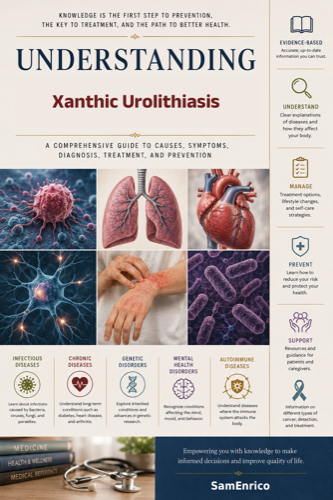
Understanding Xanthic Urolithiasis eBook
This disease publication, published by SamEnrico,
This disease publication, published by SamEnrico, covers Understanding Xanthic Urolithiasis
Formats
Free sample
Chapter 1: The Bottleneck Metabolite...--Every kidney stone tells a story. For the vast majority of patients who pass a calcium oxalate stone, the story is one of supersaturation—too much calcium, too little water, perhaps a genetic quirk in renal handling. For those with uric acid stones, the story often involves acidic urine, gouty diathesis, or a diet rich in purines. These are well-worn narratives, taught in every medical school, understood by every nephrologist. But there is another stone, one that appears in no such standard narrative.
It is radiolucent, often asymptomatic until catastrophe occurs, and arises from a metabolic failure so fundamental that it challenges our basic understanding of how the human body disposes of its own cellular waste. This is the xanthine stone, and its story begins not with the kidney at all, but with the ancient, conserved pathway by which life on Earth has handled the remnants of its genetic blueprint for over a billion years.To understand xanthic urolithiasis—the formation of stones composed primarily of xanthine—one must first understand purine metabolism. And to understand purine metabolism, one must appreciate a central irony: the same molecules that form the letters of our genetic code, the A and G in DNA and RNA, are also a waste problem that every cell must constantly solve. Purines are essential. Without them, there is no DNA replication, no RNA transcription, no ATP energy transfer, no cellular signaling.
But purines are also toxic when they accumulate. Every day, the human body turns over approximately 1-2% of its total purine pool as cells die and are replaced, as DNA is repaired, as ATP is consumed and regenerated. This daily purine load must be processed, detoxified, and excreted. The liver, and to a lesser extent the intestine, takes on this task through a carefully regulated enzymatic pathway that transforms insoluble purines into an excretable end product. In most humans, that end product is uric acid.
In patients with xanthinuria, the pathway breaks down at its most vulnerable step, and a different, less soluble metabolite accumulates. That metabolite is xanthine, and it is the bottleneck of the entire system.The Path from Nucleotide to Waste Let us begin at the beginning. Purines enter the human body through two distinct routes. The first is dietary. Every time a person consumes meat, fish, poultry, or organ meats, they ingest nucleoproteins—complex molecules containing purine bases embedded in DNA and RNA.
Digestion liberates these purines as free bases and nucleosides, which are absorbed across the small intestine and transported to the liver via the portal circulation. The second route is endogenous, and for most people, it accounts for roughly two-thirds of the daily purine load. Every cell in the body constantly turns over its nucleic acids. Old cells die and are phagocytosed; their DNA and RNA are broken down. Even within living cells, DNA repair mechanisms constantly excise damaged bases, and ATP is consumed and regenerated at staggering rates—a single resting human uses approximately 50 kilograms of ATP per day, with each molecule of ATP releasing a purine (adenine) that must be recycled or degraded.
This endogenous purine pool is massive, and it must be managed continuously.The degradation pathway, once initiated, proceeds through a series of highly conserved enzymatic steps. First, complex purine nucleotides are dephosphorylated to nucleosides. Then, nucleoside phosphorylases cleave these to free purine bases, primarily adenine and guanine. Adenine is deaminated to hypoxanthine, while guanine is directly converted to xanthine. At this point, the pathway converges: hypoxanthine and xanthine are the two intermediates standing between the purine pool and the final excretory product.
Hypoxanthine is relatively soluble in water, with a solubility of approximately 0.5 grams per liter at body temperature and neutral p H. Xanthine, by contrast, has a solubility of only about 0.1 grams per liter under the same conditions. Uric acid, the final product, has an intermediate solubility of approximately 0.3 grams per liter—but this solubility is highly p H-dependent, increasing dramatically in alkaline urine. This difference in solubility is the first clue to why xanthine is so dangerous when it accumulates.The enzyme responsible for the final two steps of this pathway is Xanthine Dehydrogenase, abbreviated XDH. This remarkable enzyme is a homodimer, meaning it consists of two identical subunits, each containing several cofactors including molybdenum, iron-sulfur clusters, and FAD.
XDH catalyzes two sequential oxidations: first, it converts hypoxanthine to xanthine; second, it converts xanthine to uric acid. Both reactions use water as the oxygen source and generate hydrogen peroxide as a byproduct. The enzyme is found primarily in the liver and small intestine, though smaller amounts are present in the kidney and other tissues. Under normal conditions, XDH operates efficiently, converting virtually all hypoxanthine and xanthine to uric acid. The steady-state concentration of xanthine in human plasma is typically less than 1 micromolar, while uric acid circulates at 200-400 micromolar.
Xanthine is a trace intermediate, not a final product.But this efficiency comes with a vulnerability. XDH is the only enzyme in humans capable of converting xanthine to uric acid. There is no backup pathway, no alternative enzyme, no salvage route. If XDH activity is lost or reduced, xanthine has nowhere to go. It accumulates in the liver, spills into the bloodstream, and is filtered by the kidneys.
In the urine, where water is being reabsorbed and the total volume is concentrated, xanthine can quickly exceed its solubility limit. When that happens, crystals form. And crystals, once formed, can aggregate into stones.The Concept of the Bottleneck Metabolite To understand why xanthine is the bottleneck, one must appreciate the concept of metabolic flux. In any biochemical pathway, the rate of product formation is determined by the slowest step. For purine degradation, the step from xanthine to uric acid—catalyzed by XDH—is not inherently slow.
Under normal conditions, XDH has plenty of capacity. But if that capacity is reduced by genetic mutation or pharmacological inhibition, the entire pathway backs up behind that step. Hypoxanthine, the precursor, can be salvaged back into the purine pool through the action of hypoxanthine-guanine phosphoribosyltransferase (HGPRT), an enzyme that reattaches a ribose sugar to the purine base and returns it to the nucleotide pool. This salvage pathway is efficient and active—it is the reason that Lesch-Nyhan syndrome, caused by HGPRT deficiency, leads to massive uric acid overproduction. Normally, however, HGPRT acts as a safety valve, recycling hypoxanthine before it reaches xanthine.
Xanthine cannot be salvaged. There is no enzyme in humans that can reattach a ribose to xanthine. Once xanthine is formed, the only way out is forward through XDH or excretion into the urine. When XDH is deficient, xanthine has no escape.This makes xanthine a uniquely dangerous metabolite. It is less soluble than its precursor.
It cannot be recycled. It is produced at a rate determined by the upstream pathway, not by downstream demand. And its only exit—uric acid production—is blocked. This is the biochemical essence of xanthinuria: a failure not of the kidney, not of the liver, but of a single enzyme at the most vulnerable point in a critical metabolic pathway.A Historical and Clinical Perspective The first case of hereditary xanthinuria was described in 1954 by Dr. Carl Dent, a…
This is the end of the free sample. Get the eBook to keep going. Buy now
About this book
Details
- Author
- Stackhouse Albertine
- Publisher
- SamEnrico
- Language
- English
- Genre
- Non-Fiction, Informative, Educational
- Released
- 2026-05-07
- Pages (approx.)
- 149
- Available as
- eBook, Audiobook

Read better in the ZLOADR app
Your eBooks on your phone or tablet. Sign in with your SamEnrico account and start reading.
More by Stackhouse Albertine
 Teen Comparison Addiction CureStackhouse Albertine$11.99
 The De-escalation HandbookStackhouse Albertine$11.99
 Teeth Grinding Night GuardStackhouse Albertine$11.99
 Disney Voice Actor MemoirStackhouse Albertine$11.99
 The CIWA Protocol GuideStackhouse Albertine$11.99
 The Snowboard Heist: How a Chilean Rebel Outsmarted the Ski EliteStackhouse Albertine$11.99
 Weekend User Testing SprintStackhouse Albertine$12.99
 International CAC StrategyStackhouse Albertine$12.99
 India's Independence: Midnight's ChildrenStackhouse Albertine$11.99
You may also like
 Hong Kong Handover 1997Dunn Johnnie$11.99
 Zumba For Postnatal Recovery CourseNeal Christian$11.99
 Zumba for BeginnersLadner Nikia$11.99
 YouTube Comment Mining GuideHumes Pandora$12.99
 Worry Box MeditationCarlin Rudy$11.99
 Workplace Stress MeditationNguyen Lynn$11.99
 Workplace Stress and Sleep RepairHawley Ivory$11.99
 Workplace Perfectionism CureDelaney Jeffry$11.99
 Workplace Injustice Anger GuideWallen Isabelle$11.99
 Work Addiction and Burnout LinkGreenwood Ester$11.99
 Women in Yoga and WellnessBeattie Galina$11.99
 Women in Stand Up ComedyChun Evangeline$11.99