
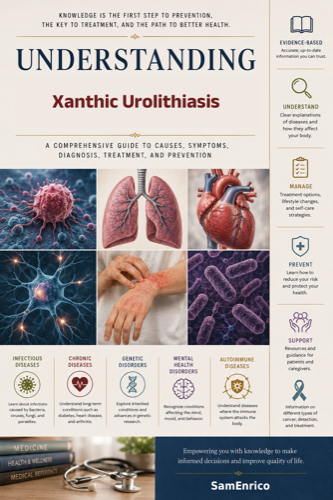
Non-FictionInformativeEducational
Understanding Xanthic Urolithiasis
This disease publication, published by SamEnrico,
This disease publication, published by SamEnrico, covers Understanding Xanthic Urolithiasis
Formats
About this book
Free sample
Chapter 1: The Bottleneck Metabolite...--Every kidney stone tells a story. For the vast majority of patients who pass a calcium oxalate stone, the story is one of supersaturation—too much calcium, too little water, perhaps a genetic quirk in renal handling. For those with uric acid stones, the story often involves acidic urine, gouty diathesis, or a diet rich in purines. These are well-worn narratives, taught in every medical school, understood by every nephrologist. But there is another stone, one that appears in no such standard narrative.
It is radiolucent, often asymptomatic until catastrophe occurs, and arises from a metabolic failure so fundamental that it challenges our basic understanding of how the human body disposes of its own cellular waste. This is the xanthine stone, and its story begins not with the kidney at all, but with the ancient, conserved pathway by which life on Earth has handled the remnants of its genetic blueprint for over a billion years.To understand xanthic urolithiasis—the formation of stones composed primarily of xanthine—one must first understand purine metabolism. And to understand purine metabolism, one must appreciate a central irony: the same molecules that form the letters of our genetic code, the A and G in DNA and RNA, are also a waste problem that every cell must constantly solve. Purines are essential. Without them, there is no DNA replication, no RNA transcription, no ATP energy transfer, no cellular signaling.
But purines are also toxic when they accumulate. Every day, the human body turns over approximately 1-2% of its total purine pool as cells die and are replaced, as DNA is repaired, as ATP is consumed and regenerated. This daily purine load must be processed, detoxified, and excreted. The liver, and to a lesser extent the intestine, takes on this task through a carefully regulated enzymatic pathway that transforms insoluble purines into an excretable end product. In most humans, that end product is uric acid.
In patients with xanthinuria, the pathway breaks down at its most vulnerable step, and a different, less soluble metabolite accumulates. That metabolite is xanthine, and it is…
This is the end of the free sample. Get the eBook to keep going. Buy now
Contents
- Chapter 1
- Chapter 2
- Chapter 3
- Chapter 4
- Chapter 5
- Chapter 6
- Chapter 7
- Chapter 8
- Chapter 9
- Chapter 10
- Chapter 11
- Chapter 12
Details
- Author
- Stackhouse Albertine
- Publisher
- SamEnrico
- Language
- English
- Genre
- Non-Fiction, Informative, Educational
- Released
- 2026-05-07
- Pages (approx.)
- 149
- Available as
- eBook, Audiobook

Read better in the ZLOADR app
Your eBooks on your phone or tablet. Sign in with your SamEnrico account and start reading.
More by Stackhouse Albertine
 Teen Comparison Addiction CureStackhouse Albertine$11.99
 The De-escalation HandbookStackhouse Albertine$11.99
 Teeth Grinding Night GuardStackhouse Albertine$11.99
 Disney Voice Actor MemoirStackhouse Albertine$11.99
 The CIWA Protocol GuideStackhouse Albertine$11.99
 The Snowboard Heist: How a Chilean Rebel Outsmarted the Ski EliteStackhouse Albertine$11.99
 Weekend User Testing SprintStackhouse Albertine$12.99
 International CAC StrategyStackhouse Albertine$12.99
 India's Independence: Midnight's ChildrenStackhouse Albertine$11.99
You may also like
 Hong Kong Handover 1997Dunn Johnnie$11.99
 Zumba For Postnatal Recovery CourseNeal Christian$11.99
 Zumba for BeginnersLadner Nikia$11.99
 YouTube Comment Mining GuideHumes Pandora$12.99
 Worry Box MeditationCarlin Rudy$11.99
 Workplace Stress MeditationNguyen Lynn$11.99
 Workplace Stress and Sleep RepairHawley Ivory$11.99
 Workplace Perfectionism CureDelaney Jeffry$11.99
 Workplace Injustice Anger GuideWallen Isabelle$11.99
 Work Addiction and Burnout LinkGreenwood Ester$11.99
 Women in Yoga and WellnessBeattie Galina$11.99
 Women in Stand Up ComedyChun Evangeline$11.99