
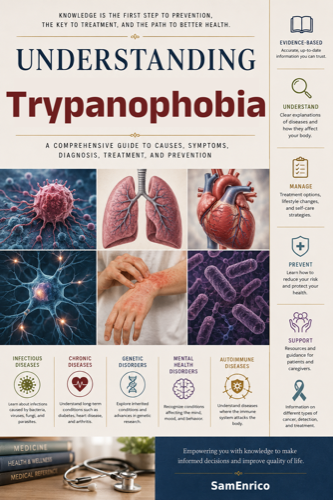
Understanding Trypanophobia eBook
This disease publication, published by SamEnrico,
This disease publication, published by SamEnrico, covers Understanding Trypanophobia
Formats
Free sample
Chapter 1: More Than a Pinch--The first time you fainted in a doctor’s office, you probably told yourself it was a fluke. The room got hot. Your ears started ringing. The fluorescent lights seemed to flicker, though they were not. Then—nothing.
You woke up on a cold exam room floor with a nurse holding your feet in the air and a concerned physician shining a penlight into your eyes. “Have you eaten today?” they asked, already writing it off as low blood sugar. “Your blood pressure just dropped a little.” You nodded, embarrassed, and promised yourself it would not happen again. But it did. At the dentist.
At a blood donation drive. When you accompanied your child to their vaccination appointment and had to sit down suddenly in the hallway, pretending you had dropped something so no one would notice. Eventually, you stopped going to appointments altogether. You told yourself you were too busy, or that you felt fine, or that the risk of skipping a blood test was lower than the certainty of panic. If any of this sounds familiar, this chapter—and this entire book—was written with you in mind.Trypanophobia is the clinical term for an extreme, irrational fear of needles.
The word comes from the Greek trypano (to bore or pierce) and phobos (fear). But unlike a simple dislike of injections or a mild preference for avoiding blood draws, trypanophobia is a specific phobia that meets formal diagnostic criteria for a mental health condition. It is not a quirk. It is not something you should “just get over.” It is a recognized medical phenomenon with predictable symptoms, identifiable causes, and—most importantly—proven treatments that actually work.This opening chapter has three jobs. First, to give you an honest, compassionate map of what trypanophobia actually is and how it shows up in real people’s lives.
Second, to help you recognize your own patterns—because understanding your specific subtype of needle fear is the single most important step toward choosing the right recovery path. And third, to convince you of something that might feel impossible right now: that you are not broken, you are not alone, and you can absolutely learn to face needles without terror. The fact that you are reading these words means you have already taken the hardest step. Now let us take the next one together.What Trypanophobia Is (And What It Is Not)Before we go any further, we need to clear away some misconceptions. Trypanophobia is not simply disliking shots.
Most people dislike shots. Discomfort during a medical procedure is entirely normal. The difference between a dislike and a phobia is the difference between inconvenience and incapacitation. Someone who dislikes needles might look away during a blood draw, wince slightly, and feel relieved when it is over. They might even schedule their annual physical with a mild sense of dread, but they show up and get it done.
Someone with trypanophobia, by contrast, might spend the entire week leading up to a scheduled blood test in a state of mounting dread. They might lose sleep, experience physical symptoms such as nausea or heart palpitations, make elaborate backup plans for canceling, and then either cancel at the last minute—or show up and have a full-blown panic attack in the waiting room, complete with hyperventilation, crying, or running out the door.Trypanophobia is also not the same as having a low pain tolerance. In fact, many people with needle phobia have normal or even above-average pain thresholds. They can tolerate stubbing a toe, burning a finger on a hot stove, or even recovering from surgery without excessive complaint. Their fear is not primarily driven by the physical sensation of the needle entering the skin.
It is driven by anticipation. By the loss of control. By the fear of fainting. By a deeply ingrained association between needles and a past traumatic event. As one patient put it during a therapy session: “The shot itself doesn’t really hurt that much.
It’s the five minutes before the shot that feel like actual torture. I would rather break my arm than sit in that waiting room again.”Finally, trypanophobia is not a character flaw or a sign of immaturity. It is a specific phobia, recognized in the Diagnostic and Statistical Manual of Mental Disorders, Fifth Edition (DSM-5), and it has identifiable neurological and psychological underpinnings. The fear you feel is real. The physical sensations—racing heart, shortness of breath, tunnel vision—are produced by the same fight-or-flight system that keeps you safe from genuine threats.
The only problem is that your brain has mistakenly classified a sterile medical instrument as a life-threatening danger. That is not your fault. It is a misfiring alarm system, and misfiring alarms can be recalibrated.The Hidden Epidemic: Prevalence and Scale The numbers surrounding trypanophobia are startling, yet they rarely appear in public health discussions. Large-scale surveys conducted across North America, Europe, and Australia consistently find that between 10 and 25 percent of adults report significant fear of needles. Approximately 5 to 10 percent meet the formal diagnostic criteria for specific phobia related to needles.
Among children, the numbers are even higher, with some studies suggesting that up to 40 percent of young children experience moderate to severe needle fear before the age of five—though many outgrow it with supportive guidance.To put that in perspective: needle phobia is roughly as prevalent as social anxiety disorder and significantly more common than fears of heights (acrophobia), spiders (arachnophobia), or flying (aviophobia). If you are reading this book in a room with ten other adults, statistically speaking, at least one or two of them share your fear. You have probably never discussed it with them because shame keeps these conversations silent. But the silence is not the same as solitude.These percentages translate into real-world consequences that affect not just individuals but entire communities. It is estimated that needle phobia causes millions of people to skip or significantly delay medical care every single year in the United States alone.
The most commonly avoided procedures include routine blood work (used to screen for diabetes, high cholesterol, thyroid disorders, anemia, and early markers of cancer), vaccinations (including influenza, tetanus, HPV, and COVID-19 boosters), dental injections (leading people to avoid fillings, root canals, and even routine cleanings), IV placements (which can cause patients to leave emergency departments against medical advice or refuse necessary surgery), and treatments for chronic conditions such as rheumatoid arthritis, multiple sclerosis, and certain cancers that require regular infusions.The public health implications are profound and measurable. When people avoid vaccines, herd immunity erodes, and preventable outbreaks—measles, whooping cough, influenza—become more likely. When people skip routine blood work, early-stage diseases go undetected until they become advanced and more difficult to treat, often requiring more aggressive and more expensive interventions. When people avoid dental care, preventable infections can spread to the bloodstream and, in rare cases, become life-threatening. When pregnant women with needle phobia decline routine glucose screening or Group B strep testing, both maternal and fetal health can be compromised.Perhaps most tragically, some people with trypanophobia also develop what clinicians call “medical avoidance syndrome”—a pattern of avoiding all non-emergency healthcare, sometimes for years…
This is the end of the free sample. Get the eBook to keep going. Buy now
About this book
Details
- Author
- Delagarza Cameron
- Publisher
- SamEnrico
- Language
- English
- Genre
- Non-Fiction, Informative, Educational
- Released
- 2026-05-11
- Pages (approx.)
- 141
- Available as
- eBook, Audiobook

Read better in the ZLOADR app
Your eBooks on your phone or tablet. Sign in with your SamEnrico account and start reading.
More by Delagarza Cameron
 Sexual Education for Recovering AdultsDelagarza Cameron$11.99
 Quality Engineering InnovationDelagarza Cameron$11.99
 Technology Failure Anger PlanDelagarza Cameron$11.99
 Postscript Influence TechniqueDelagarza Cameron$11.99
 The Legume Longevity GuideDelagarza Cameron$11.99
 The Phantom of the Andes: Peru's Victorian-Era Serial KillerDelagarza Cameron$11.99
 Construction DirectorDelagarza Cameron$11.99
 YC Work Visa Africa GuideDelagarza Cameron$12.99
 VAT Grouping and RegistrationDelagarza Cameron$12.99
 How to Become a Pipe-fitter HelperDelagarza Cameron$11.99