
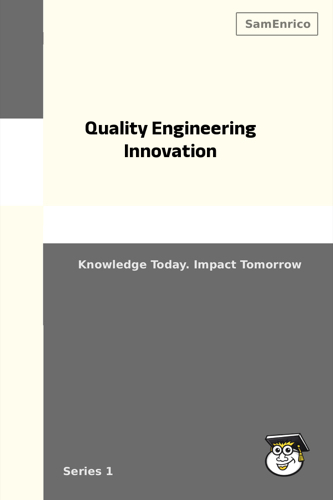
Quality Engineering Innovation
Apply creative approaches to quality control, test
Apply creative approaches to quality control, testing, and continuous improvement.
Formats
About this book
Free sample
Chapter 1: The Hypothesis Trap--–- On a crisp November morning in 2003, a quality engineer at a major pharmaceutical company watched a $47 million batch of insulin precursor flow through stainless steel pipes toward sterile fill lines. Every sensor read green. Every control chart showed stability. Every statistical process control metric indicated the batch was perfect. The engineer faced a choice: release the batch and meet the quarterly forecast, or hold it because something felt wrong—not wrong in the data, but wrong in the silence.
The pressure sensors had not varied by more than 0.3 percent in twelve hours. That was the problem. In her experience, biological processes never stayed that still for that long. She ordered a halt. The production manager screamed.
The plant manager called her office. The vice president of operations sent a terse email asking for her rationale. She had no data to defend herself—only a suspicion that the sensors might have frozen. Three days of tearing down the line later, they found the truth: a calibration failure had locked all pressure readings to a false baseline. The batch was already contaminated.
The company saved $47 million in recall costs and, more importantly, prevented hundreds of diabetic patients from receiving a potentially dangerous drug. The engineer saved the batch by refusing to treat quality as a pass/fail gate and instead treating it as a hypothesis to be tested. This chapter is about why that distinction matters more than ever.The Legacy Mindset That No Longer Works For most of the twentieth century, quality engineering operated under a simple and powerful logic: define a specification, measure against that specification, and reject what falls outside. This logic produced the Japanese automotive revolution, the Six Sigma movement, and the ISO 9000 family of standards. It worked brilliantly for mass production because mass production assumed stability—stable materials, stable processes, stable demand, and stable use conditions.
A bolt either met its torque spec or it did not. A circuit board either passed the bed-of-nails test or it failed. Quality was a gate, and the gatekeeper was the quality engineer.That world is gone.We…
This is the end of the free sample. Get the eBook to keep going. Buy now
Contents
- Chapter 1
- Chapter 2
- Chapter 3
- Chapter 4
- Chapter 5
- Chapter 6
- Chapter 7
- Chapter 8
- Chapter 9
- Chapter 10
- Chapter 11
- Chapter 12
Details
- Author
- Delagarza Cameron
- Publisher
- SamEnrico
- Language
- English
- Genre
- Non-Fiction, Self-Help, Quality Engineering
- Released
- 2026-06-09
- Pages (approx.)
- 151
- Available as
- eBook, Audiobook

Read better in the ZLOADR app
Your eBooks on your phone or tablet. Sign in with your SamEnrico account and start reading.
More by Delagarza Cameron
 Sexual Education for Recovering AdultsDelagarza Cameron$11.99
 Technology Failure Anger PlanDelagarza Cameron$11.99
 Postscript Influence TechniqueDelagarza Cameron$11.99
 The Legume Longevity GuideDelagarza Cameron$11.99
 The Phantom of the Andes: Peru's Victorian-Era Serial KillerDelagarza Cameron$11.99
 Construction DirectorDelagarza Cameron$11.99
 YC Work Visa Africa GuideDelagarza Cameron$12.99
 VAT Grouping and RegistrationDelagarza Cameron$12.99
 Understanding TrypanophobiaDelagarza Cameron$17.99
 How to Become a Pipe-fitter HelperDelagarza Cameron$11.99