
Non-FictionInformativeEducational
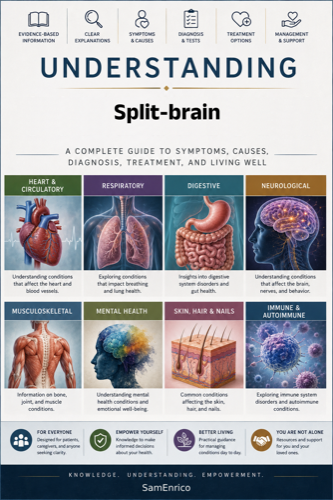
Understanding Split-brain eBook
This condition publication, published by SamEnrico
This condition publication, published by SamEnrico, covers Understanding Split-brain
Formats
Free sample
Chapter 1: The Falling Man...--The first time David’s wife found him on the kitchen floor, she thought he was dead.His body lay in a twisted sprawl, one arm bent beneath him at an impossible angle, his face pressed against the cold linoleum. A trickle of blood ran from the corner of his mouth where his teeth had clipped the counter on the way down. The coffee mug he had been holding had shattered, and shards of ceramic lay scattered around his still hand like broken ice.Margaret dropped to her knees beside him, her hands already shaking as she reached for his neck, searching for a pulse. For three endless seconds, she found nothing. Then David’s chest heaved.
A deep, guttural groan escaped his throat, and his eyes fluttered open—but they were not his eyes. They were empty, unfocused, the eyes of someone who had left his body and was only now returning from somewhere far away.“David?” she whispered. “Can you hear me?”He blinked. Once. Twice.
Then, slowly, recognition crept back into his face. He looked at her, then at the floor, then at the blood on his hand. A single tear slid down his cheek.“I’m sorry,” he said. “I’m so sorry.”Margaret helped him sit up, her own tears falling now. She had been cleaning the kitchen when she heard the crash—a sound she had learned to dread, a sound that meant her husband had fallen again, that his brain had betrayed him again, that the electrical storms inside his skull had claimed another few seconds of his life.She had stopped counting the seizures months ago.
There were too many.This was the reality of intractable epilepsy in 1962. This was the life that David—a thirty-two-year-old electrician, a father of two young daughters, a man who had once climbed telephone poles and wired entire houses without breaking a sweat—now endured every single day.And this was the desperation that would eventually lead him to a neurosurgeon’s office, to a radical and terrifying proposal, and to a discovery that would change everything we know about the human brain.The Electrical Storm To understand David’s suffering, you must first understand epilepsy—not the tidy, sanitized version you might have read about in a textbook, but the brutal, terrifying reality of living with a brain that periodically turns against itself.Epilepsy is not a single disease but a family of disorders, all characterized by the same fundamental problem: abnormal electrical activity in the brain. In a healthy brain, neurons fire in coordinated patterns, like musicians in an orchestra playing from the same sheet of music. In an epileptic brain, that coordination breaks down. Groups of neurons begin firing wildly, uncontrollably, in synchronized bursts that can spread like a wildfire across the brain’s surface.The result is a seizure.
And not all seizures are the same.Some seizures are subtle—a brief lapse of awareness, a strange taste in the mouth, a feeling of déjà vu that lasts only a few seconds. These are called focal seizures, and for some people, they are the entirety of their experience. Unpleasant, disruptive, but survivable.David’s seizures were not subtle.He suffered from what doctors call generalized tonic-clonic seizures—formerly known as grand mal seizures, a name that conveys their severity. These seizures come in two phases. First comes the tonic phase: David’s muscles would suddenly stiffen, his back arching, his jaw clamping shut, his breath stopping as his diaphragm seized.
He would cry out—not from pain, but from air being forced past his vocal cords. Then, ten to thirty seconds later, came the clonic phase: violent, rhythmic jerking of his arms and legs, his body convulsing uncontrollably. His eyes would roll back. He would lose consciousness entirely. Sometimes he would bite his tongue.
Sometimes he would lose control of his bladder or bowels. Sometimes, if he was unlucky, he would fall and crack his head on something hard.The seizures lasted one to three minutes. The aftermath—confusion, exhaustion, headache, muscle soreness—lasted hours.And they came dozens of times a day.By 1962, David was having between fifteen and twenty grand mal seizures every twenty-four hours. He could barely hold a job. He could barely drive.
He could barely be trusted alone with his own children, because what if a seizure struck while he was holding his youngest daughter? What if he fell on her?He had stopped working as an electrician after his third seizure on a ladder. He had come to on the ground, his left leg broken in two places, a gash on his scalp that would require fourteen stitches. The foreman had been kind—had driven him to the hospital himself—but had also made it clear that David could not come back. Not like this.
Not when a moment’s inattention could kill him.So David stayed home. He sat in his armchair and stared at the television, waiting for the next seizure to take him. Margaret went to work at the phone company, her stomach knotted with worry every time she left the house. The girls—Sarah, seven, and Emily, five—had learned to recognize the signs of an oncoming seizure: the strange look in Daddy’s eyes, the way he would stop talking mid-sentence, the way his hand would begin to tremble. They had learned to run to the neighbors.
They had learned not to scream.This was no way to live.The Medicine Cabinet of Despair What could doctors do for David in 1962?The answer, depressingly, was not much.The modern era of epilepsy treatment had begun in 1850 with the introduction of potassium bromide, a sedative that reduced seizure frequency in some patients but also caused a host of unpleasant side effects: lethargy, memory loss, skin rashes, and a condition called bromism—a toxic psychosis that could mimic schizophrenia. Bromide was the best option available for nearly a century. That should tell you how bad the alternatives were.In 1912, phenobarbital arrived. It was more effective than bromide and had fewer side effects, but “fewer” did not mean “none.” Phenobarbital is a barbiturate, a class of drugs that depresses the central nervous system. At therapeutic doses, it made David drowsy, confused, and cognitively sluggish.
He could barely think. He could barely hold a conversation. And even then, the seizures continued—just less frequently, dropping from twenty a day to maybe twelve. A marginal improvement. Not a cure.In 1938, phenytoin (brand name Dilantin) was discovered.
It was a genuine breakthrough: the first anticonvulsant that worked without general sedation. David could take phenytoin and still feel like himself. For a few months in 1959, he and Margaret allowed themselves to hope. Maybe this was the answer. Maybe the nightmare was over.It was not.Phenytoin worked for some people.
For David, it reduced his seizures from twenty a day to perhaps eight or nine—an improvement, but still not enough to live a normal life. And the side effects were brutal. His gums swelled and bled. His coordination deteriorated; he walked with a stagger, like a man who had drunk too much. His…
This is the end of the free sample. Get the eBook to keep going. Buy now
About this book
Details
- Author
- Reinhardt Johnette
- Publisher
- SamEnrico
- Language
- English
- Genre
- Non-Fiction, Informative, Educational
- Released
- 2026-06-02
- Pages (approx.)
- 157
- Available as
- eBook, Audiobook

Read better in the ZLOADR app
Your eBooks on your phone or tablet. Sign in with your SamEnrico account and start reading.
More by Reinhardt Johnette
 Medication Review MemoryReinhardt Johnette$11.99
 Nightmare Rescripting For Sexual AssaultReinhardt Johnette$11.99
 Color Peg System WorkbookReinhardt Johnette$11.99
 Keto Plateaus BreakerReinhardt Johnette$11.99
 Joshua Tree VanishedReinhardt Johnette$11.99
 Elderly Witness AccuracyReinhardt Johnette$11.99
 Quit Smoking for PTSD GuideReinhardt Johnette$11.99
 Cost Of Living For StudentsReinhardt Johnette$11.99
 The Architect of Marid: A Djinn’s Tower of Glass and SandReinhardt Johnette$11.99
 Us Government Use Domain GuideReinhardt Johnette$12.99
 Buy Sell Agreement Tax UpdatesReinhardt Johnette$12.99
 How to Produce Gloves and MittensReinhardt Johnette$11.99
You may also like
 Hong Kong Handover 1997Dunn Johnnie$11.99
 Zumba For Postnatal Recovery CourseNeal Christian$11.99
 Zumba for BeginnersLadner Nikia$11.99
 YouTube Comment Mining GuideHumes Pandora$12.99
 Worry Box MeditationCarlin Rudy$11.99
 Workplace Stress MeditationNguyen Lynn$11.99
 Workplace Stress and Sleep RepairHawley Ivory$11.99
 Workplace Perfectionism CureDelaney Jeffry$11.99
 Workplace Injustice Anger GuideWallen Isabelle$11.99
 Work Addiction and Burnout LinkGreenwood Ester$11.99
 Women in Yoga and WellnessBeattie Galina$11.99
 Women in Stand Up ComedyChun Evangeline$11.99