
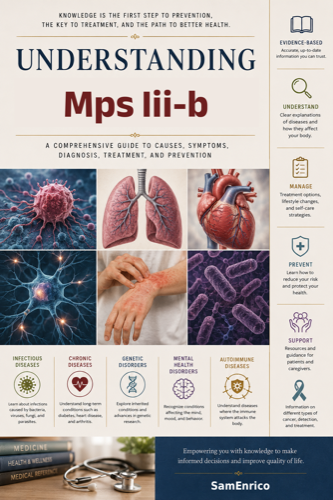
Non-FictionInformativeEducational
Understanding Mps Iii-b eBook
This disease publication, published by SamEnrico,
This disease publication, published by SamEnrico, covers Understanding Mps Iii-b
Formats
Free sample
Chapter 1: The Day the Dictionary Changed--– The phone call came on a Tuesday. Or maybe it was a Thursday. For most parents who receive this diagnosis, the exact day blurs into a smear of gray, swallowed by the larger truth that followed. What you remember is not the date but the word: Sanfilippo. And then the three letters that made it specific: B.
Type B. As if a disease could be typed, categorized, filed away like a library book you never wanted to check out. This chapter is not a medical lecture. It is not a sterile list of facts. It is a hand reaching across the abyss of the first 48 hours after diagnosis—a hand that says: You are not alone, you are not crazy, and there is a path forward, even if you cannot see it yet.The moment you heard the words "MPS IIIB" or "Sanfilippo syndrome type B," your brain likely did one of two things.
It either went completely silent—a white static where thoughts used to be—or it began racing at impossible speed, firing questions faster than any doctor could answer. Both responses are normal. Both are survival mechanisms. Your brain was trying to protect you from a truth it could not yet process: that your child has a rare, progressive, neurodegenerative disease for which there is no cure. And that word—progressive—is the one that will haunt you in the middle of the night.
It means that today is the best your child will ever be. Tomorrow will be harder. And the day after that, harder still.But here is what you also need to know, and what no doctor will tell you in that first appointment: you are capable of more than you think. Not because you are special or extraordinary, but because you are a parent. And parents do impossible things every day.
This chapter is designed to be your anchor. It will walk you through the genetics of what just happened—not the overwhelming biochemistry, but the practical, usable facts you need to make decisions. It will give you a "First 48 Hours" guide so you know what to do and, just as importantly, what not to do. It will provide a script of questions to ask your geneticist, because in the fog of diagnosis, you will forget everything you meant to say. And it will end with the single most important piece of advice any veteran Sanfilippo parent can give you: You do not have to do this alone.Your genetic report, which may look like a jumble of letters and numbers right now, actually tells a specific story.
Let us read it together.The Genetics of the Diagnosis: Your Child's Blueprint Every person on this planet carries approximately 20,000 to 25,000 genes. These genes are like instruction manuals for building and running the human body. Most of them work perfectly. Some have small typos that cause no harm. And very rarely—about once in every 70,000 births for MPS IIIB specifically—a gene carries a typo so significant that it breaks an entire biological process.In your child's case, the broken gene is called NAGLU.
Its full name is a mouthful: N-alpha-acetylglucosaminidase. You do not need to remember that name. What you need to remember is its address. The NAGLU gene lives on chromosome 17, at a specific location written as 17q21.2. Think of this as the street address for your child's broken instruction manual.
When doctors run genetic sequencing, they are literally reading the letters of the DNA at that address to find where the typo exists.There are hundreds of known typos—mutations, in medical language—in the NAGLU gene. Some are small: a single letter changed, like swapping an "A" for a "G" in a word. Others are larger: entire paragraphs missing. The specific mutation your child carries will influence, but not completely determine, how quickly or slowly the disease progresses. This is called genotype-phenotype correlation.
In plain English: some mutations are "milder," meaning your child may retain skills longer or have a slower decline. Others are "severe," meaning the disease follows a more rapid course. Your geneticist can tell you which category your child falls into, but even within the same mutation, no two children are identical. This is one of the cruelest and most confusing aspects of MPS IIIB: uncertainty lives alongside inevitability.Here is what is certain. The NAGLU gene instructs the body to produce an enzyme—a microscopic machine—also called NAGLU.
This enzyme has one job: to break down a large sugar molecule called heparan sulfate. Heparan sulfate is produced naturally inside every cell of your body, especially in the brain. Under normal conditions, cells continuously break down old heparan sulfate and replace it with new. It is a cycle of destruction and creation that happens millions of times per second without you ever noticing.In your child's body, that cycle is broken. Because the NAGLU enzyme is missing or severely deficient, heparan sulfate accumulates inside the cell's waste-processing compartments, called lysosomes.
Imagine a garbage truck that never comes. The trash piles up. It spills into the hallway. It blocks doors. It poisons the air.
That is what happens inside your child's neurons: heparan sulfate accumulates, triggers inflammation, disrupts communication between brain cells, and eventually causes those cells to die. The process is slow but relentless.One critical fact that many parents misunderstand: MPS IIIB is not contagious. You did not cause this. There is nothing you ate, drank, breathed, or did during pregnancy that led to this diagnosis. It is not a vaccine injury.
It is not a metabolic disorder caused by diet. It is a genetic condition—and it follows a specific inheritance pattern that brings us to the next section.Autosomal Recessive Inheritance: Why You and Your Partner Are Both Carriers Your child has MPS IIIB because they received two broken copies of the NAGLU gene—one from you and one from your other biological parent. This is called autosomal recessive inheritance. Let us break that down.Autosomal means the gene is not on a sex chromosome (X or Y). It is on chromosome 17, which all humans have two copies of.
This is why MPS IIIB affects boys and girls equally.Recessive means both copies must be broken for the disease to appear. If a person has one working copy and one broken copy, they are a carrier. They have no symptoms. They may never know they carry a mutation unless they have genetic testing.Statistically, you and your partner each had a one-in-approximately-100 chance of being a carrier for a NAGLU mutation. When two carriers have a child together, the odds for each pregnancy are:25% chance the child inherits two working copies (unaffected, not a carrier)50% chance the child inherits one working and one broken copy (unaffected carrier, like both parents)25% chance the child inherits two broken copies (affected with MPS IIIB)This means that for parents who already have one child with MPS IIIB, the chance of having another child with the same condition is also 25% for each subsequent pregnancy.
It is not a fluke. It is not bad luck. It is simple mathematics.Many parents ask: Should we test our…
This is the end of the free sample. Get the eBook to keep going. Buy now
About this book
Details
- Author
- Wiggins Aubrey
- Publisher
- SamEnrico
- Language
- English
- Genre
- Non-Fiction, Informative, Educational
- Released
- 2026-05-11
- Pages (approx.)
- 154
- Available as
- eBook, Audiobook

Read better in the ZLOADR app
Your eBooks on your phone or tablet. Sign in with your SamEnrico account and start reading.
More by Wiggins Aubrey
 Yahoo Cookie Forging AttackWiggins Aubrey$11.99
 Gabon Mba Oil GuideWiggins Aubrey$11.99
 International Fitness ImmigrantWiggins Aubrey$11.99
 The Imposter Syndrome Attribution GuideWiggins Aubrey$11.99
 Metta for CreativesWiggins Aubrey$11.99
 Grace in Motion: The Pioneers of Black BalletWiggins Aubrey$11.99
 A Beginners Guide to Darts (Volume 1)Wiggins Aubrey$11.99
 Siemens Industrial GuideWiggins Aubrey$12.99
 AI B Roll Footage SourcingWiggins Aubrey$12.99
You may also like
 Hong Kong Handover 1997Dunn Johnnie$11.99
 Zumba For Postnatal Recovery CourseNeal Christian$11.99
 Zumba for BeginnersLadner Nikia$11.99
 YouTube Comment Mining GuideHumes Pandora$12.99
 Worry Box MeditationCarlin Rudy$11.99
 Workplace Stress MeditationNguyen Lynn$11.99
 Workplace Stress and Sleep RepairHawley Ivory$11.99
 Workplace Perfectionism CureDelaney Jeffry$11.99
 Workplace Injustice Anger GuideWallen Isabelle$11.99
 Work Addiction and Burnout LinkGreenwood Ester$11.99
 Women in Yoga and WellnessBeattie Galina$11.99
 Women in Stand Up ComedyChun Evangeline$11.99