
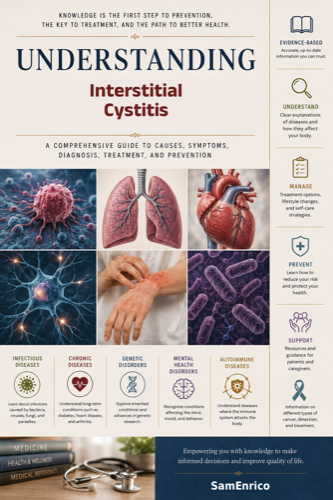
Understanding Interstitial Cystitis eBook
This disease publication, published by SamEnrico,
This disease publication, published by SamEnrico, covers Understanding Interstitial Cystitis
Formats
Free sample
Chapter 1: The Invisible Burden...--The first time Sarah peed blood, she thought she had a urinary tract infection. She was thirty-two, a graphic designer with a six-year-old daughter and a habit of drinking three cups of coffee before noon. Her doctor agreed, prescribed a week of antibiotics, and told her to drink more water. Sarah did as she was told. The burning stopped for exactly four days.
Then it came back—not as a sharp, stabbing sensation but as a low, persistent smolder, like someone had lit a match inside her bladder and left it there. Over the next eighteen months, Sarah would see eleven doctors. She would take nine courses of antibiotics, none of which worked because she never had an infection. She would be told, on three separate occasions, that nothing was wrong with her. She would be told, once, that she was "just anxious." She would spend thousands of dollars on copays, supplements, and a special water filtration system.
She would stop having sex with her husband because it hurt too much. She would stop going to her daughter's soccer games because the bleachers had no bathroom. She would cry in her car after work, not from the pain—though the pain was real—but from the exhaustion of being told, over and over, that her suffering had no name.Sarah has Interstitial Cystitis, also known as Bladder Pain Syndrome. And her story is not unusual. It is, in fact, the rule.If you are reading this book, you likely have a story of your own.
Maybe you have spent years chasing a diagnosis that never quite fit. Maybe you have a drawer full of medications that didn't work. Maybe you have stopped believing that your body will ever feel normal again. Or maybe you are a newly diagnosed patient, fresh from a urologist's office, holding a pamphlet that told you next to nothing. Perhaps you are a loved one—a partner, a parent, a friend—trying to understand what your person is going through.
Wherever you are in this journey, the pages ahead are written for you.This chapter exists for one reason: to give you a new way of seeing Interstitial Cystitis. Not as a rare, untreatable bladder disease—which is how it has been misunderstood for over a century—but as a multifaceted, manageable syndrome involving not just your bladder but your muscles, your nerves, your stress response, and your immune system. That shift in understanding is the single most important thing you can learn. Because when you change how you see the problem, you change what you do about it. And when you change what you do about it, you change your life.The History of a Medical Mystery To understand where we are now, we need to understand where we have been.
For most of medical history, the constellation of symptoms we now call Interstitial Cystitis was a ghost. Patients complained of burning, urgency, frequency, and pelvic pain. Doctors ran tests. The tests came back normal. And so the patient was dismissed.The first named description came in 1887, when a physician named A.J.C.
Skene—the same Skene for whom the Skene's glands are named—wrote about "a rare and obscure form of cystitis" that did not respond to standard treatments. He noted that the bladder wall appeared inflamed but that no bacteria could be found. For the next three decades, the condition remained a footnote in medical textbooks.Then, in 1915, a Johns Hopkins urologist named Dr. Guy Hunner published a paper describing a series of women with severe bladder pain and characteristic ulcers on their bladder walls—lesions that bled when the bladder was stretched. These became known as Hunner's ulcers, or Hunner's lesions.
For the first time, there was a visible, physical finding. Hunner's patients were the most severe, the most visible, the ones with ulcers that could be seen through a cystoscope. But what about the vast majority of patients—the Sarahs of the world—who had pain and frequency but no ulcers? They were left in limbo, diagnosed with "chronic urethritis" or "psychosomatic pelvic pain" or, in the cruelest cases, "attention-seeking behavior."For most of the twentieth century, Interstitial Cystitis was considered a rare disease, largely because the diagnostic criteria were so narrow that only patients with Hunner's lesions qualified. A 1970s urology textbook estimated the prevalence at one in 100,000.
We now know that estimate was off by a factor of more than 1,000. Today, researchers estimate that between 3 and 8 million women in the United States alone have IC/BPS, along with 1 to 4 million men. It is not rare. It is, in fact, as common as rheumatoid arthritis or psoriasis. But because it took decades for the medical establishment to widen its lens, millions of people spent years being told their symptoms were "not real."The Diagnostic Turning Point The modern era of IC diagnosis began in 1987, when the National Institute of Diabetes and Digestive and Kidney Diseases (NIDDK) published the first standardized diagnostic criteria for research studies.
These criteria were meant to ensure that researchers were studying the same condition. They required, among other things, the presence of glomerulations (small, pinprick hemorrhages on the bladder wall) or Hunner's lesions seen during a cystoscopy with hydrodistention—a procedure in which the bladder is filled with water under anesthesia and then stretched.There was just one problem. These research criteria were never intended for clinical use. They were meant to create a narrow, highly specific group of patients for drug trials. But doctors began using them as diagnostic checklists.
And because the criteria were so restrictive, many patients with genuine IC were told they did not have it. A patient could have severe pain, urgency, and frequency—could be disabled by her symptoms—but if her bladder looked "normal" under a cystoscope, she was sent away with a diagnosis of overactive bladder or chronic pelvic pain syndrome or, most damagingly, nothing at all.The NIDDK criteria have since been revised and, for most clinical purposes, retired. But the damage lingers. A 2011 study in the Journal of Urology found that the average time from symptom onset to diagnosis for IC/BPS was 4.7 years. Other studies have found delays of 7 to 10 years.
During that time, patients see an average of five different physicians. They are prescribed an average of eight different medications, most of which do nothing for their symptoms. They undergo unnecessary surgeries, including hysterectomies and bladder suspensions. They develop secondary anxiety and depression—not because they are "psychosomatic," but because chronic, unexplained pain is a profoundly destabilizing experience.The problem is not that doctors are bad or lazy. The problem is that IC/BPS is a syndrome that straddles multiple specialties: urology, gynecology, gastroenterology, pain medicine, physical therapy, and psychology.
Most doctors are trained to think inside the boundaries of their own discipline. A urologist looks for bladder problems. A gynecologist looks for uterine or ovarian problems. A gastroenterologist looks for bowel problems. But IC sits at the intersection.
It is a condition that no single specialty owns—and so, for too long, it has been a condition that no specialty reliably diagnoses.The Paradigm Shift: From Bladder-Centric to Whole-Body For…
This is the end of the free sample. Get the eBook to keep going. Buy now
About this book
Details
- Author
- Isaacson Winford
- Publisher
- SamEnrico
- Language
- English
- Genre
- Non-Fiction, Informative, Educational
- Released
- 2026-06-03
- Pages (approx.)
- 143
- Available as
- eBook, Audiobook

Read better in the ZLOADR app
Your eBooks on your phone or tablet. Sign in with your SamEnrico account and start reading.
More by Isaacson Winford
 Operation Car Wash Paulo PretoIsaacson Winford$11.99
 Closing Sales AssertivelyIsaacson Winford$11.99
 Phobia and Sleep GuideIsaacson Winford$11.99
 Action Planning for ADHD MindsIsaacson Winford$11.99
 Housing Options After Sixty FiveIsaacson Winford$11.99
 Beware the Bridge Trolls of Norway’s Mountain PassesIsaacson Winford$11.99
 How to Start a Hobby in MotocrossIsaacson Winford$11.99
 Stigma Breaking HandbookIsaacson Winford$12.99
 B2B Digital Procurement Trends GuideIsaacson Winford$12.99
 Crane Game Prize ArrangerIsaacson Winford$11.99