
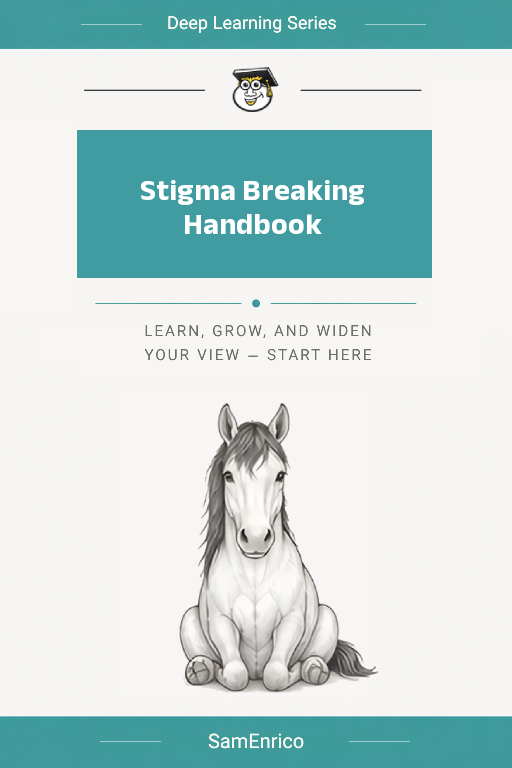
Stigma Breaking Handbook
Navigate cultural and family shame around seeking
Navigate cultural and family shame around seeking therapy in collectivist societies. Covers discreet help-seeking, normalizing mental health conversations, and finding affirming providers.
Formats
About this book
Free sample
Chapter 1: The Uninvited Audience--–- The first time you felt shame, you probably didn’t know it had a name. You just knew that something you said or did made the room go quiet. Or maybe your mother’s eyes went cold for just a second. Or your father cleared his throat in that particular way that meant we will discuss this later. You learned to scan rooms for approval before you learned long division.
You learned to calculate the emotional cost of your honesty before you learned algebra. That is not a weakness. That is a survival skill. And it was taught to you by generations who came before—not through lectures, but through silence, through sighs, through the unbearable weight of what people will say.This chapter is not about fixing you. You are not broken.
This chapter is about naming the invisible architecture that has been shaping your decisions, your secrets, and your sense of self since childhood. Once you can see it, you can decide whether to keep living inside it—or whether to build a door.The Difference Between Guilt and Shame (And Why It Matters)In Western individualist cultures, the dominant emotional framework revolves around guilt. Guilt says, “I did something bad.” It is attached to a specific action. It assumes that the person who committed the action is fundamentally good but made a mistake. Guilt can be repaired through apology, restitution, or changed behavior.
Guilt lives inside you, but it does not define you.Shame, as it operates in collectivist honor-shame cultures, says something entirely different. Shame says, “I am bad.” Not what I did. Who I am. Shame attaches to identity, not action. And because it attaches to identity, it cannot be repaired through apology alone.
You cannot apologize your way out of being a different person. Shame says: Your very existence, in this moment, is a problem for your family.To understand the difference, consider two scenarios.A child in a guilt-oriented culture breaks a family heirloom. The parent might say, “That was careless. You need to be more careful.” The focus is…
This is the end of the free sample. Get the eBook to keep going. Buy now
Contents
- Chapter 1
- Chapter 2
- Chapter 3
- Chapter 4
- Chapter 5
- Chapter 6
- Chapter 7
- Chapter 8
- Chapter 9
- Chapter 10
- Chapter 11
- Chapter 12
Details
- Author
- Isaacson Winford
- Publisher
- SamEnrico
- Language
- English
- Genre
- Non-Fiction, Mental Wealth, Mental Health Equity, Stigma Guide
- Released
- 2026-05-30
- Pages (approx.)
- 122
- Available as
- eBook, Audiobook

Read better in the ZLOADR app
Your eBooks on your phone or tablet. Sign in with your SamEnrico account and start reading.
More by Isaacson Winford
 Operation Car Wash Paulo PretoIsaacson Winford$11.99
 Closing Sales AssertivelyIsaacson Winford$11.99
 Phobia and Sleep GuideIsaacson Winford$11.99
 Action Planning for ADHD MindsIsaacson Winford$11.99
 Housing Options After Sixty FiveIsaacson Winford$11.99
 Beware the Bridge Trolls of Norway’s Mountain PassesIsaacson Winford$11.99
 Understanding Interstitial CystitisIsaacson Winford$17.99
 How to Start a Hobby in MotocrossIsaacson Winford$11.99
 B2B Digital Procurement Trends GuideIsaacson Winford$12.99
 Crane Game Prize ArrangerIsaacson Winford$11.99