
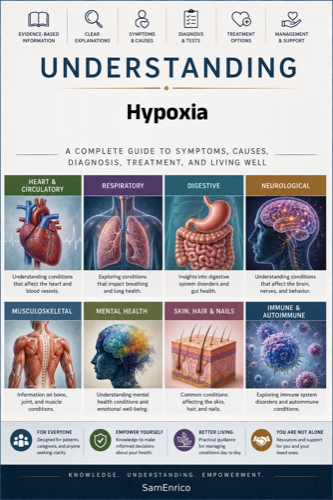
Non-FictionInformativeEducational
Understanding Hypoxia eBook
This condition publication, published by SamEnrico
by Verdin Chase
This condition publication, published by SamEnrico, covers Understanding Hypoxia
Formats
Free sample
Chapter 1: The Silent Epidemic...--–- The call came in at 2:47 AM on a Tuesday. Paramedics found a 47-year-old woman slumped over her kitchen table, confused, gasping, and blue around the lips. Her family said she had been "a little tired lately" and had mentioned feeling "foggy" for months. Her primary care doctor had told her to exercise more and reduce stress. Her pulse oximeter read 94%—technically normal—so the emergency room physician almost sent her home.
But a senior resident noticed something odd: the patient's mental status didn't match her oxygen saturation. She couldn't recall the year. She couldn't name the current president. She was, by all accounts, hypoxic in every way that mattered, even though the numbers said otherwise.Three hours later, an arterial blood gas revealed the truth. Her Pa O2 was 48 mm Hg.
Her calculated A-a gradient was massively widened. She had been living with undiagnosed interstitial lung disease for at least eighteen months, slowly starving her brain of oxygen while everyone—including her doctors—told her she was fine.This woman did not die that night. But thousands of others do every single day, not from dramatic cardiac arrests or well-publicized pulmonary embolisms, but from a quiet, creeping, invisible killer that most people have never heard of. That killer is hypoxia.The Oxygen Illusion We take oxygen for granted. The air around us is 21% oxygen, give or take, and we breathe it without thought.
When we feel short of breath, we assume our bodies are getting enough. When a pulse oximeter on a smartwatch reads 97%, we celebrate. But these assumptions are dangerous. They are built on a fundamental misunderstanding of what hypoxia actually is and how it kills.Hypoxia is not the same as breathlessness. A patient can be profoundly hypoxic—on the verge of organ failure—and feel completely fine, or only vaguely unwell.
This is the cruelest trick of the condition. The body's warning systems, which evolved to detect carbon dioxide retention rather than oxygen deprivation, are remarkably poor at alerting us to falling oxygen levels. In fact, the classic "air hunger" sensation is driven primarily by hypercapnia (too much carbon dioxide), not hypoxemia (too little oxygen). A patient with chronic lung disease can have an oxygen saturation of 80% and feel only mildly fatigued. A mountaineer at high altitude can have a Pa O2 of 40 mm Hg and still walk—until he suddenly collapses.Hypoxia is also not a single disease.
It is a final common pathway, a physiological state with dozens of distinct causes, each requiring different treatments. The woman in the kitchen had hypoxic hypoxia caused by lung disease. But a cardiac arrest patient has stagnant hypoxia from poor circulation. A victim of carbon monoxide poisoning has anemic hypoxia where the blood carries oxygen but cannot release it. And a cyanide poisoning victim has histotoxic hypoxia, where the cells themselves cannot use the oxygen delivered to them.
These four faces of hypoxia—hypoxic, anemic, stagnant, and histotoxic—look identical at the tissue level but require radically different interventions. Mistaking one for another kills patients.This book is about that distinction. It is about understanding how oxygen moves from the atmosphere to your mitochondria, where that cascade can break, and what to do when it does. But before we dive into the physiology, we must confront a uncomfortable truth: hypoxia is everywhere, it is underdiagnosed, and your doctor might be missing it.The Epidemiology of Silence Let us begin with numbers, because numbers force us to pay attention.Hypoxia is not a rare curiosity. It is the final common pathway of the most common killers in modern medicine.
Chronic obstructive pulmonary disease (COPD) affects approximately 16 million Americans, and nearly all of them experience intermittent or chronic hypoxemia. Congestive heart failure affects 6.5 million Americans, with hypoxemia occurring in advanced stages. Sleep apnea affects 30 million Americans, causing repeated episodes of nocturnal hypoxemia that most patients never know they have. Pneumonia, pulmonary embolism, pulmonary fibrosis, and COVID-19 all cause hypoxemia as their primary mechanism of injury.Then there are the silent cases. Undiagnosed interstitial lung disease, like the woman in the kitchen.
Occult hypoxemia from opioid use, where respiratory depression causes gradual oxygen desaturation without dyspnea. Chronic carbon monoxide exposure from faulty furnaces or car exhaust, where patients present with vague headache and confusion rather than the cherry-red skin of textbook poisoning. High-altitude residents and travelers who acclimatize poorly but dismiss their symptoms as "just the altitude."The World Health Organization does not track hypoxia as a cause of death, because it is always listed as a complication of something else. But if we aggregate the data, a staggering picture emerges. Hypoxia contributes to or causes directly more deaths annually in the United States than breast cancer, prostate cancer, and colorectal cancer combined.
Approximately 300,000 cardiac arrests occur outside of hospitals each year, and all of them involve severe hypoxia within minutes. Approximately 150,000 people die annually from COPD, almost all with hypoxemia as the terminal event. Tens of thousands more die from pneumonia, pulmonary fibrosis, and pulmonary embolism.And yet, ask ten people on the street what hypoxia means, and nine will guess incorrectly or admit they have no idea. This is the paradox of the silent epidemic: the most common final pathway in medicine is almost completely unknown to the public and frequently missed by clinicians.Why Doctors Miss Hypoxia If hypoxia is so common, why is it so often missed? The answer lies in the tools we use and the assumptions we make.The pulse oximeter is perhaps the most deceptive medical device ever invented.
It is small, noninvasive, and gives an immediate number that appears precise. A reading of 96% feels safe. A reading of 100% feels even safer. But pulse oximetry has limitations that most clinicians either do not know or choose to ignore.First, the device is less accurate in darkly pigmented skin. A landmark 2020 study in the New England Journal of Medicine found that Black patients were nearly three times more likely to have occult hypoxemia—an Sp O2 reading of 92-96% when the true arterial saturation was below 88%—compared to white patients.
This bias occurs because the device's algorithm was calibrated primarily on light-skinned subjects. The FDA issued a safety communication about this in 2021, but millions of devices remain in use without warning labels. The woman in the kitchen was white, but a Black patient with identical lung disease would have been even more likely to be sent home.Second, pulse oximetry cannot detect hypercapnia or acidosis. A patient with COPD who retains carbon dioxide can have a normal Sp O2 while slowly suffocating from rising Pa CO2. The oximeter reads 90%, the patient appears comfortable, and the physician breathes a sigh of relief—completely unaware that the patient's p H is 7.25 and falling.Third, pulse oximetry is delayed in detecting hypoxemia during rapid desaturation.
If a patient stops breathing, the Sp O2 reading lags behind the actual Pa O2 by 30 to 60 seconds. In that window, the brain can begin to suffer injury while the monitor still shows acceptable numbers.Fourth, and most insidiously, pulse oximetry creates a cognitive anchor. Once a clinician sees a number, it becomes difficult to override…
This is the end of the free sample. Get the eBook to keep going. Buy now
About this book
Details
- Author
- Verdin Chase
- Publisher
- SamEnrico
- Language
- English
- Genre
- Non-Fiction, Informative, Educational
- Released
- 2026-06-03
- Pages (approx.)
- 153
- Available as
- eBook, Audiobook

Read better in the ZLOADR app
Your eBooks on your phone or tablet. Sign in with your SamEnrico account and start reading.
More by Verdin Chase
 Anger and ThreatsVerdin Chase$11.99
 Imposter Syndrome For DiplomatsVerdin Chase$11.99
 Micro Outsourcing GuideVerdin Chase$11.99
 Emotional Processing DeficitsVerdin Chase$11.99
 French Green Tax IncentivesVerdin Chase$11.99
 The Interruption Escalation LadderVerdin Chase$11.99
 Estrogen MetabolismVerdin Chase$11.99
 Cash Balance Pension RolloverVerdin Chase$11.99
 The Phantom Depths: How a Soviet Submariner’s Defection Sparked a Cold War CrisisVerdin Chase$11.99
 The Great Unspooling: How One Viral Tweet Toppled a Media EmpireVerdin Chase$11.99
 How to Produce FurnitureVerdin Chase$11.99
 CS Degree Employer Prestige GuideVerdin Chase$12.99
You may also like
 Hong Kong Handover 1997Dunn Johnnie$11.99
 Zumba For Postnatal Recovery CourseNeal Christian$11.99
 Zumba for BeginnersLadner Nikia$11.99
 YouTube Comment Mining GuideHumes Pandora$12.99
 Worry Box MeditationCarlin Rudy$11.99
 Workplace Stress MeditationNguyen Lynn$11.99
 Workplace Stress and Sleep RepairHawley Ivory$11.99
 Workplace Perfectionism CureDelaney Jeffry$11.99
 Workplace Injustice Anger GuideWallen Isabelle$11.99
 Work Addiction and Burnout LinkGreenwood Ester$11.99
 Women in Yoga and WellnessBeattie Galina$11.99
 Women in Stand Up ComedyChun Evangeline$11.99