
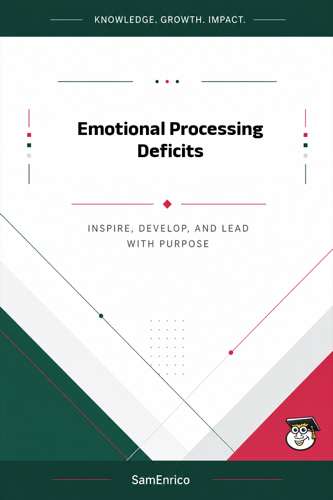
Emotional Processing Deficits
Explain how psychopaths fail to recognize fear and
by Verdin Chase
Explain how psychopaths fail to recognize fear and sadness in victims.
Formats
About this book
Free sample
Chapter 1: What Tears Cannot Teach...–- The first time I interviewed a man convicted of domestic violence, he corrected me before I could ask my first question. “I didn’t lose my temper,” he said. “I made a decision. She was crying, and I needed her to stop. So I hit her.
That’s not anger. That’s problem-solving.” He spoke in the flat, even tone of someone describing a minor home repair. When I asked how her crying had made him feel, he paused for a long moment. “Feel?” he repeated. “It didn’t make me feel anything.
It was just noise. Like a car alarm. Annoying, but not… meaningful.” He was not performing cruelty. He was not trying to shock me. He was simply reporting his internal reality as accurately as he could.
And that reality—a world in which the tears of another human being carry no emotional weight, trigger no automatic inhibition, and generate no aversive response—is the subject of this entire book.This book argues a simple proposition with devastating implications: psychopaths fail to recognize fear and sadness in others, and because they fail to recognize these distress cues, they are not stopped by them. The proposition is simple. The implications are not. If psychopaths cannot see fear and sadness the way the rest of us do, then our entire framework for understanding moral behavior—which assumes that seeing distress naturally produces an aversive response that inhibits harm—collapses for a significant portion of the population. The law assumes that people know when they are causing suffering.
The mental health system assumes that patients can be motivated by guilt or shame. Victims assume that their tears will be understood as signals of distress. For psychopaths, none of these assumptions hold.This chapter introduces the central concept of the book: the emotional blind spot. It dismantles the myths that prevent us from seeing psychopathy clearly. It defines the blind spot with clinical precision.
It explains why understanding this deficit matters for criminal justice, mental health, victim protection, and public safety. And it provides a roadmap…
This is the end of the free sample. Get the eBook to keep going. Buy now
Contents
- Chapter 1
- Chapter 2
- Chapter 3
- Chapter 4
- Chapter 5
- Chapter 6
- Chapter 7
- Chapter 8
- Chapter 9
- Chapter 10
- Chapter 11
- Chapter 12
Details
- Author
- Verdin Chase
- Publisher
- SamEnrico
- Language
- English
- Genre
- Non-Fiction, True Crime, Affective Neuroscience
- Released
- 2026-06-09
- Pages (approx.)
- 150
- Available as
- eBook, Audiobook

Read better in the ZLOADR app
Your eBooks on your phone or tablet. Sign in with your SamEnrico account and start reading.
More by Verdin Chase
 Anger and ThreatsVerdin Chase$11.99
 Imposter Syndrome For DiplomatsVerdin Chase$11.99
 Micro Outsourcing GuideVerdin Chase$11.99
 French Green Tax IncentivesVerdin Chase$11.99
 The Interruption Escalation LadderVerdin Chase$11.99
 Estrogen MetabolismVerdin Chase$11.99
 Cash Balance Pension RolloverVerdin Chase$11.99
 The Phantom Depths: How a Soviet Submariner’s Defection Sparked a Cold War CrisisVerdin Chase$11.99
 The Great Unspooling: How One Viral Tweet Toppled a Media EmpireVerdin Chase$11.99
 Understanding HypoxiaVerdin Chase$11.99
 How to Produce FurnitureVerdin Chase$11.99
 CS Degree Employer Prestige GuideVerdin Chase$12.99