

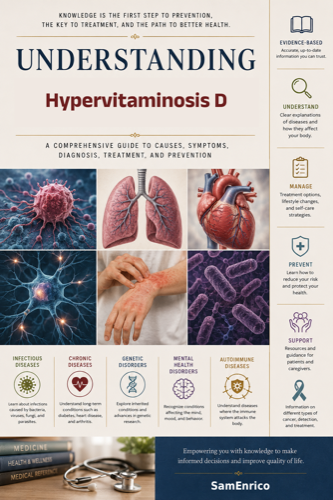
Non-FictionInformativeEducational
Understanding Hypervitaminosis D eBook
This disease publication, published by SamEnrico,
by Dix Corazon
This disease publication, published by SamEnrico, covers Understanding Hypervitaminosis D
Formats
Free sample
Chapter 1: The Sunshine Paradox...--–- The woman sitting across from me in the emergency department was crying, not from pain but from confusion. She had done everything right. At fifty-four years old, she was a health-conscious marathon runner, a nonsmoker, a clean eater, and a devoted reader of wellness blogs. For the past two years, she had been taking 50,000 international units of vitamin D daily—not because a doctor told her to, but because she had read online that high-dose vitamin D could prevent cancer, boost immunity, and slow aging. She felt proud of her proactive approach to health.
Until three months ago, when the symptoms began.The fatigue came first. She chalked it up to menopause. Then came the unquenchable thirst—she started carrying a water bottle everywhere, waking three to four times each night to urinate. She blamed aging. Then the bone pain started, a deep ache in her shins and lower back that made her daily runs feel like marathons.
She switched to a new mattress, tried acupuncture, and increased her vitamin D dose, convinced she needed more of the "sunshine vitamin" to fight whatever was wrong with her.By the time she arrived at the emergency department, her blood calcium level was 14.2 milligrams per deciliter. Normal is 8.5 to 10.2. Her vitamin D level was 412 nanograms per milliliter. Normal is 30 to 80. Her kidneys, which had been perfectly healthy two years earlier, were now operating at less than forty percent of normal function.
The calcium in her blood had been so high for so long that it had precipitated out of solution and crystallized inside the delicate filtering units of her kidneys—a condition called nephrocalcinosis. The damage was permanent.She looked at me through tears and asked the question I have heard dozens of times since: "How could something that is supposed to be good for me do this?"That question is the reason for this book.The Vitamin That Isn't a Vitamin Before we can understand how vitamin D became a public health crisis disguised as a wellness trend, we must first understand what vitamin D actually is—and the answer surprises most people. Vitamin D is not a vitamin in the traditional sense. A vitamin, by definition, is an essential nutrient that the body cannot produce on its own and must obtain from food. Vitamin C is a vitamin.
The B vitamins are vitamins. But vitamin D is different. The human body can manufacture its own vitamin D when skin is exposed to ultraviolet B radiation from sunlight. This makes vitamin D, technically speaking, a hormone—or more precisely, a secosteroid hormone, meaning a steroid molecule with one broken bond that allows it to perform unique biological functions.This distinction matters enormously because hormones are potent biological signaling molecules that operate at very low concentrations. Think of thyroid hormone, estrogen, testosterone, or cortisol.
These substances regulate entire body systems, and the difference between a normal level and a toxic level is often extremely small. The same is true for vitamin D, except that vitamin D has a peculiar duality: the body can safely produce massive quantities from sunlight, but oral supplementation bypasses the body's natural safety valves. This is the sunshine paradox, and it is the central tension of everything that follows.A Brief History of Vitamin D: From Rickets to Religion The story of vitamin D begins in the industrial revolution, when children in smog-choked cities developed a horrifying bone disease called rickets. The disease causes soft, weak bones that bow under the weight of the body. In nineteenth-century London, Manchester, and Boston, up to eighty percent of children in poor urban areas showed some signs of rickets.
The condition was so common that bowed legs were considered normal among working-class children, which tells us something terrible about how quickly we can normalize suffering when we lack explanations for it.For decades, doctors were baffled. They suspected poor nutrition, lack of fresh air, and something about the dark, crowded tenements where these children lived. In 1822, a Polish doctor named Jedrzej Sniadecki noticed that children who lived in the countryside never developed rickets, while their urban cousins were crippled by it. He proposed that sunlight was the protective factor, but his colleagues dismissed him. Sunlight as medicine?
It sounded like superstition.The breakthrough came in the early twentieth century. In 1919, Sir Edward Mellanby discovered that rickets could be induced in dogs fed a restricted diet and prevented with cod liver oil. Something in the oil was protective. In 1921, Elmer Mc Collum identified the active compound and named it vitamin D—the fourth vitamin discovered, after A, B, and C. In a stroke of genius, he also showed that exposing food to ultraviolet light could generate the vitamin, proving Sniadecki right nearly a century later: sunlight was the original source.The solution to rickets was so simple and so effective that it became a public health triumph.
Milk was fortified with vitamin D. Cod liver oil became a childhood staple. By the 1950s, rickets had nearly disappeared from the developed world. The message embedded itself in the cultural consciousness: vitamin D is good. Vitamin D prevents disease.
More vitamin D is better.That last part—more is better—is the seed of the problem we face today.The Modern Vitamin D Explosion In the late 1990s and early 2000s, a wave of research appeared to show that low vitamin D levels were associated with nearly every disease imaginable: cancer, heart disease, diabetes, multiple sclerosis, depression, dementia, autoimmune disorders, and even the severity of infectious diseases. Some studies found that people with lower vitamin D levels had higher rates of these conditions, and the media exploded with headlines: "Vitamin D Deficiency Linked to Cancer!" "Low Vitamin D Doubles Heart Attack Risk!" "The Vitamin That Prevents Everything!"What the headlines did not explain—because headlines never do—is that association is not causation. People who are sick spend less time outdoors. People with chronic diseases often have poor nutrition. The direction of the arrow was never clear: does low vitamin D cause disease, or does disease cause low vitamin D?
Nevertheless, the message took hold. Vitamin D deficiency was declared an epidemic. Some researchers suggested that up to one billion people worldwide had suboptimal levels. The standard reference range for normal vitamin D crept upward, pushed by experts who believed that higher levels were healthier.The supplement industry, naturally, seized the opportunity. Vitamin D supplements were cheap to manufacture, easy to sell, and carried no prescription requirement.
Sales exploded. In 2000, the global vitamin D supplement market was valued at roughly two hundred million dollars. By 2020, that number had surpassed one billion dollars. And not just supplements—food manufacturers began fortifying everything from orange juice to breakfast cereal to protein bars with extra vitamin D. The message was everywhere: you need more vitamin D.But no one was asking the obvious question.
If a little is good, is more better? And if more is better, how much is too much?The Two Faces of Vitamin DTo answer that question, we need to understand how the body handles vitamin D from different sources. This is where the sunshine paradox reveals its…
This is the end of the free sample. Get the eBook to keep going. Buy now
About this book
Details
- Author
- Dix Corazon
- Publisher
- SamEnrico
- Language
- English
- Genre
- Non-Fiction, Informative, Educational
- Released
- 2026-06-02
- Pages (approx.)
- 157
- Available as
- eBook, Audiobook

Read better in the ZLOADR app
Your eBooks on your phone or tablet. Sign in with your SamEnrico account and start reading.
More by Dix Corazon
 Lava Jato The Full StoryDix Corazon$11.99
 Weekly Health ReviewDix Corazon$11.99
 Franchise Builder's Franchise Accountant StoryDix Corazon$11.99
 Values And Mission Alignment Conflict ResolutionDix Corazon$11.99
 The Great Diamond Heist: How a Single Gem Sparked a Global ObsessionDix Corazon$11.99
 Silent Screens: The Forbidden Footage of Cleopatra’s Last NightDix Corazon$11.99
 How to Become a Dinkey OperatorDix Corazon$11.99
 Exoskeleton Rehabilitation GuideDix Corazon$12.99
 Podcast Audience Growth HandbookDix Corazon$12.99
 Naive Bayes OperatorDix Corazon$11.99
You may also like
 Hong Kong Handover 1997Dunn Johnnie$11.99
 Zumba For Postnatal Recovery CourseNeal Christian$11.99
 Zumba for BeginnersLadner Nikia$11.99
 YouTube Comment Mining GuideHumes Pandora$12.99
 Worry Box MeditationCarlin Rudy$11.99
 Workplace Stress MeditationNguyen Lynn$11.99
 Workplace Stress and Sleep RepairHawley Ivory$11.99
 Workplace Perfectionism CureDelaney Jeffry$11.99
 Workplace Injustice Anger GuideWallen Isabelle$11.99
 Work Addiction and Burnout LinkGreenwood Ester$11.99
 Women in Yoga and WellnessBeattie Galina$11.99
 Women in Stand Up ComedyChun Evangeline$11.99