
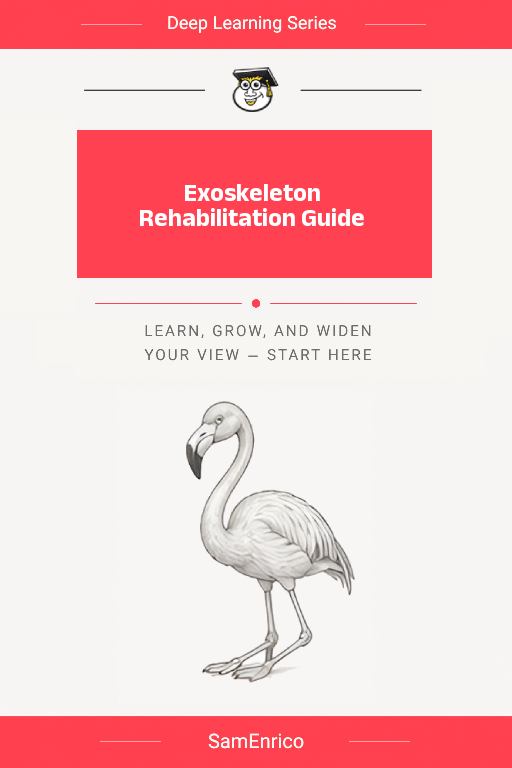
Non-FictionForecast & OutlookExoskeleton
Exoskeleton Rehabilitation Guide
Explore powered suits helping spinal cord and stro
by Dix Corazon
Explore powered suits helping spinal cord and stroke patients regain walking ability and upper limb function.
Formats
About this book
Free sample
Chapter 1: The Walking Paradox...--–- The patient stood at the parallel bars, her hands gripping the supports with white-knuckled intensity. Six months earlier, a spinal cord injury at the T8 level had transformed her from a marathon runner into someone who could not move her legs. Today, for the first time, she stood upright wearing a powered exoskeleton—a wearable robot strapped to her torso, thighs, and shins. Her physical therapist pressed a button on a handheld remote. The device whirred softly.
Her left leg lifted, stepped forward, and lowered. Then her right leg repeated the sequence. She walked. It was slow, mechanical, and dependent on crutches for balance. But it was walking.
Her eyes filled with tears. "I never thought I would feel the ground beneath my feet again," she whispered.This scene, replicated in rehabilitation centers around the world, captures both the extraordinary promise and the fundamental paradox of powered exoskeletons. The promise is obvious: individuals paralyzed by spinal cord injury or debilitated by stroke can stand, walk, and reach again. The paradox is more subtle but equally important: these remarkable machines are not autonomous miracle workers. They are tools—powerful, sophisticated, and expensive tools—that succeed or fail based entirely on how they are integrated into comprehensive rehabilitation programs.
A powered exoskeleton without a skilled clinical team is like a scalpel without a surgeon: impressive technology in search of a purpose.The central argument of this book is straightforward: exoskeleton rehabilitation succeeds when clinicians understand not only how to operate these devices, but also how to select appropriate patients, design progressive training protocols, integrate exoskeleton sessions with conventional therapy, navigate reimbursement systems, and plan for long-term device use or transition to other mobility aids. This chapter lays the foundation for everything that follows by answering three fundamental questions: What exactly are powered exoskeletons? How did they evolve from military prototypes to clinical tools? And what is the scientific rationale—grounded in neuroplasticity and motor learning—for using them in neurological rehabilitation?Defining the Exoskeleton: A Wearable Robot The term "exoskeleton" derives from biology, where it refers to the external skeleton…
This is the end of the free sample. Get the eBook to keep going. Buy now
Contents
- Chapter 1
- Chapter 2
- Chapter 3
- Chapter 4
- Chapter 5
- Chapter 6
- Chapter 7
- Chapter 8
- Chapter 9
- Chapter 10
- Chapter 11
- Chapter 12
Details
- Author
- Dix Corazon
- Publisher
- SamEnrico
- Language
- English
- Genre
- Non-Fiction, Forecast & Outlook, Exoskeleton
- Released
- 2026-05-30
- Pages (approx.)
- 158
- Available as
- eBook, Audiobook

Read better in the ZLOADR app
Your eBooks on your phone or tablet. Sign in with your SamEnrico account and start reading.
More by Dix Corazon
 Lava Jato The Full StoryDix Corazon$11.99
 Weekly Health ReviewDix Corazon$11.99
 Franchise Builder's Franchise Accountant StoryDix Corazon$11.99
 Values And Mission Alignment Conflict ResolutionDix Corazon$11.99
 The Great Diamond Heist: How a Single Gem Sparked a Global ObsessionDix Corazon$11.99
 Silent Screens: The Forbidden Footage of Cleopatra’s Last NightDix Corazon$11.99
 How to Become a Dinkey OperatorDix Corazon$11.99
 Understanding Hypervitaminosis DDix Corazon$17.99
 Podcast Audience Growth HandbookDix Corazon$12.99
 Naive Bayes OperatorDix Corazon$11.99
You may also like
 Hong Kong Handover 1997Dunn Johnnie$11.99
 Zumba For Postnatal Recovery CourseNeal Christian$11.99
 Zumba for BeginnersLadner Nikia$11.99
 YouTube Comment Mining GuideHumes Pandora$12.99
 Worry Box MeditationCarlin Rudy$11.99
 Workplace Stress MeditationNguyen Lynn$11.99
 Workplace Stress and Sleep RepairHawley Ivory$11.99
 Workplace Perfectionism CureDelaney Jeffry$11.99
 Workplace Injustice Anger GuideWallen Isabelle$11.99
 Work Addiction and Burnout LinkGreenwood Ester$11.99
 Women in Yoga and WellnessBeattie Galina$11.99
 Women in Stand Up ComedyChun Evangeline$11.99