
Non-FictionInformativeEducational
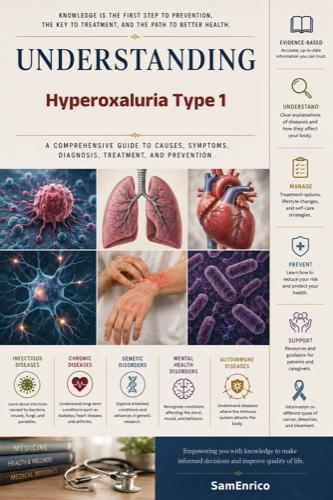
Understanding Hyperoxaluria Type 1 eBook
This disease publication, published by SamEnrico,
This disease publication, published by SamEnrico, covers Understanding Hyperoxaluria Type 1
Formats
Free sample
Chapter 1: The Crystal Curse...--–- Emma woke to pain she could only describe as a knife twisting inside her left flank. She was twenty-eight years old, a yoga instructor who had never been hospitalized, and she assumed it was a kidney stone—painful, yes, but common, treatable, forgettable. The ER doctor agreed. He sent her home with flomax, a strainer for her urine, and a casual reassurance: "Drink more water. Avoid spinach.
You'll be fine." Emma passed the stone three days later. She flushed it without a second thought. That was her first mistake.–- Six years later, at age thirty-four, Emma’s primary care physician noticed her creatinine was elevated on routine blood work. A subsequent renal ultrasound showed bilateral nephrocalcinosis—tiny crystals embedded throughout both kidneys, like sand scattered inside a sponge. A kidney biopsy revealed interstitial fibrosis and crystalline deposits.
By then, her estimated glomerular filtration rate (e GFR) had fallen to 28 m L/min. She was in stage 4 chronic kidney disease. The diagnosis that finally emerged, after a decade of intermittent stones and three different urologists, was Primary Hyperoxaluria Type 1 (PH1). Emma’s story is not unusual. It is, in fact, the norm.–- This chapter is about why Emma’s story happens, again and again, and why it does not have to.
It is about the hidden epidemic of misdiagnosed kidney stones, the critical distinction between primary and secondary hyperoxaluria, and the fundamental biology that makes PH1 a systemic killer rather than a mere nuisance. By the end of this chapter, you will understand why “just a kidney stone” is a phrase that should raise immediate alarm in certain patients, why early diagnosis saves kidneys, and how a disease that begins in the liver can destroy bones, hearts, and eyes before anyone thinks to look for it.The Stone That Was Never “Just a Stone”–- Every year, more than half a million Americans visit emergency departments for kidney stones. The lifetime risk of forming at least one stone is approximately 11% in men and 9% in women. The vast majority of these individuals have what nephrologists call “idiopathic calcium oxalate stones”—stones with no identifiable underlying metabolic cause, often related to low urine volume, dietary factors, or mild hypercalciuria. For these people, increased fluid intake and dietary modifications are genuinely sufficient.
They pass a stone, perhaps a second one years later, and live the rest of their lives without kidney damage.–- But a small subset of stone formers—approximately 1 in 58,000 to 1 in 120,000 live births, depending on the population—carry a genetic time bomb in their liver. These individuals have Primary Hyperoxaluria Type 1, an autosomal recessive disorder caused by mutations in the AGXT gene. Their livers overproduce oxalate, a metabolic waste product that the kidneys cannot excrete fast enough. The oxalate binds with calcium in the urine to form calcium oxalate crystals—sharp, insoluble, and destructive. Unlike the occasional idiopathic stone former, the PH1 patient will continue to form stones and crystals relentlessly, year after year, until the kidneys become scarred, calcified, and ultimately nonfunctional.–- The tragedy is that PH1 is almost always misdiagnosed as idiopathic stone disease for years—often a decade or more.
In one large European registry, the median time from first symptom to correct diagnosis was 8.5 years. During those years, silent kidney damage accumulates. By the time a physician finally orders a 24-hour urine oxalate test or genetic sequencing, many patients have already lost significant kidney function. Some, like Emma, are diagnosed only when they are already approaching end-stage renal disease (ESRD). Others are diagnosed post-transplant, having received a kidney alone that was subsequently destroyed by recurrent oxalate crystals.–- This chapter exists to prevent that delay.
If you are reading this book, you or someone you love has either been diagnosed with PH1, or you suspect it. You are already ahead of the curve. But to understand the disease, you must first understand the fundamental distinction that every doctor should make but too often misses: the difference between primary and secondary hyperoxaluria.Primary Versus Secondary Hyperoxaluria: A Critical Distinction–- Hyperoxaluria simply means “too much oxalate in the urine.” The normal 24-hour urinary oxalate excretion is less than 0.46 mmol (approximately 40 mg) for adults, or less than 0.45 mmol/1.73m² per day for children when indexed to body surface area. When levels exceed these thresholds, calcium oxalate supersaturation occurs, and crystals begin to form. But why is oxalate elevated?
The answer splits into two fundamentally different categories.–- Secondary Hyperoxaluria (also called enteric or dietary hyperoxaluria) occurs when oxalate levels rise due to external factors. The most common causes are:–- High dietary oxalate intake: Consuming large amounts of spinach, nuts, beets, rhubarb, chocolate, wheat bran, or star fruit without adequate calcium to bind oxalate in the gut.–- Fat malabsorption: Conditions such as Crohn’s disease, ulcerative colitis, celiac disease, gastric bypass surgery, or chronic pancreatitis cause unabsorbed fatty acids to bind calcium in the intestine. With calcium unavailable to bind oxalate, free oxalate is absorbed into the bloodstream and excreted in urine.–- Antibiotic use or microbiome alterations: The gut bacterium Oxalobacter formigenes degrades oxalate normally. When this bacterium is depleted (by antibiotics or disease), less oxalate is broken down in the gut, leading to increased absorption.–- Secondary hyperoxaluria is common, often reversible, and managed by treating the underlying cause (reducing dietary oxalate, adding calcium with meals, treating malabsorption). It does not involve a genetic defect in oxalate metabolism.
The liver enzymes that process glyoxylate are normal.–- Primary Hyperoxaluria, in stark contrast, is a genetic disorder of liver metabolism. The patient’s liver overproduces oxalate regardless of diet. Even if the patient eats zero oxalate, the liver will continue to convert glyoxylate to oxalate because the AGT enzyme that should divert glyoxylate to glycine is missing or dysfunctional. This is not a dietary disease. It is a metabolic disease.
No amount of spinach avoidance will fix it. No probiotic will cure it. This is a fundamental point that many patients—and even some physicians—fail to grasp.–- Primary Hyperoxaluria Type 1 is the most common and severe form, accounting for approximately 80% of all Primary Hyperoxaluria cases. It is caused by mutations in the AGXT gene on chromosome 2q37.3, leading to deficiency of the liver peroxisomal enzyme alanine:glyoxylate aminotransferase (AGT). Without AGT, glyoxylate is converted to oxalate instead of glycine.
The result is a relentless overproduction of oxalate, typically 2 to 10 times the normal rate, every day, for the patient’s entire life.–- There are two other, rarer types: Primary Hyperoxaluria Type 2 (PH2, caused by GRHPR gene mutations, generally milder, rarely causing systemic oxalosis) and Primary Hyperoxaluria Type 3 (PH3, caused by HOGA1 gene mutations, mildest form, primarily childhood stones with preserved kidney function). These are covered in detail in Chapter 2. For now, understand that PH1 is the one that destroys kidneys, bones, and hearts if untreated. It is the one that requires aggressive intervention. And it is the one most frequently misdiagnosed as “recurrent idiopathic stones.”The Epidemic of Diagnostic Delay–- Why is PH1 diagnosed so late?
The reasons are multiple, interrelated, and deeply frustrating for patients who spend years suffering before anyone thinks to look for…
This is the end of the free sample. Get the eBook to keep going. Buy now
About this book
Details
- Author
- Stinson Beryl
- Publisher
- SamEnrico
- Language
- English
- Genre
- Non-Fiction, Informative, Educational
- Released
- 2026-06-02
- Pages (approx.)
- 158
- Available as
- eBook, Audiobook

Read better in the ZLOADR app
Your eBooks on your phone or tablet. Sign in with your SamEnrico account and start reading.
More by Stinson Beryl
 Anger And Child's Breakup PainStinson Beryl$11.99
 Performance Pressure AngerStinson Beryl$11.99
 Couple Time Blocking GuideStinson Beryl$11.99
 Pain Neuroscience for NursesStinson Beryl$11.99
 The Timbuktu Scholars: Love, Learning, and the Golden Age of African KnowledgeStinson Beryl$11.99
 The Last Broadcast: Titan's WhisperStinson Beryl$11.99
 Wildlife Photography (Scientific)Stinson Beryl$11.99
 Voice Payment Authentication TechStinson Beryl$12.99
 One Page Portfolio Resume GuideStinson Beryl$12.99
You may also like
 Hong Kong Handover 1997Dunn Johnnie$11.99
 Zumba For Postnatal Recovery CourseNeal Christian$11.99
 Zumba for BeginnersLadner Nikia$11.99
 YouTube Comment Mining GuideHumes Pandora$12.99
 Worry Box MeditationCarlin Rudy$11.99
 Workplace Stress MeditationNguyen Lynn$11.99
 Workplace Stress and Sleep RepairHawley Ivory$11.99
 Workplace Perfectionism CureDelaney Jeffry$11.99
 Workplace Injustice Anger GuideWallen Isabelle$11.99
 Work Addiction and Burnout LinkGreenwood Ester$11.99
 Women in Yoga and WellnessBeattie Galina$11.99
 Women in Stand Up ComedyChun Evangeline$11.99