
Non-FictionInformativeEducational
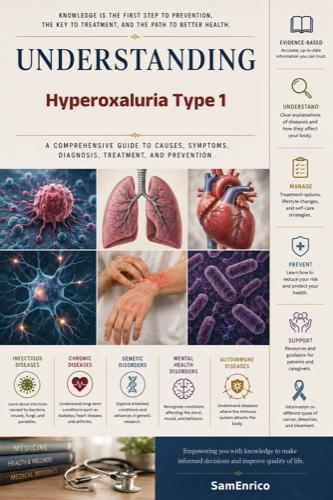
Understanding Hyperoxaluria Type 1 Audiobook
This disease publication, published by SamEnrico,
This disease publication, published by SamEnrico, covers Understanding Hyperoxaluria Type 1
Formats
Free sample
Chapter 1: The Crystal Curse...--–- Emma woke to pain she could only describe as a knife twisting inside her left flank. She was twenty-eight years old, a yoga instructor who had never been hospitalized, and she assumed it was a kidney stone—painful, yes, but common, treatable, forgettable. The ER doctor agreed. He sent her home with flomax, a strainer for her urine, and a casual reassurance: "Drink more water. Avoid spinach.
You'll be fine." Emma passed the stone three days later. She flushed it without a second thought. That was her first mistake.–- Six years later, at age thirty-four, Emma’s primary care physician noticed her creatinine was elevated on routine blood work. A subsequent renal ultrasound showed bilateral nephrocalcinosis—tiny crystals embedded throughout both kidneys, like sand scattered inside a sponge. A kidney biopsy revealed interstitial fibrosis and crystalline deposits.
By then, her estimated glomerular filtration rate (e GFR) had fallen to 28 m L/min. She was in stage 4 chronic kidney disease. The diagnosis that finally emerged, after a decade of intermittent stones and three different urologists, was Primary Hyperoxaluria Type 1 (PH1). Emma’s story is not unusual. It is, in fact, the norm.–- This chapter is about why Emma’s story happens, again and again, and why it does not have to.
It is about the hidden epidemic of misdiagnosed kidney stones, the critical distinction between primary and secondary hyperoxaluria, and the fundamental biology that makes PH1 a systemic killer rather than a mere nuisance. By the end of this chapter, you will understand why “just a kidney stone” is a phrase that should raise immediate alarm in certain patients, why early diagnosis saves kidneys, and how a disease that begins in the liver can destroy bones, hearts, and eyes before anyone thinks to look for it.The Stone That Was Never “Just a Stone”–- Every year, more than half a million Americans visit emergency departments for kidney stones. The lifetime risk of forming at least one stone is approximately 11% in men and 9% in women. The vast majority of these individuals have what nephrologists call “idiopathic calcium oxalate stones”—stones with no identifiable underlying metabolic cause, often related to low urine volume, dietary factors, or mild hypercalciuria. For these people, increased fluid intake and dietary modifications are genuinely sufficient.
They pass a stone, perhaps a second one years later, and live the rest of their lives without kidney damage.–-…
This is the end of the free sample. Get the Audiobook to keep going. Buy now
About this book
Details
- Author
- Stinson Beryl
- Publisher
- SamEnrico
- Language
- English
- Genre
- Non-Fiction, Informative, Educational
- Released
- 2026-06-02
- Pages (approx.)
- 158
- Available as
- eBook, Audiobook

Listen in the VoxFlicks app
Audiobooks and audio dramas wherever you go. Sign in with your SamEnrico account and press play.
More by Stinson Beryl
 Anger And Child's Breakup PainStinson Beryl$11.99
 Performance Pressure AngerStinson Beryl$11.99
 Couple Time Blocking GuideStinson Beryl$11.99
 Pain Neuroscience for NursesStinson Beryl$11.99
 The Timbuktu Scholars: Love, Learning, and the Golden Age of African KnowledgeStinson Beryl$11.99
 The Last Broadcast: Titan's WhisperStinson Beryl$11.99
 Wildlife Photography (Scientific)Stinson Beryl$11.99
 Voice Payment Authentication TechStinson Beryl$12.99
 One Page Portfolio Resume GuideStinson Beryl$12.99
You may also like
 Hong Kong Handover 1997Dunn Johnnie$11.99
 Zumba For Postnatal Recovery CourseNeal Christian$11.99
 Zumba for BeginnersLadner Nikia$11.99
 YouTube Comment Mining GuideHumes Pandora$12.99
 Worry Box MeditationCarlin Rudy$11.99
 Workplace Stress MeditationNguyen Lynn$11.99
 Workplace Stress and Sleep RepairHawley Ivory$11.99
 Workplace Perfectionism CureDelaney Jeffry$11.99
 Workplace Injustice Anger GuideWallen Isabelle$11.99
 Work Addiction and Burnout LinkGreenwood Ester$11.99
 Women in Yoga and WellnessBeattie Galina$11.99
 Women in Stand Up ComedyChun Evangeline$11.99